
Deep blue lake below forested volcanic slopes with cloud sitting on the summit at Hakone, Kanagawa
Step-free
Partly step-free
Grass plazas, with an assistant
The main road
Kuzuryū Forest road
九頭龍の森セラピーロード · Lake Ashi shore
Open
Year-round
Temporary winter closures at the hall
The record
What you need to go
Open season
Not published. With 156 maple-family species in it, November is the obvious month
Getting there
not published
Fees
not published
Onsen
not published
The walk
Main trail
The Kuzuryū Forest road (九頭龍の森セラピーロード), along an unfrequented stretch of the Lake Ashi shore under big old trees
All trails
2 trails, both named and described. No lengths, times or surfaces published
The step-free road
The trails are flat, bright and gently graded, and some of the grass plazas can be entered in a wheelchair, though an assistant is required. Three toilets
The forest
Forest type
Flat lakeside forest on the shore of Lake Ashi, inside the Fossa Magna rift, which is why so much grows here. Five grass plazas
What grows
Cedar · Hinoki cypress · Zelkova · Japanese evergreen oak · Beech, plus the Hakone rose, bean cherry and Ōshima cherry
What lives
85 species of wild bird, alongside 430 plant species and many other organisms
Certified since
2016
All figures updated 5 October 2026
The forest, before the facts
One hundred and fifty-six species of the maple family, observable in one forest.
Beside that number: 430 species of plant, and 85 species of wild bird.
Most certified forests in Japan will not tell you what lives in them — not a bird, not a mammal, nothing, in primeval beech and four-hundred-year-old cypress and national parks. Hakone has counted. Nowhere else in the country puts a plant count, a bird count and a maple count on one page.
And the reason it can is geological. Sanshōbara, also called the Hakone rose, along with mamezakura and ōshimazakura and other Fossa Magna element trees, can also be seen here.
Fossa Magna is not a decorative phrase. It is the great rift that cuts Honshū in half, and Hakone sits in it. The flora here is the flora of a tectonic seam.
Five reasons to come
One hundred and fifty-six maple species, 430 plants and 85 birds, all counted.
Flat, bright trails on the shore of Lake Ashi, with plazas a wheelchair can enter.
A second road nobody walks, on a slope untouched long enough to grow rare plants.
Trees found here because Hakone sits inside the rift that splits Japan.
Five grass plazas, three toilets, and a craft hall with a quiz trail.
Flat, bright, and honest about the help you need
Hakone town holds this base, certified in April 2016, as the Hakone Ashinoko Forest Therapy Base (箱根芦ノ湖森林セラピー基地), under a tagline that means the forest and lake that heal me.

Four hundred cedars, planted in 1618 to shade travelers on the Tokaido, and still doing it.
The accessibility description here is unusually careful, and the care is in the parenthesis.
The trails within the base are flat and easy to walk, enjoyable regardless of age or sex. It is bright, and most of the road is a gentle gradient. And then: there are also plazas that can be entered even in a wheelchair (an assistant is required).
Read that last sentence closely, because it is doing three things no other base manages at once. It says which parts are accessible — the plazas, not necessarily the whole road. It says a wheelchair can get in. And it states the condition in brackets rather than hiding it: you will need somebody with you.
The Society’s yes-or-no accessibility field is close to useless, because it asks a municipality for a guarantee and gets a disclaimer. Hakone has done the thing that solves it: answered yes, and then written the limits down. The only other base to put conditions in writing is BIOTOPIA in the same prefecture, which marked inbound yes but English only and children yes but elementary age and up.
Two Kanagawa bases, independently, have worked out that a bracket is more useful than a box checked.
The description also names the mechanism directly, which is rare: relax in the scent of phytoncides, and spend an unhurried while in the plazas. Plaza, open grassy ground, is the operative word here rather than trail, and it suggests the honest shape of a visit: this is a base you sit down in.
Marked yes for barrier-free access, corporate training and children. No for overseas visitors.
No guiding in English, at Hakone
That last mark deserves its own paragraph, because of where it is.
Hakone is one of the most visited places in Japan by foreign travelers. It is the standard second stop out of Tokyo, on every itinerary that includes Mount Fuji, served by a dedicated railway, a ropeway, a pirate-ship ferry on this very lake, and an enormous concentration of hotels. The town’s whole modern economy is built on receiving visitors, a great many of whom do not read Japanese.
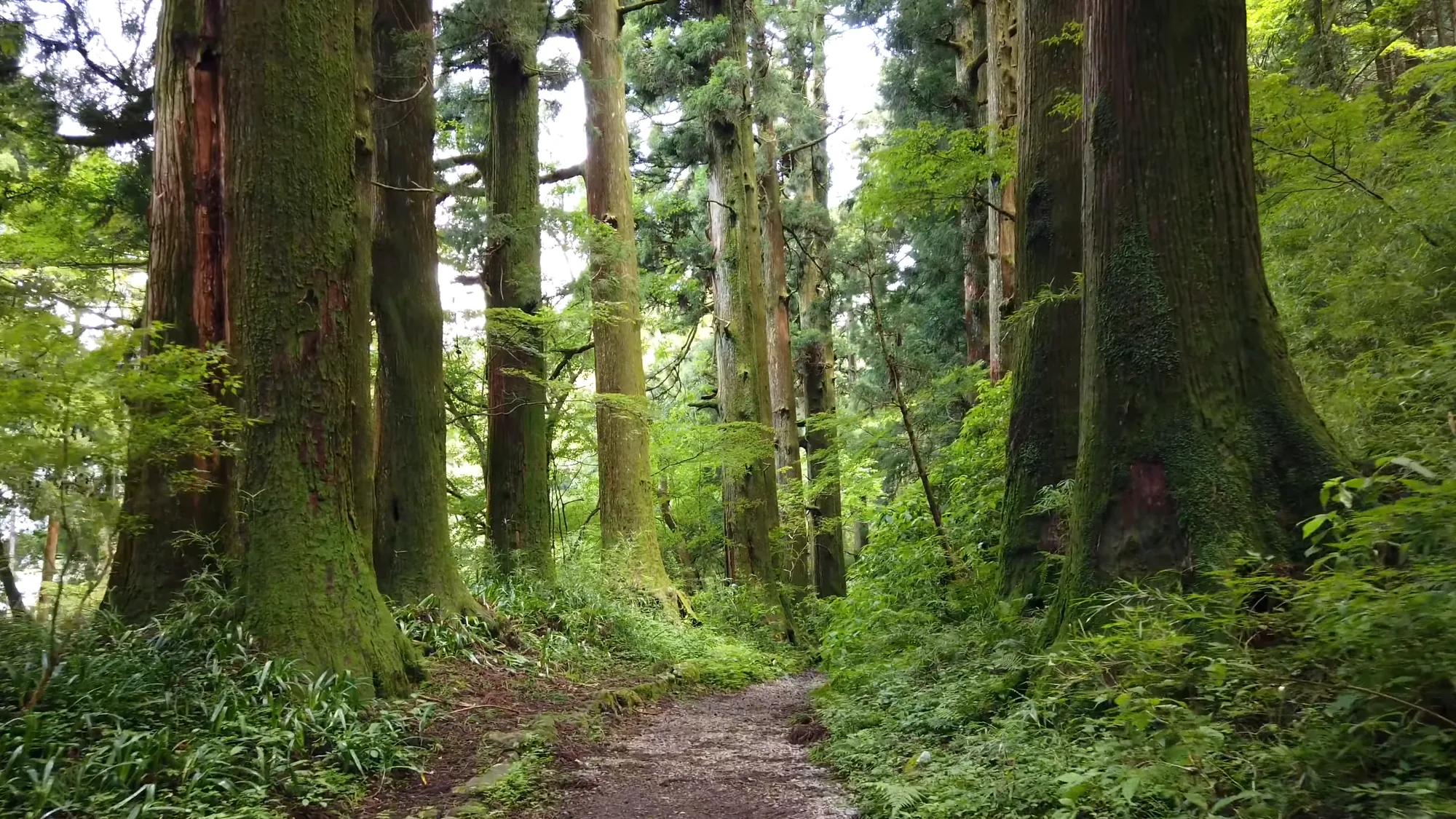
Off the main avenue the trail narrows and the trunks get closer together.
And its certified forest therapy base is marked no for overseas visitors.
That mark generally means we will not promise, not you cannot come. Here it almost certainly means something narrower and more specific: no guiding, no materials and no program in a language other than Japanese — which is consistent with the rest of the page, because the base publishes no program and no price at all.
So the practical reading for a non-Japanese-speaking reader is encouraging rather than discouraging. The roads are flat, bright, and on the shore of a lake you were coming to anyway. What is not available is somebody to walk them with you. A yes would have been honest too; the no is the town being careful.
Two roads, and the quiet one is the find
Both roads are named and described, which is more than most bases manage with twice as many.
The Forest of Tranquility road (箱根やすらぎの森セラピーロード) is the developed one, and it is where the counting happens: a nature-rich forest where 430 plant species and 85 bird species live, along with many other organisms.
The infrastructure is published in full and it is better than any other base’s: parking, three toilets, five grass plazas. The hub is the forest contact hall, Mori-no-Fureai-kan (森のふれあい館), with exhibits, craft experiences, and a quiz rally around the grounds.
Three toilets and five plazas across one road is an unusual amount of detail to publish, and it is exactly the detail that decides whether a day works for somebody with a small child, a bad knee, or a wheelchair and an assistant. Most bases do not tell you whether there is a toilet at all.
The Kuzuryū Forest road (九頭龍の森セラピーロード) is the other kind of place entirely, and its description is the best piece of writing Hakone has published.
Most of the path falls at the lower end of Jingūzan (神宮山) on the flank of Kamiyama (神山), and having gone a long time without human hands entering it, large trees and rare plants can also be seen.

Four hundred years of rain on the same bark.
And then: because it is an unfrequented part of the Lake Ashi shore, you look out at the lake water through the trees, and it is a place where the heart is washed clean.
A place with few people is a remarkable thing for a tourist authority to advertise in Hakone. The town receives staggering numbers of visitors, almost all of them concentrated on the same handful of viewpoints, boats and museums. Its own certified forest road is being recommended on the grounds that nobody goes there.
That is the single most useful thing Hakone publishes, for anybody who has been there in high season and found it unbearable. There is a quiet shoreline, on an unworked slope, with big trees, and the town is telling you where it is.
The other listed environment is Hakone-en (箱根園), which has an open, spacious feel and a location worth enjoying.
Two roads, two philosophies, and you should walk both
It is worth pausing on the fact that these two roads are not variations on each other. They are two different answers to what a forest therapy base is for, and Hakone has built both and described both, which almost no other base has done.
The Forest of Tranquility is the provided one. Parking, three toilets, five grass plazas, a hall with exhibits and craft sessions and a quiz trail round the grounds, 430 plants and 85 birds counted and published. It is a forest that has been equipped. You arrive, you are catered for, the species have been inventoried on your behalf, and there is somewhere to sit every few hundred meters.
Kuzuryū is the withheld one. No facilities are listed on it at all. What is published instead is that human hands have not entered it for a long time, that there are big trees and rare plants as a result, and that nobody goes there.
One road is good because of what has been added. The other is good because of what has not been.

The canopy is high enough that the light arrives in patches rather than beams.
That is the central tension of this whole scheme, and Hakone states it in two paragraphs. Every base has had to decide how much to build: Minami-Minowa put a protocol on signboards, Akasawa paved an entire road and ran a railway down it, Kijimadaira declined all four service questions and left eight trails in a national forest. Hakone did not decide. It built one of each and told you which is which.
For a reader that is unusually useful, because the two roads suit opposite days and opposite people. Take the Forest of Tranquility when you are with somebody who needs a toilet, a bench, a reason or a lift home. Take Kuzuryū when you want the thing the brochures cannot give you, which at Hakone is solitude.
And the fact that the second one exists at all, on this lake, is the real surprise here.
What 156 maples actually means
Return to the number, because it needs unpacking rather than repeating. 156 species in the maple family alone, observable in this forest.
That figure is higher than the number of maple species native to Japan, so it is likely to be counting cultivated varieties and forms as well as wild species — Japanese horticulture has produced an enormous number of named Acer palmatum selections, and a collection in a maple-rich area can assemble hundreds.
But whichever it is, the point stands and is unusual: somebody at Hakone has inventoried this forest to the level of 156 entries in one plant family, 430 plants overall, and 85 birds. That is not a tourism brochure number. That is a survey.
And the Fossa Magna explanation tells you why it was worth surveying. It is the great tectonic trench running across central Honshū, where the island arc is effectively torn and rejoined, and it carries a distinctive flora — species that occur along the rift and nowhere else, or that reach their limits there. Hakone is volcanic country inside it.
Three of these are named: the Hakone rose (サンショウバラ), a thorny wild rose with large single pink flowers that is a Fuji–Hakone specialty and carries the town’s name in its alternative reading; the bean cherry (マメザクラ), a small early-flowering mountain cherry of the Fuji region; and the Ōshima cherry (オオシマザクラ), the island cherry whose leaves are the ones pickled and wrapped around sakura mochi.
Two cherries and a rose, all regional, all explained by a geological rift. No other base explains its own flora by tectonics, and very few explain it at all.
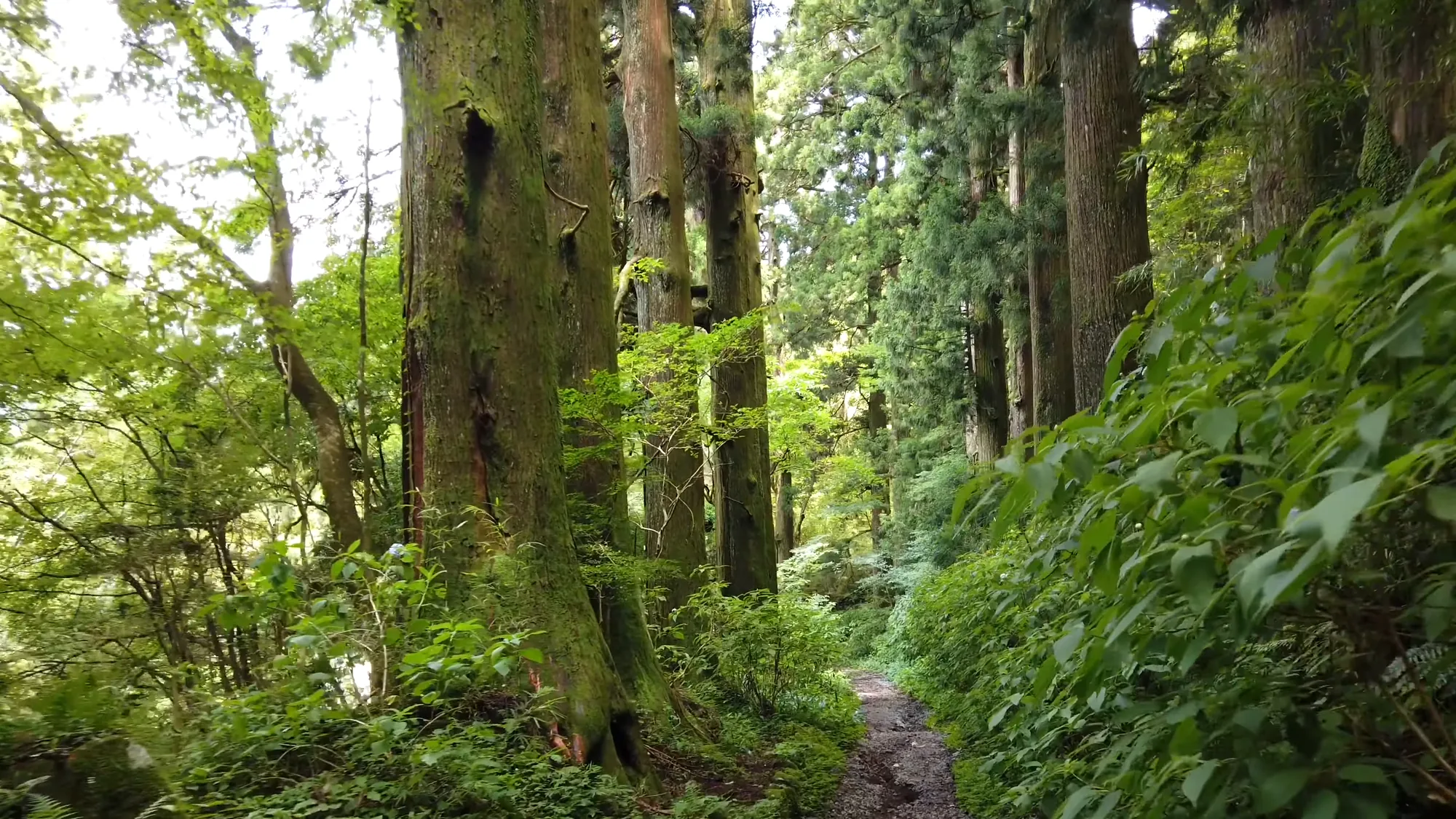
Lake Ashi appears through the trunks about halfway along.
The trees themselves are a solid Hakone set: cedar and hinoki cypress among the conifers; Japanese zelkova, Japanese evergreen oak and Japanese beech among the broadleaves.
That broadleaf trio is itself interesting, because it should not really coexist. Zelkova is a lowland tree of valley floors and village edges. Evergreen oak belongs to the warm temperate belt. Beech is the signature tree of the cool temperate zone and the deep-snow belt — the tree of Otari, Taruda and Kijimadaira, hundreds of kilometers (hundreds of miles) north and a thousand meters (3,300 feet) higher.
Finding all three in one forest means this base straddles a boundary: warm-temperate evergreen below, cool-temperate beech above, on a volcanic mountainside in a rift valley. Which is the other half of the answer to why 430 plants.
No seasonal note is published at all, which on a base built around 156 maples is absurd. A forest with 156 maples in it has exactly one obvious season, and nobody mentions it.
The checkpoint, and what else is there
The single listed facility is the Hakone Checkpoint (箱根関所), and Hakone is unusually lyrical about it: the reconstruction used the craft techniques and the tools of the period, and after roughly a hundred and fifty years the checkpoint has appeared again on the shore of Lake Ashi. Its imposing bearing is moving — as though you have wandered into the Edo period.
The Hakone checkpoint was one of the most important control points on the Tōkaidō, the road between Edo and Kyoto, where travelers were inspected. Putting it beside a forest therapy base is a reminder of what this lake was before it was a resort: a chokepoint on the only sensible road across the mountains.
No hot spring is listed, which at Hakone is startling. No bentō. No program. No price. No guide message. No elevation. No area. No road lengths, times or surfaces.
The operator is the town’s Planning and Tourism Department, Tourism Division — on 0460-83-6006 or morifure@town.hakone.kanagawa.jp, and the site is hakone.or.jp/morifure/, named after the Mori-no-Fureai-kan hall.
2016, and the pattern it confirms
One date settles something.

Planted cedar below, natural broadleaf above, and the line between them is sharp.
Hakone was certified in April 2016. Minami-Bōsō was the 57th base nationally, in March 2014 — which means the scheme certified fifty-six bases in its first eight years and only a handful in the twelve years since. The late additions cluster in the Tokyo commuter belt: Okukuji in Ibaraki (2016), Kitamoto in Saitama (2019), Hadano in Kanagawa (2020).
Hakone (2016) is a fourth, and it is the clearest case of all — a resort town on the busiest tourist corridor in Japan, certifying a flat lakeside forest with plazas and toilets.
So the arc holds, and it is worth stating plainly because it is the most interesting structural fact about Japan’s forest therapy scheme. It began in 2006 among mountain villages that were overwhelmingly forest and had almost no other economy — Uenomura, Nukumidaira, Akasawa, Kijimadaira. It has ended up, twenty years later, in the suburbs and the resorts, on flat ground, within reach of a tired person on a train.
Whether that is the scheme maturing into something useful or running out of mountains is an open question. But Hakone is what the late end of it looks like: counted, surfaced, provided with toilets, and closed to guiding for the foreign visitors streaming past it.
Go for the quiet road, in November
The recommendation writes itself.
Go in November, for the maples — because a forest advertising 156 species of the maple family has an autumn, even though nobody has published a date for it.
And walk the Kuzuryū road rather than the developed one. It is the unfrequented part of the Lake Ashi shore, on a slope that has had no human hands in it for a long time, with big trees and rare plants and the lake showing through the trunks. In a town that receives as many people as Hakone does, a certified path the town itself describes as unpopular is worth more than any viewpoint.
Do the Forest of Tranquility road too, with its three toilets and five grass plazas and its quiz trail, if you have children or if somebody in the party needs to sit down often. Use the plazas as the destination rather than the trail, and if you are pushing a wheelchair, bring the assistant the brackets ask for.
Then go and look at the checkpoint, and think about the fact that this lake shore was once a place where the government read your papers before letting you walk any further. Now it has 85 species of bird on it, and somebody has counted them.
Nearby and alike

Kanagawa · Certified 2018
me-byo valley BIOTOPIA
A privately owned therapy road on a Jomon spring plateau, in a valley named for the state between health and illness — where the guides invite you to crush leaves as you walk.

Kanagawa · Certified 2020
Hadano
Five roads on the near face of Tanzawa, an hour from Tokyo, with the most complete commercial terms in Japan’s certified forests — and no description of the forest at all.

Kanagawa · Certified 2007
Nanasawa (Atsugi)
A plantation forest the size of a city on the foot of Tanzawa, with four onsen districts beneath it, boar hotpot from October, and a coppice working party on the third Sunday.
Verified by The Japan Onsen Society
Sources
森林セラピー「神奈川県 箱根芦ノ湖森林セラピー基地」— https://fo-society.jp/facility/hakone-ashinoko/ (私を癒す 森と湖; 箱根町; 認定 2016年4月; barrier-free 可 · corporate 可 · inbound 否 · children 可; 芦ノ湖の畔にあり、緑あふれる自然豊かな森です。セラピー基地内のトレイルは平坦で歩きやすく、老若男女問わず楽しめます。フィトンチッドの香りでリラックスし、広場でゆったりと過ごしましょう。明るく、ロードのほとんどが緩やかな勾配です。車いす(介助者が必要です。)でも入ることの出来る広場もあります; ロード数 2; 箱根やすらぎの森セラピーロード — 430種類の植物や85種類の野鳥のほか、多くの生物が生息する自然豊かな森。駐車場のほか、3ヶ所のトイレ、5ヶ所の芝生の広場がある。中心施設の森のふれあい館では、展示のほか、工芸体験や園内を巡るクイズラリーなども体験できる; 九頭龍の森セラピーロード — 歩道の大半は、神山中腰の神宮山の下端にあたり、長い間人の手が入らず、大きな樹木や希少植物も見られる。芦ノ湖岸の人気の少ない場所のため、木々の間から湖水を眺め、心洗われる場所でもある。また、箱根園には開放感のある開けた環境があり; セラピー弁当 無; conifers スギ・ヒノキ, broadleaves ケヤキ・アカガシ・ブナ, special trees dashes; ⭐ 樹木のその他特記事項: サンショウバラ(はこねばら)やマメザクラ、オオシマザクラなどのフォッサマグナ要素の樹木もみられる。カエデ科だけで156種類が観察できる。; all four seasonal fields ー; no programme, no price, no guide message, NO ONSEN SECTION; 箱根関所 — 江戸時代交通史の重要な遺跡, その復元にも当時の匠の技や道具を使いおよそ150年の時を経て再び、芦ノ湖畔にその姿をあらわしました, まるで江戸時代に迷いこんだよう; contact 箱根町 企画観光部観光課, morifure@town.hakone.kanagawa.jp, 0460-83-6006; official site https://www.hakone.or.jp/morifure/)
森林セラピーソサエティ「森林セラピー基地 検索・一覧」— https://fo-society.jp/base-road_list/ (Hakone-Ashinoko = No. 18, 神奈川県; barrier-free ◯, corporate ◯, inbound BLANK, children ◯ — confirms the 否 on inbound against the national table)
森林セラピー「千葉県 南房総市」— https://fo-society.jp/facility/minamiboso/ (for the arc: 平成26年3月、全国57番目、千葉県初)
Verified: 2026-10-05