
Soft mossy trail running between broadleaf trunks toward timber steps in summer forest at Tsubetsu, Hokkaido
Step-free
Partly step-free
Flat and part boardwalk
The main road
Komorebi no Michi
こもれびの道 · 1.4 km (0.9 mi) · 30 min
Open
Year-round
Snowshoes and frost flowers in the deep cold
The record
What you need to go
Open season
Open year round. Violets and trillium in spring, primrose from mid-June, maple in autumn, snowshoes and frost flowers in the deep cold
Getting there
Memanbetsu Airport, then about 50 km (31 mi) and roughly an hour by car. No bus or shared transport to the trailhead is published
Fees
not published
Onsen
Ramp no Yado Mori Tsubetsu (ランプの宿 森つべつ), an inn with a day-use hot spring standing inside the certified forest itself
The walk
Main trail
Komorebi no Michi (こもれびの道), about 1.4 km (0.9 mi) in 30 minutes, flat and part boardwalk, running beside the primrose
All trails
3 trails, 1.4 to 2.4 km (0.9 to 1.5 mi), 30 to 80 minutes. Only the longest has a published climb, of about 40 m (131 ft)
The step-free road
Barrier-free is marked no, yet the same page calls Komorebi no Michi flat, part boardwalk and walkable by toddlers and the very old together. Call and ask
The forest
Forest type
The northernmost certified forest in Japan, midway between Lake Akan and Lake Kussharo, at the head of the Abashiri river
What grows
Sakhalin fir · Yezo spruce · Japanese yew · Erman’s birch · Mongolian oak · Painted maple, with Sargent’s cherry and rowan
What lives
Japanese sable and great spotted woodpecker come to the cafe windows, and animal tracks write over the snow in winter
Certified since
2011
All figures updated 5 October 2026
The forest, before the facts
The people who run this forest named it with somebody else’s word. Nonno is Ainu for flower, and they chose it because from spring to autumn the forest floor here does not stop producing them — violets and trillium under the last of the snow, then, for about three weeks from the middle of June, a colony of Japanese primrose (クリンソウ, kurinsō) so dense along the stream that the water itself runs pink.
The forest sits in the Kamisato district of Tsubetsu, exactly midway between Lake Akan and Lake Kussharo, and it is the northernmost forest certified for therapy in Japan. Yezo spruce and Sakhalin fir stand mixed with Mongolian oak and Erman’s birch, which is the combination that makes a Hokkaidō wood look like nowhere further south — dark conifer, pale trunks, and a floor of leaf and needle together. The water running through it is the head of the Abashiri river, and the three walking roads follow it.
Come in the last week of June, when the primrose is at its height and the mosquitoes have not yet become the main event. Or come in February, when the air is cold enough to grow flowers out of the ice itself.
Five reasons to come
The northernmost certified forest in Japan, named with the Ainu word for flower.
A stream that runs pink for three weeks in June under a mass of primrose.
Frost flowers on the ice in the deep cold, which form overnight and do not survive the morning.
A sea of clouds over Lake Kussharo from the pass above, met on seven mornings in ten at the season’s best.
An inn with a hot spring inside the certified forest, so the bath is a walk and not a drive.

Snowmelt water, still cold in August.
What you walk into
Nonno no Mori (ノンノの森) is the Forest Therapy Society’s certified forest in Tsubetsu, in Abashiri district, eastern Hokkaidō. It was certified in 2011, though the month is not published, and the Society calls it plainly the northernmost forest therapy base in Japan. It is also the only one in Hokkaidō, which for an island of that size says something about how the certification has spread.
The official summary is unusually plain and worth taking at face value: spruce and fir mixed with oak and birch, a forest that is characteristically Hokkaidō, with several walking paths laid along a clear stream that is the source of the Abashiri river, so that you can match the walk to your energy and your mood. That last phrase is the operating idea of the place. There are three roads of increasing effort and you are expected to choose honestly.
The operator is Mori no Kodama (森のこだま), the echo of the forest, a nonprofit that runs the Nonno no Mori Nature Center — a tour desk, a café and a shop, in a building that is also the base’s front door. Its forest therapists and forest therapy guides hold the Society’s own qualifications, passed by examination. The forest connects to the forest of Akan-Mashu National Park, and the center’s framing is that this is of a piece with that landscape rather than an island in it.
Three roads, measured
This is one of the better-documented small bases anywhere in the scheme, because there is a length, a time, and in one case a height difference for every road.
Komorebi no Michi (こもれびの道), the path of light through leaves, is the easy one: flat, with boardwalk sections, about 30 minutes, and everyone from small children to the very old can walk it together. Its distance is published twice and not identically — about 1 km (0.6 mi) in one place, about 1.4 km (0.9 mi) in another. Neither has been reconciled; the difference is probably a loop measured with or without a spur, so plan on the longer figure. This is the road the primrose colony runs along.
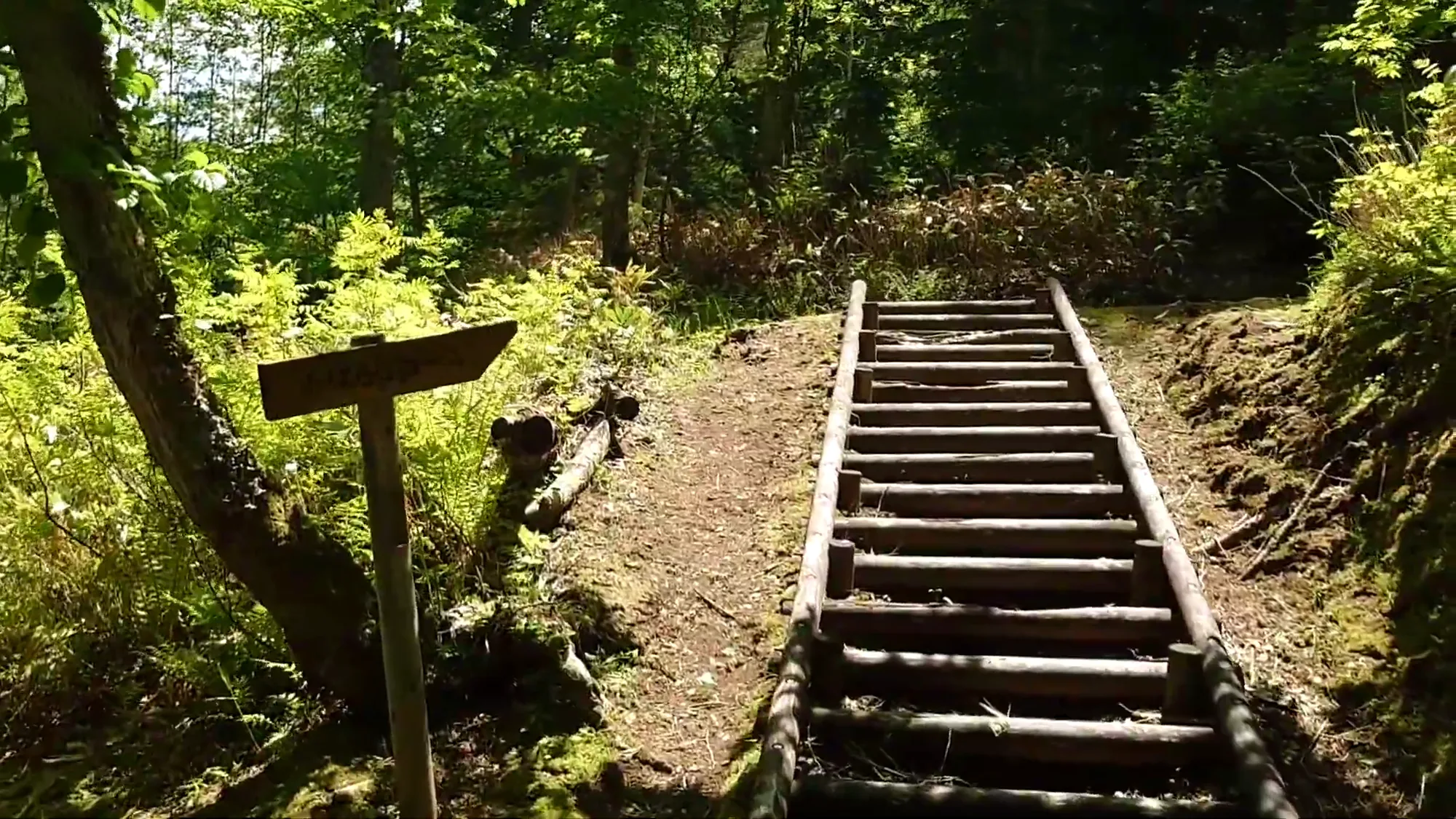
The steps up to the ridge loop, cut into the bank.
Seiryū no Michi (清流の道), the clear-stream path, is about 1.8 km (1.1 mi) and about an hour, through forest described as close to primary. Its stated draw is not a view but a relationship: the seasonal business between the plants and the animals, which is a guide’s description of a walk rather than a tourist board’s.
Miharashi no Michi (みはらしの道), the lookout path, is about 2.4 km (1.5 mi), about 80 minutes, with about 40 m (131 ft) of height difference, and it is graded intermediate. Forty meters over two and a half kilometers (1.5 mi) is not a climb by any ordinary standard, which tells you something useful about the grading convention these bases use: intermediate here means undulating, not steep.
The guided session is about 90 minutes and begins indoors. Blood pressure is measured and a stress check taken before anyone goes into the trees — the same before-and-after logic the Society’s certification experiments use, applied to the customer rather than the research subject.
Nonno, and what the name admits
A Japanese organization naming its forest with an Ainu word is not a neutral act in Hokkaidō, and the operator’s own explanation is short and unembellished: nonno means flower in Ainu, and they chose it because so many flowers bloom here from spring to autumn.
That is all they say, and it would be wrong to build an argument on top of it. What can be said is that the surrounding names are Ainu too — Kussharo, Akan, Abashiri, Tsubetsu itself — because they were the names before they were anything else, and the forest at the head of the Abashiri sits in the middle of them. If you want that history, you will not get it here, and you should go looking for it deliberately.
What the center does say about its relationship with the forest is practical and rather good. Staff work on the forest through all four seasons, and the offcuts of that maintenance, the growth rings, the bark, the seed shapes, are made into craft and sold in the shop, specifically so that the forest pays some of the cost of being looked after. Visitors may not collect plants themselves; the amount that grows is limited and they say so. You can come and make something from wood they have already cut, which is a more honest souvenir than most.

Across the water and straight back up the other side.
The cold, and what it makes
The one-line note for winter here is the forest under snow in extreme cold, and frost flowers.
Frost flowers are worth being precise about, because the name does a lot of work. They are not frost on a window and not hoar on a branch. They form on the surface of ice, overnight, when the air is very much colder than the ice beneath it and the air is still: water vapor passes directly to crystal and grows outward in feathered plates, sometimes several centimeters (an inch or two) across, standing up off the surface like something botanical. They need a hard cold, a windless night, and no snow cover over the ice. They are gone within an hour or two of the sun reaching them.
So they are not a thing you book. They are a thing you are in position for, which means being on the ice early on a morning after a still, brutally cold night — and the snowshoe programs are the mechanism for being there. The snowshoe walk in the snowy forest runs through the snow season, and the center describes the result in terms of a Grimm fairy tale: snow-loaded branches reading as monsters, and the floor written over with animal tracks you are invited to identify. The starlight walk runs from early November to late May. And the center’s own photographs include the Japanese sable and the great spotted woodpecker, both of which come to the café windows.
No temperature or snow-depth normals are published anywhere. The operator links a third-party weather page instead, which is a fair admission that the number changes. But take the phrase extreme cold seriously: nobody in Japan uses it lightly, and if you are coming from a temperate country, find the winter figures before you pack.
The summer counterpart to the frost flowers is above the forest rather than in it. From early June to late October the center runs a dawn tour up to the Tsubetsu pass observatory (津別峠), reached before opening hours, for the sea of clouds over Lake Kussharo — and it publishes a number for its best month: a 72.7 percent encounter rate in August 2020. That is one month in one year, not a promise. The guides explain how the cloud forms, which is the part that makes it a program rather than a viewpoint.

Butterbur to the waist along the water, which is normal here and startling elsewhere.
What the certificate measures, and what it does not
The Society certifies against a standard written in words rather than numbers. A base needs two or more paths that are wide, gently sloped and easy to walk, with lodging, and before certification the Society requires a field experiment on the ground: heart-rate variability, blood pressure and pulse, mood by questionnaire, and the forest’s impression by semantic differential, run in the warm half of the application year.
No result from Tsubetsu’s 2011 experiment has ever been published — no institution, no sample size, no measure. The certificate exists and the data behind it does not. And the pattern holds right across the scheme: the Society publishes that the experiments happen, and never what they found.
What Tsubetsu does publish, and most do not, is the shape of its own roads — three lengths, three times, one height difference. If you are deciding between forests, that is worth more than a research abstract.
The one flat road, and an honest answer about wheels
The Society marks this base no for barrier-free. Not accommodated. It is one of the few on the national list that says no outright, and that should not be buried.
But the same page describes Komorebi no Michi as flat, part boardwalk, and walkable by everyone from toddlers to the very elderly together. Those two statements sit a few hundred words apart, and both of them are official. The likely explanation is that the no is an answer about the base as a whole: the facilities, the other two roads, the guided program, the winter. It is not a verdict on that one path.
So the useful answer, if you are planning around a wheelchair, is neither yes nor no. It is: the official answer is no; there is one flat boardwalk road of about 1.4 km (0.9 mi); the operator is a small nonprofit with a staffed desk and a telephone; call it. The number is 0152-77-3344. Ask specifically about Komorebi no Michi — the width of the boardwalk, whether there is a step onto it, the surface of the approach from the parking lot, and the toilet at the nature center. Those four questions get a real answer. Is it accessible? does not.
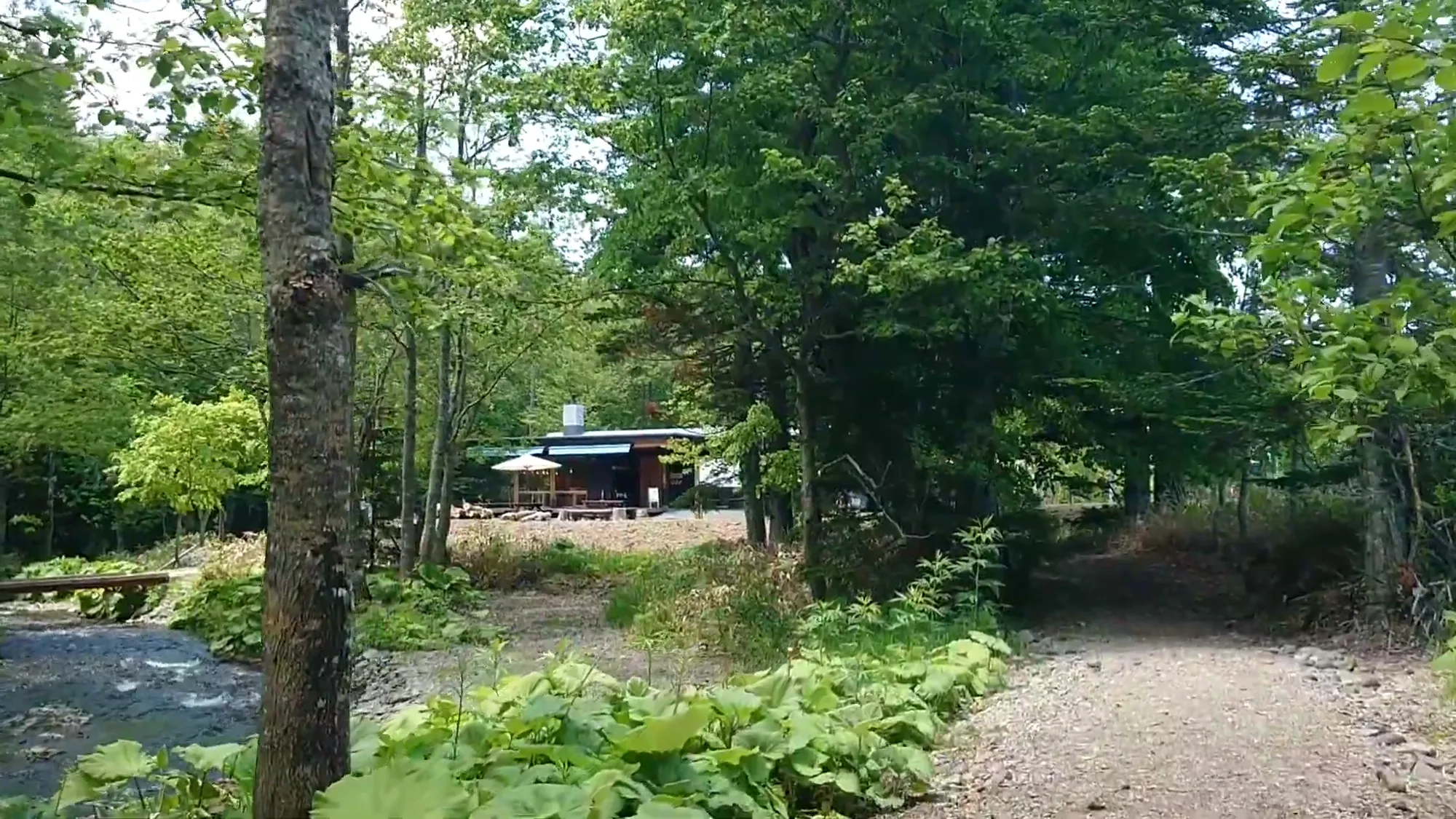
The clearing where the trails meet, and the only built thing on the loop.
That is the single most useful phone call anybody could make about this forest, and the answer would be worth having.
Getting there, and the lamp-lit inn
Memanbetsu Airport is the arrival point: about 50 km (31 mi), roughly an hour by car. That is the only transport figure published anywhere, and it assumes a car. No bus, shared taxi or shuttle to the nature center appears anywhere at all. Ask the center before you plan around anything else, because a forest an hour from an airport with no public transport is a real constraint, not a detail.
Once there, the geography is the selling point. Lake Akan is one way and Lake Kussharo the other, and the forest is at the midpoint of a route most visitors to eastern Hokkaidō are already driving. The pass road climbs to the observatory above Kussharo. The national park forest continues beyond the base’s own boundary.
And then the thing you will not find anywhere else on the list. Ramp no Yado Mori Tsubetsu (ランプの宿 森つべつ), the Lamp Inn, is a hotel inside the certified forest — the Society says so in those words, a hotel within Nonno no Mori, which is itself the certified base. It takes overnight guests and day visitors to the bath. Everywhere else, the pairing of forest and hot water is a drive. Here the walk ends and the bath is right there.
That makes the ideal shape of a visit obvious, and it is the shape the practice wants anyway: arrive the evening before, sleep in the trees, walk Komorebi no Michi slowly in the early morning while the primrose is still wet, take the clear-stream path after, and be in the bath before lunch. Leave thirty minutes between the walk and the water, as the medical societies suggest. Then drive on to one lake or the other with the whole afternoon still in front of you.
Nearby and alike

Nagano · Certified 2006
Iiyama
The 2007 NK-cell study walked these forests. Iiyama is certified, quiet, and a shinkansen stop from Tokyo.

Aomori · Certified 2008
Shirakami Jūniko
A blue pond nobody can explain, beech at the foot of a World Heritage forest, and a bath a meter from the Sea of Japan.

Akita · Certified 2008
Kazuno
Three hot spring districts under one certified forest on Hachimantai, one of them a tōji cure-place for centuries. Beech above, Akita cedar below, and a public bath inside the therapy station.

Forest Bathing in Japan
Japan named forest bathing in 1982, then measured it. The practice, the places, and what the studies show.

The Walk
A measured forest walk is about thirty minutes and no destination. Here it is, sense by sense, step by step.

Choosing a Base
Eight forests, from Kusatsu to Yakushima. Which fits your days, your season and the onsen waiting after.
Verified by The Japan Onsen Society
Sources
森林セラピーソサエティ「北海道 津別町森林セラピー基地」— https://fo-society.jp/facility/tsubetsu/ (認定 2011年, month blank; 日本最北; 3 roads with distance, time and こもれびの道’s internal 1 km / 1.4 km discrepancy; みはらしの道 高低差約40m; 木道 on こもれびの道; the full species list; the four-season notes including フロストフラワー and the kurinsō window of mid-June to early July; the 90-minute program with blood pressure and stress check; barrier-free 否, corporate 可, inbound 可, children 可; ノンノ = Ainu for 花; 網走川の源流; the Akan–Kussharo midpoint; operator NPO法人森のこだま, 0152-77-3344; ランプの宿森つべつ described as a hotel inside the certified forest)
森林セラピーソサエティ「基地一覧」— https://fo-society.jp/base-road-list/ (Hokkaidō holds exactly one entry; 62 bases counted by region on this date)
森林セラピーソサエティ「基地認定について」— https://fo-society.jp/authorization/ (the road criterion in words; the required field experiment and its measures)
ノンノの森ネイチャーセンター(公式)— https://www.nonnonomori.com/ (女満別空港から車で約50km/約1時間; 阿寒摩周国立公園 connection; 津別峠 sea-of-clouds tour, early June to late October, 最大遭遇率72.7% in August 2020; 宇宙ガイドツアー; スノーシューDE雪の森さんぽ in the snow season; 星灯りさんぽ early November to late May; 森の香り作りセラピー hydrosol distillation, year-round; 森の散策ガイド June to October; 畑のガイドツアー currently suspended; guides qualified by the Society’s own examination; エゾクロテン and アカゲラ at the café; the craft-from-maintenance policy and the no-collecting rule; weather delegated to a third-party page)
Verified: 2026-10-05