
Low sun breaking through the cypress canopy onto a small timber shelter in the Akasawa forest.
Step-free
Step-free
Paved and bridged end to end
The main road
Komadori Course
駒鳥コース · 2.7 km (1.7 mi) · about 70 min
Open
25 Apr – 8 Nov
Closed in winter
Nearest station
Agematsu
JR Chūō Main Line, then 30 min by bus
The record
What you need to go
Open season
Open 25 April to 8 November. Closed in winter
Getting there
Agematsu (上松駅) on the JR Chūō Main Line, then the Ontake Kōtsū bus 15 km (9 mi) to Akasawa, about 30 minutes
Fees
Forest free. Parking ¥700 (about $5) per car. Forest railway ¥1,000 (about $7). Guided walk ¥8,000 (about $53) per guide; therapist-led session ¥15,000 (about $100); stress check ¥550 (about $4)
Onsen
Kiso-Fukushima (木曽福島), an old post town 8 minutes down the Chūō line, where the baths look at the river
The walk
Main trail
Komadori Course (駒鳥コース), 2.7 km (1.7 mi), about 70 minutes
All trails
7 trails, 1.5 to 3.3 km (0.9 to 2.1 mi), 40 to 110 minutes
The step-free road
Fureai no Michi is paved and bridged end to end, and the forest railway has a carriage you can board in a wheelchair
The forest
Forest type
759.56 ha (1,877 acres) of national forest, 1,080 to 1,558 m (3,543 to 5,112 ft), under four centuries of protection
What grows
Hinoki cypress · Sawara cypress · Asunaro · Marubanoki · Shiromoji · Yamaboshi
What lives
not published
Certified since
2006
All figures updated 5 October 2026
The forest, before the facts
Forest bathing started here.
In 1982 the country’s first forest-bathing event was held here. This is the birthplace of forest bathing. That sentence sits in the middle of a paragraph on Akasawa’s own page, unemphasized, between a 1970 designation and a note about fragrance.
Everything descends from it. The sixty-two certified bases, the Society that certifies them, the physiological experiments, the qualified therapists, the lunchboxes and the guide fees and the yes and no in every box — all of it is downstream of a gathering in a cypress forest in the Kiso valley in 1982, which gave the practice its name.
And the forest it happened in was already old in the way that matters. Four hundred years since protection began is the base’s own tagline, and it explains it: these slopes have been held under a forest conservation policy that, it says, led the world four centuries ago.
This is also the homeland of the sacred trees for the periodic rebuilding of Ise Shrine. The cypress that becomes Japan’s most important shrine, every twenty years, comes from these slopes.
So: the oldest protected forest, the first recreation forest, the birthplace of the practice, and the timber of Ise. One site.
Five reasons to come
The forest where Japan invented forest bathing, in 1982.
A fully paved road, wheelchairs welcome, and a railway with wheelchair-accessible cars.
Four hundred years of protection, and the cypress that rebuilds Ise Shrine.
A therapist-led four-hour session with an optional stress check for ¥550.
A forest chosen by the Ministry of the Environment as one of Japan’s hundred scents.

The Akasawa stream, running low over granite between the cypress.
Four hundred years, and a policy that led the world
Agematsu (上松町) is in the Kiso valley of southern Nagano, and Akasawa Natural Recreation Forest (赤沢自然休養林) was certified in 2006, in the Society’s first cohort. Which is a little absurd, since the Society’s entire subject matter began here.
The chronology on the page is worth laying out properly, because each date is doing work.
Four hundred years ago, a forest conservation policy the base calls ahead of the world began protecting these slopes. The Kiso forests were put under strict control, and what grew under that control is what you walk through now.
1970: designated as Japan’s first Natural Recreation Forest. Number one. A new national category of forest managed for people to be in rather than for timber, and Akasawa was the first example of it.
1982: the country’s first forest-bathing event. The birthplace of forest bathing.
1985: the Ise Shrine sacred trees were felled, and the site of the felling is a stop on one of the certified roads.
2006: certified by the Forest Therapy Society, alongside bases that had existed as tourism products for two years.
And one more designation that tells you what it is like to be there: the cypress forest, with its fresh fragrance, is on the Ministry of the Environment’s list of the hundred selected scent landscapes of Japan. A government list of places chosen for how they smell, and this forest is on it.
The answer to all four standard questions (wheelchairs and strollers, corporate groups, overseas visitors, children) is yes.

The forest railway runs the old logging line from April to November. It is the one thing at Akasawa that exists nowhere else.
Hinoki, sawara, asunaro — and what the Kiso forest actually is
The tree list is short, and if you know Japanese forestry it is a loaded little list.
Conifers: hinoki (Japanese cypress), sawara (Sawara cypress), asunaro (hiba). Broadleaves: marubanoki, shiromoji, yamaboshi.
Those three conifers are three of the Five Trees of Kiso, the species placed under protection when these forests came under strict control, and which could not be felled without permission. The policy the page dates to four hundred years ago is the reason they are standing, and it is why the Kiso valley holds some of the finest cypress in the world.
Hinoki is the central one. It is slow, straight-grained, pale, rot-resistant and intensely aromatic, and it is the timber of Japanese sacred architecture — the wood Ise is rebuilt from, the wood of temple pillars and bath tubs and the best joinery in the country. A mature hinoki forest smells of it continuously, and that smell is the thing the Ministry of the Environment put on a list.
It is also the reason forest bathing could plausibly be invented here rather than anywhere else. The volatile compounds that the Japanese literature calls phytoncides are emitted most strongly by conifers, and hinoki is among the most aromatic conifers in Japan. If you were going to hold the country’s first event asserting that air in a forest does something to a person, a four-hundred-year-old protected hinoki stand in a narrow Kiso valley is the most persuasive room you could have booked.
The broadleaves are a good autumn set. Marubanoki — Disanthus cercidifolius, the round-leaf witch hazel, turns a deep red-purple and flowers in autumn rather than spring, which is unusual. Shiromoji goes clear yellow. Both are named in the autumn seasonal field, and the page is explicit that they are what you come for in October.
Seven roads, and three of them described
Seven roads radiate from the hub, and they can be combined into circuits. Three are described in full, and they form a ladder.
Fureai no Michi (ふれあいの道) — the accessible one, and the most important paragraph on the page.

The carriages are open at the sides. One has space to board without leaving a wheelchair.
The entire length is laid out with paving and wooden bridges, so people in wheelchairs and people who are not confident on their feet can enjoy forest bathing easily.
The entire length. Not “from the summit station,” not “one of four,” not a yes in a box. The whole road.
It runs from Akasawa bridge (赤沢橋) and the forest classroom ground, up along the stream, to Maruyamado halt (丸山渡停車駅), and it is the only one of the seven that is out-and-back rather than a loop. There are rest shelters and open pavilions at many points, and information boards about the forest.
And then the detail that makes it a day rather than a walk: there is no ticket gate at Maruyamado, so you board the forest railway at the railway boarding point. And the forest railway has cars you can board while remaining in your wheelchair.
That is the best accessibility sentence at any base in Japan. Achi tells you the road at the top of its ropeway is barrier-free and never says whether the cabin is boardable, which is exactly the gap a trip fails on. Akasawa closes it, for a railway, in one clause.
The Komadori course (駒鳥コース) — the main one. The Robin Course goes out along Fureai no Michi and branches at Maruba bridge to make a circuit of Akasawa’s signature scenery. It passes the site where Ise Shrine’s sacred trees were felled in 1985, and Dondonbuchi, a rest place on the stream, which has toilets, and where you will see people unhurriedly eating a lunchbox. It comes back down past the great hinoki and the great sawara at Sawarakubo, the park’s first and second largest giants.
The Tsumetazawa course (冷沢コース) — the deep one. A 3.3 km (2.1 mi) loop. It walks the innermost part of Akasawa for the Kiso cypress scenery at its best. You go out along Fureai no Michi to Maruyamado, then walk the trackbed of the old forest railway to Hontani bridge (本谷橋), cross it, and climb a pass road to Sawarakubo. At the top of the Tsumetazawa pass, relatively large hinoki grow in stands. And from late April into early May, baikaōren flowers scatter at your feet like stars.
So the structure is unusually legible. One fully paved out-and-back with a railway home, one signature loop with a toilet and a lunch spot, and one 3.3-kilometer climb to a pass on an abandoned railway bed. A visitor can pick their day honestly, which almost no other base makes possible.
Three prices, and a guide fee that tells you something
Akasawa publishes three programs with full prices, and the structure is unusually carefully thought out.

Three-hundred-year hinoki, grown straight in the Kiso valley and cut for Ise Shrine.
The forest walk guide. About 120 minutes. Around 15 people, 10 recommended. ¥8,000 (about $53) flat per guide for up to 10 people, then ¥1,000 (about $7) for each additional person.
The forest therapy guide. The full course, led by a Society-certified forest therapist. About four hours. One to five people, three recommended — and over five requires a second guide. ¥15,000 (about $100) per guide. And: an optional stress check is ¥550 (about $4) per person.
The forest bathing guide. The middle option, described as taking the good parts of both: a simple guided rest experience, stimulating the five senses, for people who want a little of each. Two to three hours, 10–15 people per guide. ¥10,000 (about $67) flat for up to 10, then ¥1,000 each.
Three things in that structure are worth pulling out.
First, the pricing is tiered by what the session actually is. A sightseeing walk for a group of ten costs ¥800 (about $5) a head. A four-hour therapist-led session for three costs ¥5,000 (about $33) a head. The same forest, priced six times apart, because they are not the same product — and almost no other base distinguishes them in writing.
Second, the group sizes encode the method. The walk takes fifteen. The therapy session takes five, and recommends three. A certified therapist working with three people for four hours is a different activity from a guide leading fifteen for two hours, and the numbers say so without needing to claim anything.
Third, the ¥550 stress check. A handful of bases hand measurement back to the visitor — Oguni’s stress check, Kazuno’s self-service equipment, Akagi’s check sheet, Hadano’s priced salivary-amylase test, Otari’s public health nurse. At ¥550 (about $4) this is the cheapest of them, and it is offered at the one place where the whole idea started.
The page also gives the cleanest definition of its own subject you will find anywhere: forest therapy is forest bathing backed by scientific evidence. The birthplace of forest bathing defining forest therapy as the version of it with evidence attached.
A hospital on the program
One line in the base’s description is easy to skim and should not be: one of its distinguishing features is that it prepares menus and events in partnership with the prefectural Kiso Hospital.

Akasawa signs in both languages, which is rarer than it should be.
A certified forest therapy base in a formal tie-up with a public hospital. Not a health department, which Saku has. Not a public health nurse on a plan, which Otari has. A hospital.
How close do these bases come to being medicine? Closer than you would expect, and never quite. Akasawa is the closest. The practice was named here in 1982; the Society defines the certified version as the one with evidence behind it; this base sells a four-hour therapist-led session with a stress check; and the local prefectural hospital co-designs programs with it.
What those partnered menus and events actually are is not published, and it is the question worth asking when you call.
The railway, and why the trackbed is a therapy road
The Akasawa forest railway (赤沢森林鉄道), known locally as rintetsu, is a narrow-gauge line that ran from 1916 to 1975, and the Society’s description of what it was for is unusually direct: the railway that laid the foundation of Kiso forestry, and also the local residents’ transport.
1.1 km (0.7 mi) of it has been restored and runs out and back for visitors, and it carries wheelchairs.
The rest of it is underfoot. The Tsumetazawa course walks the trackbed from Maruyamado to Hontani bridge.
Which makes Akasawa the cleanest instance of a pattern that turns up again and again. Japan’s certified healing forests are almost all laid over somebody else’s abandoned works: Kōyasan’s pilgrim roads, Mizukami’s shrine approach, Kanra’s quarry track, Nanasawa’s Kamakura pilgrimage, Tsu’s Ise highway, Hinokage’s railway, Otari’s salt road, Tsunan’s old road, Saku’s charcoal kilns, and here a logging railway that was also a bus service.
And Akasawa makes the reason visible rather than leaving it to be inferred. A logging railway is graded, drained, gently sloped and wide enough for a wagon. That is the exact specification of a good walking path, arrived at for completely different reasons. A forest that was logged industrially for sixty years is left behind with a network of the best-engineered gentle routes anybody will ever build through it — and when the logging stops, somebody notices that they are perfect for walking slowly on.
The 1.1 kilometers (0.7 mi) that still has rails carries wheelchairs. The rest, with the rails lifted, carries walkers. It is the same piece of civil engineering doing both jobs.

Hinoki bark, fibrous and splitting with age.
Closed in winter, and what the rest of the year gives
Akasawa describes all four seasons, and the fourth is one word: closed. The 2026 season ran from 25 April to 8 November.
Few bases publish a winter closure at all — Tsunan’s Taruda forest in Niigata is the only other one. A mountain base in snow country is often simply shut, and the Society’s page is usually the only place that says so.
The other three seasons are given as species lists, which is the most useful form:
Spring: baikaōren, shōjōbakama, akayashio. Baikaōren is the small white flower the Tsumetazawa course description compares to scattered stars, out from late April. Shōjōbakama is a pink woodland lily. Akayashio is a mountain azalea that flowers on bare branches before its leaves.
Summer: kisogawasatsuki, ōyamarenge, yamaboshi. The first is a Kiso river azalea named for this valley. Ōyamarenge is a magnolia with large nodding white flowers and a strong scent, which grows in exactly this kind of cool mountain forest and is one of the better things to meet in a Japanese summer wood.
Autumn: marubanoki, shiromoji — the red-purple and the yellow.
And the lunchbox is the right kind: a handmade box centered on locally grown vegetables, the pride of the town’s local-products development center, and adjusted to your budget.
What is not published
For the most historically important base in Japan, the gaps are small but pointed.
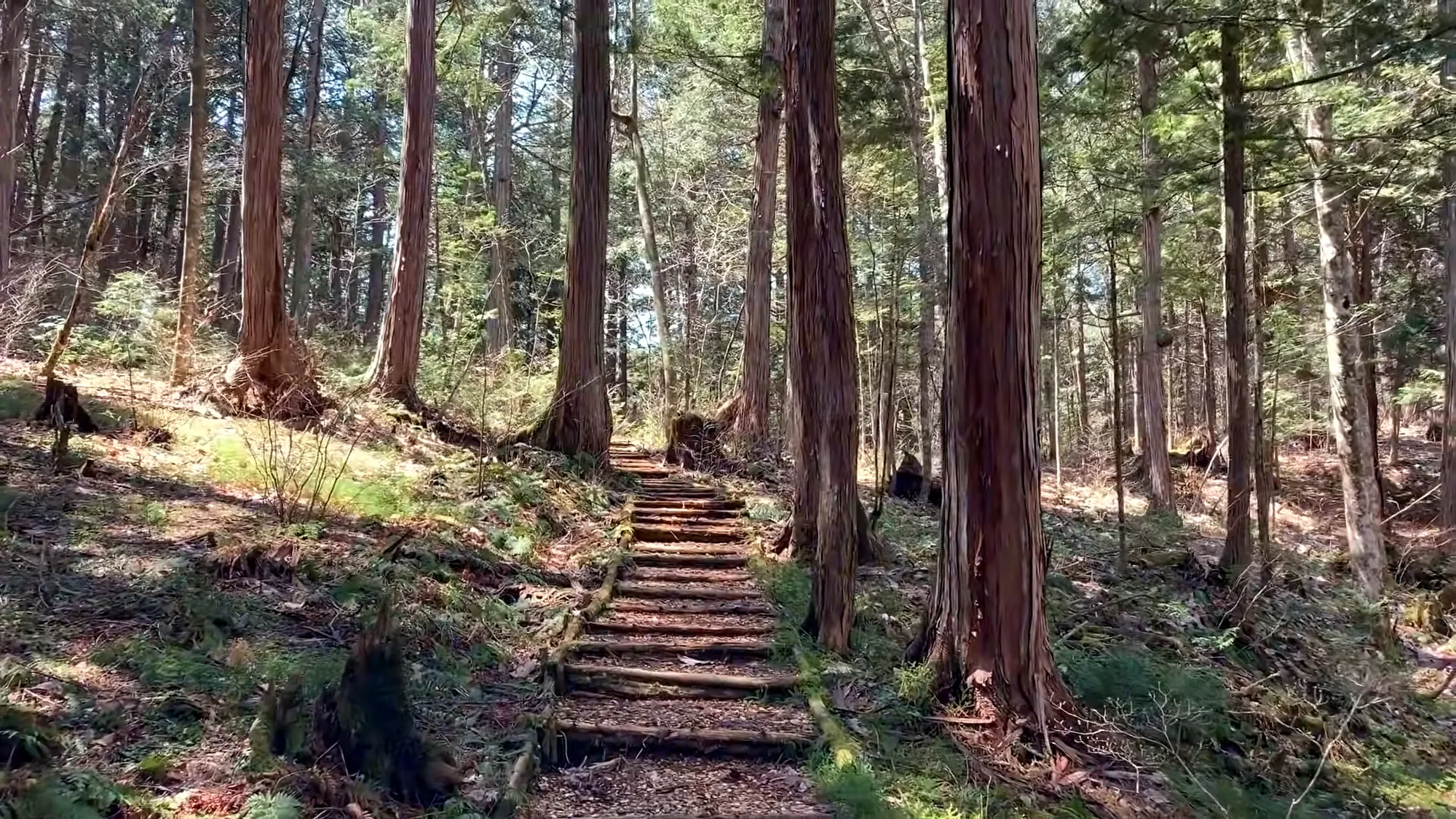
Most of Akasawa's walking is this: a graded path, soft underfoot.
Three of the seven roads are described in full. The operator’s own course map measures all seven, and the two the Society leaves unmeasured are there: Fureai no Michi is 2.8 km (1.7 mi), about an hour, and the Komadori loop 2.7 km (1.7 mi), about seventy minutes.
What is still missing is elevation, the area of the base, and any mention of wildlife — nothing at all, in four-hundred-year-old protected forest, which given the quality of the plant lists is a surprising omission. And there is no detail on the Kiso Hospital partnership, which is the most interesting thing here.
The operator is the Agematsu town tourism association (一般社団法人上松町観光協会), on 0264-52-1133 or hinoki@avis.ne.jp, and the site is kiso-hinoki.jp — Kiso cypress.
The yes for barrier-free here is, unusually, supported by the base’s own prose: an entire road paved and bridged, pavilions and rest stops along it, and a railway with wheelchair-accessible cars. It is the rare yes a reader could act on without a phone call. Two questions are still worth asking: the surfaced width, and whether there is a step between the parking lot and Akasawa bridge. But the hard part is already answered in writing.
Go in late April, and take the train back
This is the one base where the recommendation is also an argument.
Go in the last days of April or the first of May, when the baikaōren is out at your feet on the Tsumetazawa pass and the akayashio is flowering on bare branches. Walk Fureai no Michi first, the whole paved length along the stream, slowly, because this is the road that proves a forest can be made available to anybody who wants it. Then take the Komadori loop past the ground where Ise’s sacred trees came down in 1985, eat the town’s vegetable lunchbox at Dondonbuchi where the toilets are, and come back past the two biggest trees in the park.
If you have four hours and two friends, book the certified therapist instead — ¥15,000 (about $100) between three, four hours, and ¥550 (about $4) each for the stress check. It is the most complete version of this practice that is for sale anywhere in Japan, offered in the forest where the practice was named.
And ride the railway back. A kilometer (0.7 mi) of restored narrow gauge through four-hundred-year-old cypress, on the line that built the Kiso timber industry and carried its people, with a carriage you can roll a wheelchair onto.
Everything that came after is an attempt to do what somebody first tried here in 1982. This is the room it happened in, and it still smells of it.
Nearby and alike

Nagano · Certified 2006
Shinano-machi
Thirteen nurses spent three days in these woods for the 2008 study. Shinano’s forest lies below Kurohime.

Nagano · Certified 2010
Achi / Heavens Sonohara
A single 2.3-kilometer loop in forest the operator calls primeval, at the top of a cable car — the only certified base in Japan using a lift to solve the mountain.

Nagano · Certified 2008
Shiga Kōgen
Five therapy roads across a UNESCO-certified highland of seventy ponds and marshes. One of them is barrier-free, and the village says so in a number.
Verified by The Japan Onsen Society
Sources
森林セラピー「長野県 赤沢自然休養林」— https://fo-society.jp/facility/nagano-akasawa/ (保護活動をはじめて400年; 上松町; 認定 2006年; 伊勢神宮式年遷宮の御神木のふるさと; 400年前、世界に先駆けた森林保護政策によって守られてきました; 昭和45年に自然休養林第1号に認定; ⭐ 昭和57年には国内初の森林浴大会が開催された森林浴発祥の地; 爽やかな芳香があるヒノキの森林は、環境省「かおりの風景100選」にも選定; 拠点に赤沢森林交流センター・せせらぎの里赤沢・森林資料館・森林鉄道記念館; ここを起点に7本の散策コース, ほかのコースと組み合わせて周回することもできます; ⭐ 県立木曽病院と提携したメニューやイベントを用意しているのも特徴のひとつ; all four service fields 可; ふれあいの道 — 全線が舗装と木橋で整備されており、車椅子や足に自信のない方でも気軽に森林浴を楽しむことができます; このコースのみ往復; 赤沢橋・森林教室広場から渓流をさかのぼり丸山渡停車駅まで; 休憩所やあづまやも多く; 森林に関する案内板; 丸山渡停車駅には改札がございません; ⭐⭐ 森林鉄道には、車椅子のまま乗車できる車両もございます; 駒鳥コース — ふれあいの道を経由, 丸葉橋から分岐, 昭和60年の「伊勢神宮御神木伐採跡地」, 渓流の休憩地「吞曇渕」(トイレあり, お弁当を食べる方の姿も多く), ヒノキ大樹と椹窪を経由して床堰, ヒノキ大樹と椹窪のさわら大樹は園内でも1、2を争う巨木; 冷沢(つめたざわ)コース — 1周3.3km, 赤沢一帯の最深部, 木曽ヒノキの見事な景観, 丸山渡停車駅から本谷橋へ森林鉄道の軌道跡を歩く, 冷沢峠で比較的大きなヒノキが群生, 4月下旬から5月初旬にバイカオウレンの花が星を散らしたように; セラピー弁当 有 — 上松町特産品開発センター自慢の地元で採れた野菜を中心とした手作りお弁当, ご予算に応じます; conifers ヒノキ・サワラ・アスナロ, broadleaves マルバノキ・シロモジ・ヤマボウシ; seasons — spring バイカオウレン/ショウジョウバカマ/アカヤシオ, summer キソガワサツキ/オオヤマレンゲ/ヤマボウシ, autumn マルバノキ/シロモジ, winter 閉園中; ⭐ 3 programs — 森林散策ガイド 約120分, 15名前後(推奨10), ガイド1名につき10名まで一律8,000円 以降1名ごとに1,000円追加; 森林セラピーガイド — 森林セラピーソサエティ認定森林セラピストによるフルコース, 約4時間, 1~5名(推奨3, 5名超はガイド2名), ガイド1名につき15,000円, オプションのストレスチェック別途550円/1名; 森林浴ガイド — 約2時間~3時間, 10~15名, ガイド1名につき10名まで一律10,000円 以降1,000円追加; 森林セラピーとは科学的な証拠に裏付けされた森林浴のこと; 赤沢森林鉄道 — 通称りんてつ, ナローゲージ, 大正5年(1916)から昭和50年(1975)にかけて運行, 木曽の林業の礎を築いた鉄道で地域住民の足でもあった, 現在は観光用に復元された1.1kmを往復運行; guide message = photograph only; contact 一般社団法人上松町観光協会 事務局, hinoki@avis.ne.jp, 0264-52-1133; official site https://kiso-hinoki.jp)
森林セラピーソサエティ「基地認定 について」— https://fo-society.jp/authorization/
森林セラピーソサエティ「森林セラピー基地 検索・一覧」— https://fo-society.jp/base-road_list/ (the 62-row national table; Akasawa = No. 32, 長野県, all four columns ◯)
Verified: 2026-10-05