
Signpost reading Fujimidai Kogen 1,739m and Central Alps Quasi-National Park on an open ridge at Achi, Nagano
Step-free
Partly step-free
Barrier-free from the ropeway summit
The main road
Iwana-no-mori
いわなの森 · 2.3 km (1.4 mi) · about 40 min
Open
Year-round
Snowshoe tours in winter
The record
What you need to go
Open season
All four seasons walkable. Skunk cabbage in spring, color in autumn, snowshoe tours in winter. Ropeway hours and season not published
Getting there
not published
Fees
A two-hour guided tour is ¥33,000 (about $220) per guide and covers up to fifteen people, booking required. The ropeway fare is not published
Onsen
Hirugami Onsen (昼神温泉郷), ten minutes by car, about twenty inns on an alkaline simple sulfur spring known as a beauty bath
The walk
Main trail
Iwana-no-mori (いわなの森), the Char Forest, a 2.3 km (1.4 mi) circuit beside a small stream
All trails
1 trail, a 2.3 km (1.4 mi) loop with benched rest areas along it
The step-free road
The road is barrier-free from the ropeway’s summit station, and wheelchairs and strollers can reach it. Whether the cabin itself is boardable is not published
The forest
Forest type
Forest the operator calls primeval, at 1,400 m (4,590 ft), where the summer average is 20 °C (68 °F)
What grows
Larch · Hinoki cypress · Hemlock · Maple · Oak
What lives
not published
Certified since
2010
All figures updated 5 October 2026
The forest
You get to this forest by cable car.
From the ropeway’s summit station it becomes barrier-free, and wheelchairs and strollers can reach the forest therapy road. One sentence, and it is unusual enough to be the reason to come.
Every other certified base in Japan has the same unspoken problem: the good forest is up the mountain, and getting up the mountain is the barrier. The accessible roads are accessible because they are low — a lakeside, a suburban park, a motorway rest area. The high forest has belonged to people who can climb to it.
Achi put a ropeway under the problem. The therapy road sits at 1,400 m (4,590 ft), in forest the operator calls primeval, and you arrive at the top of it in a cabin. From there it is a 2.3 km (1.4 mi) loop with benches, and the operator says plainly that a wheelchair can do it.
The operator, incidentally, is not a town. It is the ropeway company.
Five reasons to come
A primeval forest at 1,400 meters (4,590 ft) that a wheelchair can reach, by cable car.
A 2.3-kilometer (1.4 mi) loop with benches, beside a stream, and nothing else to do.
An average summer temperature of 20°C, about 68°F, while the valleys cook.
Skunk cabbage colonies in spring, snowshoe tours in winter, on the same loop.

The old cedar on the approach, lit sideways for about twenty minutes a day.
A guide priced by the guide, not by the head — so a group of fifteen pays little each.
One road, and nothing left unsaid
Achi is a village in southern Nagano, and the certified base is not the village. It is the Fujimidai Highland Ropeway, Heavens Sonohara (富士見台高原ロープウェイ ヘブンスそのはら), a ski and sightseeing operation certified in April 2010.
The base has exactly one road, and because there is only one, it is described completely:
Iwana-no-mori (いわなの森), the Char Forest, named for the iwana, the white-spotted char that lives in cold mountain streams in Japan. A 2.3 km (1.4 mi) circuit of primeval forest. Abundant trees, a healing promenade, the murmur of a small stream to listen to while you take nature in slowly. There are rest areas with benches. And from small children to elderly people, everyone can enjoy it.
It is the tagline of the whole base, though, that tells you what the operator thinks it is selling: a forest therapy road at 1,400 meters (4,590 ft). Not a village, not a brand, not a healing town. An altitude.
It says yes to barrier-free access, corporate training and children. It says no to overseas visitors — the only one of the four it declines, which on a facility that already runs a ropeway and sells tickets to the public probably means nobody on staff is confident in English.
What a ropeway does to the accessibility question
Most certified forests answer the accessibility question with a yes or a no. Achi describes the mechanism instead, and nowhere else does it this way.

The shrine at the top of the avenue, and the reason the cedar was never cut.
Otari quantifies: four roads, one of them barrier-free. Achi explains the chain: the ropeway lands you at the summit station, and from the summit station onward it is barrier-free. That tells you where the accessible section starts and what gets you to it, which is worth more than a yes.
It is worth being precise here, because the difference is where a wheelchair user’s day succeeds or fails. What is confirmed is the road, from the summit station onward. Whether a wheelchair can board the cabin itself (a step, a gap, a staff lift) is not confirmed anywhere, and it is the whole trip.
So there are four questions worth asking before you book, and they go to 0265-44-2311 or info@mt-heavens.com: whether a wheelchair can board the gondola and how, the surfaced width of the loop, whether the 2.3 kilometers (1.4 mi) is continuously surfaced or only in part, and where the accessible toilet is at the summit station.
But the structural point stands. A lift is an accessibility solution for a mountain, and almost nowhere else is using it that way. Several other bases sit under existing ropeways and gondolas. Otari’s Tsugaike moor is reached by one. Only Achi has framed it as the thing that makes the forest reachable rather than as a scenic ride.
The altitude, and what 1,400 meters buys
All four seasons here are really four descriptions of one fact: this forest is cold.
Spring brings colonies of skunk cabbage. Summer is a cool walking path with an average temperature of 20°C (68°F). In autumn the color spreads. Winter is snowshoe tours walking on the snow.
The summer figure is the one to take seriously. A Japanese summer at low altitude is punishing in a way that visitors consistently fail to anticipate, and southern Nagano’s valleys get the full version of it.

One tree, one week, and a dark hillside to show it against.
An average of 20°C (68°F) at 1,400 meters (4,590 ft) is the difference between a forest you cannot use and a forest that is the best place in the region to be. Air cools as it rises, and 1,400 meters of elevation is worth a substantial number of degrees against the valley floor — before you add the shade of a closed canopy and the cold air coming off a mountain stream.
Which reframes the ropeway again. It is not just an accessibility device. In August it is air conditioning.
Skunk cabbage, Lysichiton camtschatcensis, is the other altitude marker, and it turns up at three of these forests: here, at Otari’s Tsugaike moor at 1,900 meters (6,230 ft), and in Otari’s Tsuga forest. It is a cold-wetland plant that pushes a white hood up through meltwater as soon as the snow leaves, often while there is still snow beside it, and a colony of it is one of the defining sights of a Japanese mountain spring. It is reliable evidence of altitude and standing water, and its presence on a 2.3-kilometer (1.4 mi) loop beside a stream is consistent with everything else here.
The trees match: conifers karamatsu (Japanese larch), hinoki (Japanese cypress) and tsuga (hemlock); broadleaves momiji (maple) and nara (oak). Larch and hemlock together are a cold, high-elevation signature — larch is the only deciduous conifer in common Japanese planting and turns gold before dropping its needles, which is part of why the autumn here is worth the ticket.
Primeval forest is what the operator calls the loop. There is no species breakdown behind the word, and hinoki in a tree list usually indicates planting, so it is worth asking about rather than taking on faith. Otari at least names a climax species for its own primeval beech.
Why one road beats six
There is a pattern here that inverts what you would expect. Count a base’s roads against how many of those roads it actually describes.
Taruda: 3 roads, 3 described. Each named, measured, timed and graded. Shinanomachi: 3 roads, 3 described. Each named, measured, and given a season and a landmark. Achi: 1 road, 1 described. Named, measured, with its surface situation, its benches and its four seasons. Matsukawa: 2 roads, 0 described. Otari: 4 roads, 0 described, though it does quantify the accessible one. Saku: 6 roads, 2 described, and the two are summarized rather than measured.
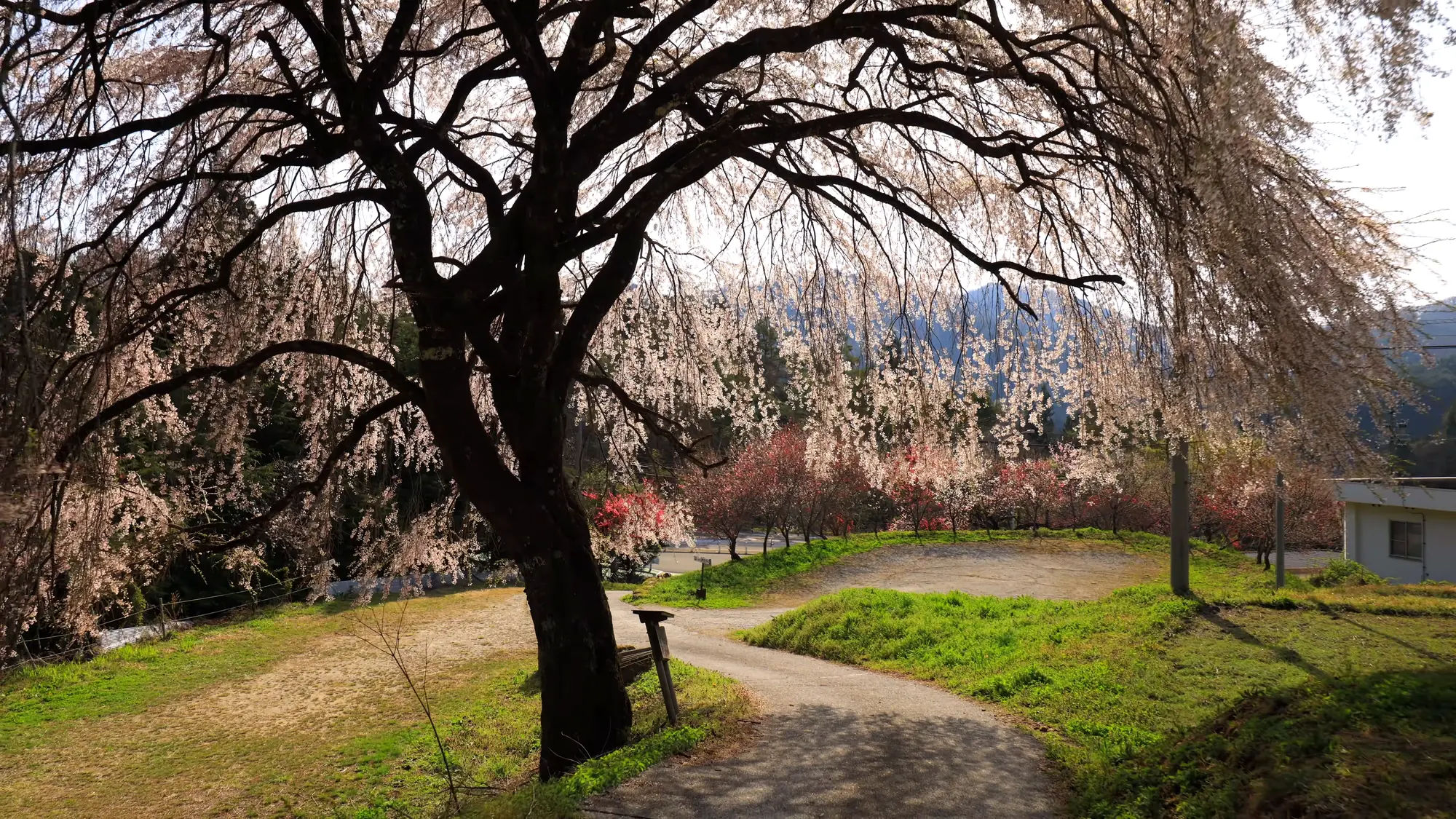
Still bare in late April, which at 1,000 meters is normal.
The bases with the fewest roads describe them best, and the base with the most describes them least.
That is not a coincidence and it is not laziness in any simple sense. A road is a thing you have to maintain, measure, sign, insure and talk about. A base with one road can tell you everything about it because there is one thing to know. A base with six is managing a portfolio, and the portfolio gets summarized.
The consequence for a reader is the opposite of intuitive. A high road count is not a richer base. It is often a less legible one — and the number worth using is not how many paths exist but how much you can learn about any of them before you arrive.
Achi has the smallest number possible. One loop, 2.3 kilometers (1.4 mi), at 1,400 meters (4,590 ft), in forest the operator calls primeval, with benches, beside a stream, reachable from a cable car, in four described seasons. There is nothing to choose between and nothing left unsaid, and for a visitor who wants to know what they are walking into before they buy a ticket up a mountain, that is worth more than five more roads would be.
Two hot springs, both close
The onsen here are unusually close.
Hirugami Onsen (昼神温泉郷) is ten minutes by car from Heavens Sonohara, with about twenty inns, and the water is an alkaline simple sulfur spring, famous as a bijin no yu — a beauty bath.
That is an unusual combination, and it is worth knowing why. Alkaline water saponifies the oils on the surface of the skin — a real reaction, not a metaphor, which is why high-pH springs feel slippery and leave skin smooth. Sulfur does something different: it is the water that smells of eggs, and it is the classic Japanese therapeutic spring for skin conditions. The two together give the smoothness alongside the sulfur, which is a pairing inns advertise heavily. Twenty of them in one valley, ten minutes from the ropeway.

Working forest. The track is there to get the timber out.
Tsukigawa Onsen (月川温泉) is two minutes by car — a single inn, surrounded by flowering peach that comes into full bloom in spring. Hanamomo is grown for the blossom rather than the fruit, and in southern Nagano it is planted in quantity.
So the shape of a visit assembles itself. Ropeway up in the morning, 2.3 kilometers (1.4 mi) of cold primeval forest at 1,400 meters (4,590 ft), down in the afternoon, and alkaline sulfur water within ten minutes. In spring the flowering peach is out at the bottom and the skunk cabbage is out at the top, which is the week to come.
A ropeway company runs it, and that explains everything
The operator is a commercial ski and sightseeing business, which makes it one more entry on a very long list of the kinds of organization that run Japan’s certified forests: municipal tourism and industry divisions · a board of education at Iwate · forestry cooperatives at Tome and Kōyasan · a registered nonprofit at Kitamoto · private companies at Akagi and BIOTOPIA · a health insurance section at Yamakita · a dedicated forest engagement section at Hadano · a health promotion division at Saku · a community organization at Shinanomachi · and now a ropeway.
That list is the most useful thing to know about these places, and it has nothing to do with landscape. Who runs a base predicts what it will actually give you.
A ski resort has a lift, a summit station, staff on duty in winter, snowshoes to rent, a car park, toilets and a café, and it already knows how to move members of the public up a mountain and look after them at the top. Which is exactly why this is the base with a wheelchair-accessible high forest. No municipality was going to build a ropeway to certify a therapy road. A ropeway company already had one, and noticed what it was for.
The flip side is in the gaps. There is nothing about the wildlife in a forest named after a fish, no elevation profile, no surface, no bentō, and a no to overseas visitors on a facility that sells tickets to the public. A resort operates a season; a town operates a program. Neither does the other’s job well, and a reader should pick a base by which of the two they need.
What you will have to ask for
For a base with a single fully described road, the gaps are concentrated in one place: the thing you have to buy.

Above the treeline the sasa takes over completely, and the path is the only gap in it.
No ropeway fare. No ropeway operating hours or season, on a mountain facility that certainly has both. No gradient or surface for the loop. No elevation gain. No area. Nothing about the wildlife — in primeval forest, in a place named after a char. No bentō. And no message from the guides at all, just a photograph.
The no to overseas visitors is also, practically, a gap rather than a fact: a reader who does not read Japanese is being told not to come to a forest that a wheelchair can reach, which is a loss on both sides.
The fares, the hours and the season are on the operator’s own site, mt-heavens.com.
Go in spring, and ask about the gondola
This is the easiest recommendation to give and the hardest to be sure of, for the same reason: the whole thing depends on one cable car.
Go in spring. The flowering peach is out at Tsukigawa at the bottom. The skunk cabbage is out at the top. Take the ropeway to 1,400 meters (4,590 ft), walk the 2.3-kilometer (1.4 mi) loop slowly beside the stream, sit on the benches, and come down into alkaline sulfur water ten minutes away.
If you are coming as a group, book the guide — ¥33,000 (about $220) divided fifteen ways is about ¥2,200 (about $15) a head, the cheapest guided forest therapy walk you are likely to find. If you are coming alone, walk it yourself and spend the money on the inn.
And if you use a wheelchair, call 0265-44-2311 before you book anything, and ask specifically about boarding the gondola. The road at the top is the part they have solved and said so. The cabin is the part nobody has written down, and it is the part the day turns on.
Nearby and alike

Nagano · Certified 2007
Otari
Primeval beech under a mountain on Japan’s hundred-famous list, a hundred-hectare high moor at 1,900 meters, ten hot springs, and the salt road where an enemy was kept alive on purpose.

Mie · Certified 2009
Tsu (Misugi)
Ninety percent forest under three thousand-meter peaks, with the largest road network in Japan — from twenty meters of climb to six hundred and seventy.

Saitama · Certified 2019
Kitamoto
The nearest certified forest to the capital, on flat ground, where the shortest road takes fifteen minutes to walk and the session built on it runs two hours.
Verified by The Japan Onsen Society
Sources
森林セラピー「長野県 富士見台高原ロープウェイ ヘブンスそのはら」— https://fo-society.jp/facility/achi/ (標高1400mの森林セラピーロード; 下伊那郡阿智村; 認定 2010年4月; ロード数 1 — いわなの森, 1周2.3kmの原生林, 小川のせせらぎを聞きながら, ゆっくりと自然を満喫, ベンチを設けた休憩所, 小さなお子様から年配の方まで楽しむことができます; ⭐ ロープウェイに乗って標高1400mの高原まで移動; ロープウェイ山頂駅からはバリアフリーとなり、車いすやベビーカーでも森林セラピーロードへ移動できます; barrier-free 可, corporate 可, inbound 否, children 可; all four seasonal fields — spring 水芭蕉の群生地, summer 平均気温20℃の涼しい散歩道, autumn 紅葉が広がる, winter 雪の上を歩くスノーシューツアー; conifers カラマツ・ヒノキ・ツガ, broadleaves モミジ・ナラ, special trees and notes blank; セラピー弁当 無; ⭐ セラピーガイドツアー — 場所いわなの森, 時間2時間, 料金 ガイド1名 33,000円(15名まで対応可能), 要予約; guides’ message = photograph only, no text; 昼神温泉郷 — 車で10分, 20件ほどの旅館, アルカリ性単純硫黄泉の「美人の湯」; 月川温泉 — 車で2分, 春に満開になる花桃に囲まれた1件宿; contact 富士見台高原ロープウェイ ヘブンスそのはら, info@mt-heavens.com, 0265-44-2311; official site https://mt-heavens.com)
森林セラピーソサエティ「基地認定 について」— https://fo-society.jp/authorization/
Verified: 2026-10-05