
Massive moss-covered root plate spreading across the forest floor on Yakushima, Kagoshima
What you walk into
Yakushima is not a forest therapy base and holds no Society certificate; it is absent from the Society’s list read on 28 and 29 September 2026, and this record says so first. It is a granite island 60 km (37 mi) off the southern tip of Kyushu, a UNESCO World Natural Heritage site since 1993, whose interior is cedar forest older than most things in Japan, and it is on this property because a site about Japanese forests that left it out would be lying by omission.
The trees are ヤクスギ (yakusugi), the island’s name for a Cryptomeria over a thousand years old; younger cedars are simply 小杉. The one everyone walks to is 縄文杉 (Jōmon-sugi), at 1,328 m (4,357 ft), which the town puts at between 2,170 and 7,200 years old, the range being a measure of how hard it is to date a tree that has been hollow for centuries. The town’s own figure for the walk is eight to ten hours round trip from the 荒川 (Arakawa) trailhead, much of it on the bed of an old logging railway and the rest on steep root-and-rock path. It is a mountain walk, not a therapy road, and the paths are not built to the Society’s standard of width and gradient.
The gentler forest is 白谷雲水峡 (Shiratani Unsuikyō), the moss ravine above Miyanoura, where the walking is shorter and the moss is what people come for. The town asks visitors not to walk on it. Everything here is wet: the island’s own reputation is rain most days, and the forest is the colour it is because of that.
After the walk
The bath is the strangest on this property. 平内海中温泉 (Hirauchi Kaichū Onsen) is a set of rock pools on the south coast that the sea covers twice a day; the town’s page says they can be used for about two hours either side of each low tide, for a contribution of ¥300 (about $2) in the box, mixed bathing, no swimsuits, a wrapped towel or bathing robe allowed. The tide table is the timetable. The forest-and-onsen record sets out the order of the day; here the order is set by the moon.
Walking Jōmon-sugi has a cost beyond the bus. The Ministry of the Environment’s Yakushima page gives the 山岳部環境保全協力金, the mountain conservation contribution, as ¥1,000 (about $7) for a day walk and ¥2,000 (about $13) for a night in the mountains, from junior-high age, payable at the Arakawa bus stop, the Yodogawa trailhead or the tourism association. It has run since March 2017.

Over six hundred species of moss on one island, and most of them are in this frame.
Getting there, and when
Yakushima is reached from Kagoshima, which is itself a flight from Tokyo. Japan Air Commuter flies Kagoshima to Yakushima in 35 to 40 minutes, four times a day by the prefecture’s count. By sea, the 種子屋久高速船 high-speed boats, Toppy and Rocket, run Kagoshima port to 宮之浦 (Miyanoura) in about 1 hour 45 minutes direct, or 2 hours 40 to 50 minutes via Tanegashima, about six departures a day, at ¥14,000 (about $93) one way for an adult from 11 May 2026 with a seven-day return at ¥25,900 (about $173); the car ferry フェリー屋久島2 leaves Kagoshima at 8:30 and reaches Miyanoura at 12:30, once a day, ¥6,500 (about $43) second class.
On the island the buses are the prefecture’s figures, since the operators’ own pages could not be reached in this pass. From Miyanoura port to Shiratani Unsuikyō is 30 to 35 minutes and about 12 km (7.5 mi), four to eight buses a day depending on operator. To the Jōmon-sugi trailhead, a direct bus runs Miyanoura port to Arakawa in 83 minutes over 42.6 km (26.5 mi), four a day, or a bus to the 屋久杉自然館 (Yakusugi Museum) in 48 minutes connects with the 荒川登山バス shuttle, 35 minutes and 15.6 km (9.7 mi), six or seven a day.
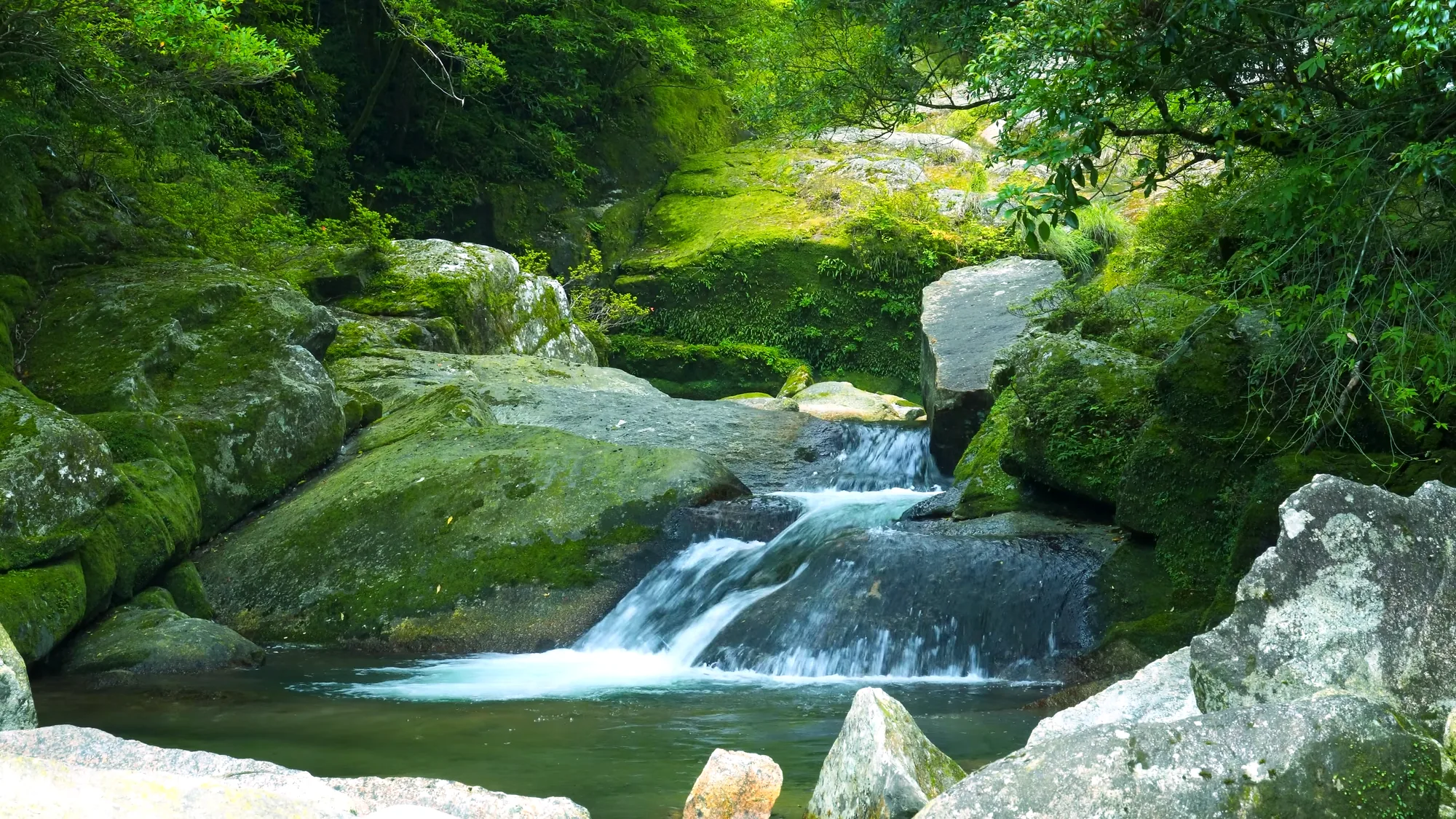
Granite below, rainforest above, and some of the clearest water in Japan between them.
Private cars are barred from the Arakawa road from 1 March to 30 November and the shuttle runs only in that window, with tickets sold at the tourism association offices near the port and the airport; its fare sits on a site whose certificate this property’s tools refused, and stays unverified. The bus to Hirauchi is on the south-coast line, 97 minutes end to end from Miyanoura to Kurio, and no reachable timetable itemises the Hirauchi stop.
The island is walked year-round and rained on year-round. Typhoons come from June to October; the Jōmon-sugi walk is a March-to-November walk for anyone without a winter permit and a car. The sea bath is open whenever the tide is out and the swell allows.
The forest is free and the bath asks ¥300. What costs money is the crossing, the contribution, the shuttle and two nights on the island, because nobody should try Jōmon-sugi as a day trip from the mainland.
Nearby and alike

Origins
A forestry bureau named shinrin-yoku in 1982. The manners it asked for are older, and they are still kept.

Choosing a Base
Eight forests, from Kusatsu to Yakushima. Which fits your days, your season and the onsen waiting after.

Forest and Onsen
Two old Japanese ways of resting the body meet in the Kiso valley. Cypress air, hot water, and what is known.