
Weathered wooden sign reading Tomin no Mori at the entrance to the forest park in Hinohara, western Tokyo
Step-free
Step-free
Wood chip throughout, the least steep road in the park
The main road
Way of the Great Falls
大滝の路 · 1 km (0.6 mi) · about 20 min
Open
Year-round
Closed Mondays and 29 Dec – 3 Jan
Nearest station
Musashi-Itsukaichi
JR Itsukaichi Line, then 75 min by bus
The record
What you need to go
Open season
Not published. Hossawa Falls nearby freezes solid in winter, and the Akigawa gorge is a known spot for autumn color
Getting there
Meet at Musashi-Itsukaichi (武蔵五日市駅), a Tokyo station, and the day ends there or at the Kazuma-no-yu hot spring
Fees
A model day trip is ¥6,000 to ¥8,000 (about $40 to $53) an adult in a group of about six. The hot spring is ¥1,100 (about $7) for adults and ¥600 (about $4) for children
Onsen
Kazuma-no-yu (檜原温泉センター数馬の湯), with a jacuzzi, a medicinal open-air bath and a sauna, among helmet-roofed farmhouses
The walk
Main trail
The Way of the Great Falls (大滝の路), wood-chipped end to end, with a viewing platform partway and a 35 m (115 ft) waterfall at the finish
All trails
1 trail, chosen as the gentlest in the park. No length, time or gradient published
The step-free road
All four questions answered yes, and the road is the least steep in the park with wood chip throughout. Wood chip compresses, so ask when it was last topped up
The forest
Forest type
197 ha (487 acres) of mountain forest inside Tokyo, on the flank of Mitōsan from 1,000 to 1,500 m (3,280 to 4,920 ft), in five named zones
What grows
Cedar · Hinoki cypress, with the notes calling it mixed forest. One of the five zones is a beech forest at the top
What lives
Not published, although one zone is called the forest of wild birds and has an observation hut inside it
Certified since
2007
All figures updated 5 October 2026
The forest, before the facts
There is a certified forest therapy base in Tokyo.
Not near Tokyo. Not a ninety-minute train from Tokyo. In it. At the westernmost edge of Tokyo Metropolis, in one of the city’s very few villages, is the Hinohara Citizens’ Forest.
Tokyo has a village, and the village has 197 hectares (487 acres) of mountain forest between 1,000 and 1,500 meters (3,280–4,920 ft), and one certified therapy road through it that ends at a waterfall thirty-five meters (115 ft) high.
And then the lunchbox. Where every other certified forest in the country answers the lunch question with a bare yes or no, Hinohara has printed a six-course menu with a note explaining each dish — village potatoes with wild-onion miso arranged from a local way of eating, duck supplied directly from the farm, maitake and medicinal-herb tempura, sprouted brown rice, and grilled bamboo shoot in home-made miso.
It is the only one of these forests that tells you what lunch is.
Five reasons to come
A certified forest therapy base inside Tokyo, in one of its very few villages.
The least steep road in the whole park, wood-chipped end to end, to a 35-meter (115 ft) fall.
A six-course therapy lunch, published dish by dish, from village produce.
A day itinerary with a price, from a Tokyo station, ending at a hot spring.
Potato shōchū, yuzu wine, and a frozen waterfall in February.

The trail gains height in short flights of stone, each one greener than the last.
One road, and it is the gentlest in the park
Hinohara (檜原村) is the village, and the Hinohara Citizens’ Forest (檜原都民の森) was certified in March 2007. Its subtitle is simply the Way of the Great Falls.
The park is large and zoned. It spreads across the flank of Mitōsan (三頭山), the highest of the three Tama mountains, between 1,000 and 1,500 meters (3,280–4,920 ft), over about 197 hectares (487 acres). It is divided into five zones with names that tell you what each is for: the forest of meeting, the forest of living, the forest of adventure, the forest of wild birds, and the forest of beech.
The hub is the Forest Hall (森林館), and scattered around it are a timber craft hall, a charcoal-burning hut and a bird observation hut. A great many plants and wild creatures live here, the village says, without naming one of them.
There are a number of walking paths through the park, but the one designated as the therapy road is the Way of the Great Falls (大滝の路). One road, chosen from several.
And the reason it was chosen is published, which is the useful part: It has the least gradient of anything in the Citizens’ Forest, and wood chip is laid along its whole length — a reassuring design.
Reassuring design is a phrase from the language of accessible building rather than hiking, and you will not find it on another forest page in the country. Somebody selected the gentlest path in a 197-hectare (487-acre) mountain park, surfaced it in wood chip, and described the result as designed to put you at ease.
There is a viewing platform partway along with a good prospect, and at the end the Mitō Great Falls (三頭大滝), a drop of thirty-five meters (115 ft).
All four service answers are yes: wheelchairs and strollers, corporate groups, overseas visitors, children.

Cedar planted for timber, left standing long enough to become something else.
The trees named are cedar and cypress, with nothing at all listed under broadleaves — and then a note at the bottom of the same page calls the place mixed forest. Those two statements cannot both be complete, and the same contradiction turns up at Matsukawa and Minami-Minowa. The note is almost certainly right and the list is almost certainly lazy, and you cannot tell from the page which half to trust.
And nothing at all is said about the seasons — which, in a village whose other waterfall is famous specifically for freezing, is a real loss.
Five zones, and what their names admit
The park’s five zones are worth reading as a set, because the names are a statement of philosophy that almost nobody else in the scheme has bothered to make.
The forest of meeting. The forest of living. The forest of adventure. The forest of wild birds. The forest of beech.
Those are five different reasons to be in a wood, and the park has zoned the ground accordingly. Two of them are about nature: birds and beech, the things that are there. Two are about the visitor: meeting, and adventure, the things you came to do. And one, the forest of living, is about neither.
Living here means daily life, livelihood, making a living. A forest of daily life is the zone where the woodland and the village touch: where wood was cut, charcoal burned, mushrooms gathered, roofs thatched. And the facilities confirm it — the park holds a timber craft hall and a charcoal-burning hut.
Japan’s certified healing forests are nearly all worked ground rather than wilderness — plantations, coppice, pilgrim roads, quarry tracks, logging railways, charcoal kilns. Hinohara is the only one that has given the worked part its own name and put it on a map.
And note what that means about the beech. The beech zone is one of five, at the top of a mountain that runs from 1,000 to 1,500 meters (3,280–4,920 ft) — so the beech here is the cool-temperate cap on a mountain whose lower slopes are cedar and cypress plantation. The park is a cross-section of Japanese forest history arranged by altitude: planted conifer below, worked satoyama in the middle, natural beech at the top. Nobody has to explain it, because the zone names do.
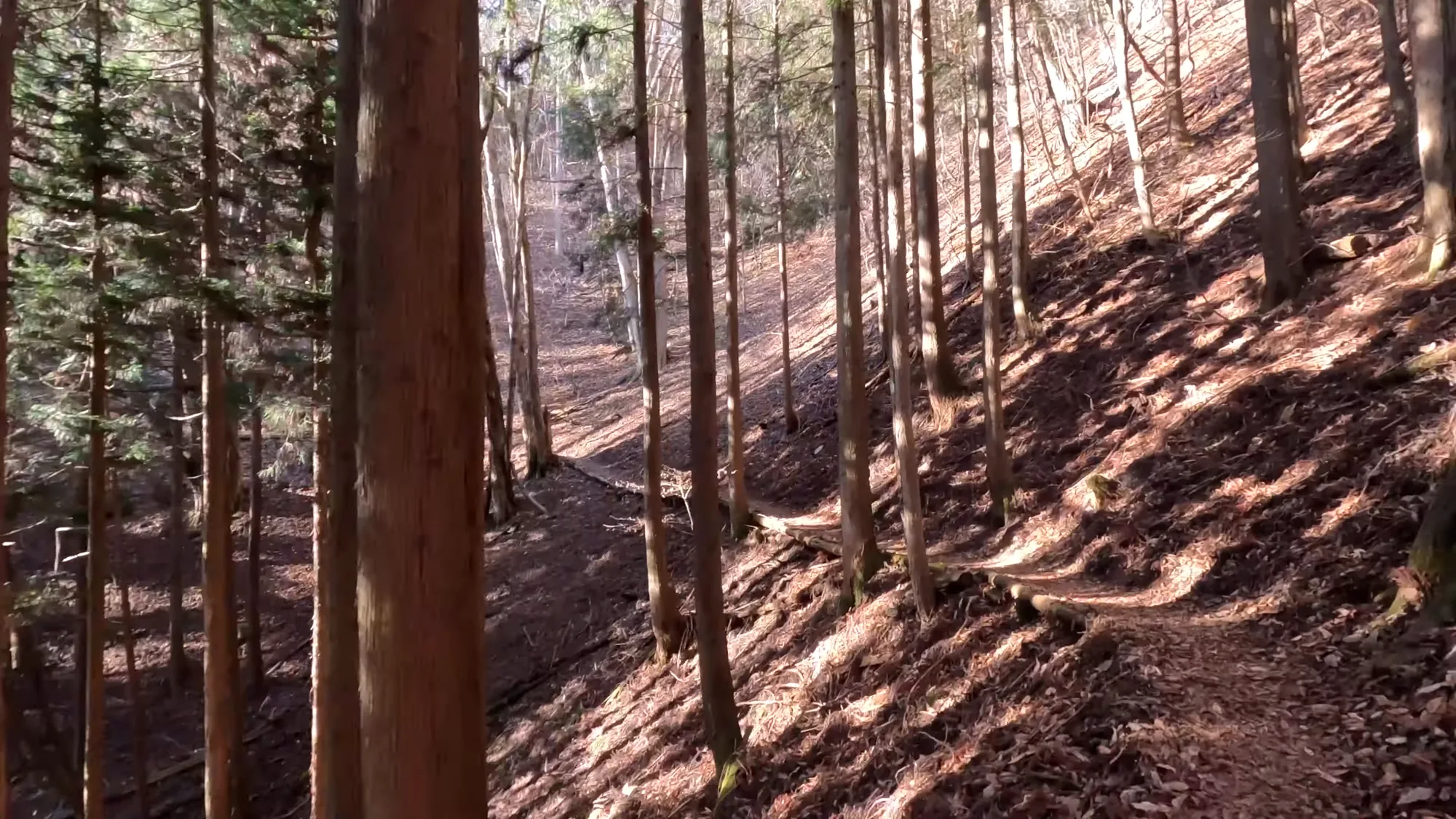
Low November light comes in sideways through the trunks.
The certified therapy road, incidentally, is not in the beech zone. The Way of the Great Falls is the gentlest path in the park, which means it is the low one.
The lunchbox, course by course
This is the only therapy bentō in the whole scheme that has been written out, and it deserves to be given whole, because the notes are as good as the dishes.
1. Hinohara potato with nobiru miso. The note: arranged from a way of eating particular to Hinohara village. Nobiru is a wild allium, a field garlic that grows on banks and verges and is gathered rather than farmed.
2. Pickled myōga, with daikon and yuzu miso. The note: please enjoy Hinohara’s specialty yuzu miso.
3. Duck loin with a yuzu jam sauce, and sashimi konnyaku. The note is the one that gives the whole thing away: the carefully raised duck was supplied directly from the farm, and we are told linoleic acid is very good for the body.
4. A tempura assortment of Hinohara maitake and medicinal-food ingredients: tea leaves, bamboo shoots, maitake and others.
5. Sprouted brown rice. The note: it seems that if you think about health, you arrive at brown rice.
6. Grilled bamboo shoot and spinach miso soup, in home-made miso.

After leaf-fall the slope opens up and you can see how the mountain is built.
Three things about that menu are worth saying.
It is a yakuzen meal, and it says so. Yakuzen is Japanese medicinal cuisine, the idea that ingredients are chosen for what they do rather than only for how they taste, and it is the culinary half of the tradition these forests belong to. A village certified for the measurable effect of walking in a forest has put a medicinal-food lunch in the middle of the day, and explained its choices in terms of the body.
And the explanations are charmingly unscientific, which is the honest part. We are told linoleic acid is very good for you. It seems that if you think about health you arrive at brown rice. Those are not claims. They are a village cook repeating what she has heard, in writing, with the hedge left in — which is more trustworthy than a nutrition table would be. Take them as the kitchen’s view of its own food, not as advice about your health.
And every single ingredient is local or gathered. Village potato, village yuzu, village maitake, wild allium, bamboo shoot, duck from a named farm, home-made miso. Nobody else in the scheme publishes a food supply chain, and Hinohara does it without appearing to notice.
A price, a station, and a hot spring at the end
Hinohara also publishes a complete day as an itinerary with a price attached, which hardly anybody else does, and it is unusually useful because it starts at a railway station.
A model day trip — ¥6,000–8,000 (about $40–53) per adult, for a group of around six.
Meet at Musashi-Itsukaichi station (武蔵五日市駅) → a guided walk in the Citizens’ Forest, the forest walked together with a guide → lunch → the Kazuma-no-yu hot spring, or back to Musashi-Itsukaichi, and done.
Musashi-Itsukaichi is a Tokyo station, which means you can assemble this day from a timetable rather than a car rental. That is rarer than it ought to be — forest after forest in the scheme publishes no access information whatsoever, including ones that answer yes to overseas visitors.

Steps you find by feel, under a fortnight of fallen leaves.
And the day ends with a choice between the station and a hot spring, which is the correct shape for any walk.
Kazuma-no-yu (檜原温泉センター数馬の湯) is the hot spring, in the Kazuma district, which is scattered with kabuto-zukuri (helmet-build) farmhouses, the steep gabled roof form of the mountain villages of eastern Japan.
The bathhouse is well equipped and the prices are published: a jacuzzi, a pressure-jet bath, an open-air medicinal-water bath, a pounding-stream bath, and a sauna; a relaxation room with massage chairs; and a large-hall dining room serving soba and kamameshi — plus a therapy menu from ¥1,500 (about $10), by reservation. 10:00–19:00, closed Mondays (the following day if Monday is a holiday), ¥1,100 adults and ¥600 children. 042-598-6789.
A therapy menu in a public bathhouse, bookable separately from the forest program, is a small piece of joined-up thinking nobody else in the scheme manages.
What else the village does
The remaining facilities are, taken together, the best picture anywhere in the scheme of what a mountain village actually has to offer when it stops talking about trees.
The village community center runs classes, and the list is specific: bread making, pan-roasted black tea, konnyaku, oyaki dumplings, miso, and Hinohara washi paper. 042-598-0069, 9:00–16:30, open every day except the New Year period.
The tea class is worth pausing on. Pan-roasted black tea is an unusual craft — Japan overwhelmingly makes green tea, and the few producers firing black tea in a pan rather than by machine are doing something close to historical reconstruction. A village that teaches it as a class is sitting on a better story than it knows.
The souvenirs are the same economy in jars: the village’s two headline products are potato and yuzu, and out of them come a potato shōchū called HINOHARA, in capitals, after the village, plus yuzu wine and yuzu jam, and alongside them mugwort-rice-cake oyaki, maitake, konnyaku and tofu. The village calls all of it the plain tastes of the worked countryside.

The ridge path is railed where the ground falls away, which is most of the way.
The village folk museum (檜原村郷土資料館) covers Jōmon to recent times, with history, folklore, nature and tourism sections, and it singles out the silk-rearing and folk-implement displays as the interesting ones, a way of imagining the life of the village. Free. 042-598-0880, 9:30–17:00, 10:00–16:00 from December to March, closed Tuesdays.
Silkworms and helmet-roofed houses may be the same fact twice. The kabuto-zukuri roof form is associated with silkworm rearing in the upper story, and a village museum whose best display is silk is telling you what paid for those houses. It is the Kanra and Saku pattern again: the forest therapy base sits on top of a dead industry — here silk, and charcoal, judging by the charcoal-burning hut in the park.
A frozen waterfall, and a hundred-meter rock wall
The last listed attractions are the ones to plan around, and the first of them is the reason to come in February.
Hossawa Falls (払沢の滝) is one of Japan’s hundred selected waterfalls, and the village says it is famous for its winter ice fall. A waterfall that freezes solid, inside the Tokyo metropolitan boundary.
Kanotoiwa (神戸岩) is a great rock wall about a hundred meters (330 ft) high. And the Akigawa gorge (秋川渓谷) is a noted place for autumn color.
So the village has, within its own boundaries: a 35-meter (115 ft) waterfall at the end of the certified therapy road, a second waterfall on the national hundred-list that freezes in winter, a hundred-meter (330 ft) rock face, and a gorge known for its maples. And it says nothing at all about which season to come in.
What you will have to ask for
For a village that publishes this much, the gaps are specific and a little odd.
No length, time or gradient for the one road: only that it is the gentlest in the park and surfaced in wood chip. No elevation for the road itself, though the park’s range is given. Nothing on the seasons, in a village with a famous frozen waterfall and a famous autumn gorge. No wildlife — one of the five zones is called the forest of wild birds and there is a bird observation hut inside it, and not one species is named. No price for anything except the model day and the bathhouse. And no email address: the tourism association gives only a phone number, and it is the same number as the community center.

A shelter near the top, built open on three sides, with a bench facing the valley.
The operator is the Hinohara Village Tourism Association on 042-598-0069, with the site at hinohara-kankou.jp.
The yes for barrier-free is better supported here than almost anywhere, because the road is the least steep in the park, wood-chipped from end to end, and described as reassuring by design. But wood chip is not a wheelchair surface in the way that concrete or boardwalk is — it compresses unevenly, it holds water, and it needs topping up. So the four questions go to 042-598-0069: the surfaced width, whether there is a step between the parking lot and the trailhead, how recently the wood chip was laid, and where the accessible toilet is.
And one more, specific to this base: whether the road is open in winter, because at 1,000 to 1,500 meters on a Tokyo mountain, it may well not be — and the page does not say.
Go in February, and order the lunch
Two recommendations, and they point at opposite ends of the year.
Go in February for the ice. Hossawa Falls frozen solid is a rare sight to have inside the Tokyo metropolitan boundary, and the village is reachable on a train whose name the base has published. Check first whether the therapy road itself is walkable at that season, because nobody has written it down.
Or go in autumn for the gorge, and book the lunch. ¥6,000 to ¥8,000 (about $40 to $53), six people, collected at Musashi-Itsukaichi, walked up the gentlest path in a 197-hectare (487-acre) park to a thirty-five-meter (115 ft) waterfall, fed a six-course medicinal-food meal of village potato and farm duck and sprouted brown rice, and dropped at a hot spring in a hamlet of silkworm houses.
That is a complete day, published with a price, inside Tokyo, and almost nobody knows it exists.
And when the bentō arrives, read the notes that come with it. We are told linoleic acid is very good for the body. It seems that if you think about health, you arrive at brown rice. Sixty-two certified forests in Japan, and exactly one of them talks to you like that.
Nearby and alike

Tokyo · Certified 2008
Okutama
The town with more giant trees than any in Japan is in Tokyo. Five certified roads, a thousand-year cypress, and a bath by the station.

Kanagawa · Certified 2007
Nanasawa (Atsugi)
A plantation forest the size of a city on the foot of Tanzawa, with four onsen districts beneath it, boar hotpot from October, and a coppice working party on the third Sunday.

Nagano · Certified 2006
Akasawa
Four hundred years of protection, the cypress that rebuilds Ise Shrine, Japan’s first recreation forest, and the 1982 gathering that gave forest bathing its name.
Verified by The Japan Onsen Society
Sources
森林セラピー「東京都 檜原都民の森」— https://fo-society.jp/facility/tokyo-hinohara/ (~大滝の路~; 檜原村; 認定 2007年3月; all four service fields 可; 東京都の最西端、東京に数少ない村にあるのが檜原都民の森。多摩三山の最高峰・三頭山の中腰、標高1000~1500mに広がり、197万㎡という広大な敷地をもつ; 5 zones 「出会いの森」「生活の森」「冒険の森」「野鳥の森」「ブナの森」, 拠点施設となる森林館, 木材工芸館, 炭焼き小屋, 野鳥観察小屋, 数多くの植物や野生生物が生息する; ロード数 1; いくつもの散策路があるが、セラピーロードに指定されているのが「大滝の路」。都民の森の中でも一番勾配が少なく、ウッドチップが敷き詰められた安心設計。途中にある展望台からの眺めもよく、終点には落差35mの三頭大滝が落ちている; ⭐⭐ セラピー弁当 有, with a SIX-COURSE MENU and a note per dish — 1. 檜原ジャガイモとのびる味噌(檜原村独特の食べ方をアレンジしました)2. みょうがの酢漬け、大根のゆず味噌添え(檜原特産の柚子味噌をご堪能ください)3. 合鴨ロースの柚子ジャムソースと刺身こんにゃく(大事に育て上げられた合鴨を農場から直接提供していただきました。リノール酸は身体に大変良いとのことです)4. 檜原舞茸と薬膳の天ぷら盛り合わせ(お茶の葉、竹の子、舞茸、他)5. 発芽玄米御飯(健康を考えれば玄米に行き着くのだそうです)6. 焼き竹の子とほうれんそうのお味噌汁(香ばしい焼き竹の子を自家製味噌でお楽しみください); conifers スギ・ヒノキ, broadleaf fields BLANK, notes 混交林; all four seasonal fields ー; ⭐ 日帰りコース(モデルプラン) 6,000円~8,000円 / 大人1名(6名前後のグループの場合)— 武蔵五日市駅 集合 → 都民の森 ガイドウォーク(森をガイドと一緒に歩きます)→ 昼食 → 檜原温泉センター数馬の湯 または 武蔵五日市駅 解散; 檜原村地域交流センター(教室メニュー)— パン教室・釜炒り紅茶教室・こんにゃく教室・おやき教室・みそ教室・檜ノ原和紙教室, 042-598-0069, 9:00~16:30, 無休(年末年始を除く); おみやげ — 特産品はジャガイモとユズが代表格, じゃがいも焼酎「HINOHARA」やゆずワイン、ゆずジャム, 草餅のおやきやマイタケ、コンニャク、豆腐, 里山の素朴な味; 檜原温泉センター数馬の湯 — 兜造りの民家が点在する数馬地区, ジャグジー風呂・圧注浴風呂・薬湯露天風呂・打たせ湯・サウナ, マッサージ機を備えたリラクゼーションルーム, そばや釜飯のほかセラピーメニュー1500円~(要予約)もそろう大広間の食事処, 042-598-6789, 10:00~19:00, 定休 月曜(祝日の場合は翌日), 1,100円(大人)・600円(小人); 檜原村郷土資料館 — 縄文から近年までの歩みを知る歴史と民族コーナー, 自然と観光コーナー, 村の暮らしを偲ぶ養蚕や民具の展示が興味深い, 042-598-0880, 9:30~17:00(12~3月は10:00~16:00), 定休 火曜, 入場無料; 払沢の滝 — 「日本の滝百選」の一つで、冬の氷瀑で有名; 神戸岩 — 高さ約100mの大岩壁; 秋川渓谷 — 紅葉の名所; contact 檜原村観光協会, 042-598-0069, email field EMPTY; official site https://hinohara-kankou.jp/)
森林セラピーソサエティ「森林セラピー基地 検索・一覧」— https://fo-society.jp/base-road_list/ (Hinohara = No. 14, 東京都, 檜原都民の森, all four columns ◯)
Verified: 2026-10-05