Kanagawa · Certified 2007
Nanasawa Forest Therapy Base: Fifteen Hundred Hectares, Four Hot Springs, and Lunch on What You Cut
A plantation forest the size of a city on the foot of Tanzawa, with four onsen districts beneath it, boar hotpot from October, and a coppice working party on the third Sunday.

Pampas grass on an open slope with the forested Tanzawa foothills beyond at Nanasawa, Kanagawa
Step-free
Unverified
Answered yes, no width or gradient published
The main road
Hakusan Junrei Pass
白山順礼峠ハイキングコース · three thousand cherries
Open
Year-round
Colour from late November
The record
What you need to go
Open season
Not published for the roads. The hub park has cherry in April, rhododendron in May, hydrangea in June and July, and color from late November
Getting there
No station or fare published. The base is 46 km (29 mi) from Tokyo and 32 km (20 mi) from Yokohama, about 8 km (5 mi) from central Atsugi
Fees
The coppice session on the third Sunday is ¥300 (about $2), 10:30 to 15:00, canceled in rain. No therapy or guide price is published
Onsen
Four districts. Higashi-Tanzawa Nanasawa has seven inns on alkaline water, with wild boar hotpot from October to March. Iiyama has four more
The walk
Main trail
The Hakusan Junrei Pass course (白山順礼峠ハイキングコース), up a protected hillside of three thousand cherry trees to a temple founded in 725
All trails
3 trails, none of them named or measured, across about 1,500 ha (3,700 acres)
The step-free road
All four service questions are answered yes, and the hub is a prefectural urban park, but no path width, gradient or surface is published
The forest
Forest type
About 1,500 ha (3,700 acres) of planted conifer on the eastern foot of Tanzawa, with a 64 ha (159 acre) coppice park at its heart
What grows
Cedar · Hinoki cypress, and nothing else listed. The roads run through planted forest, while the hub park is coppice woodland
What lives
not published
Certified since
2007
All figures updated 5 October 2026
The forest, before the facts
On the third Sunday of every month, between half past ten and three, a group of people go into the coppice at Nanasawa, cut and tend it, and then cook lunch over the firewood that comes out. It costs three hundred yen, about two dollars. It is canceled if it rains.
The park calls it the “food” satoyama conservation session (「食」の里山保全活動), and it is as honest a description of a Japanese worked woodland as you will find anywhere. A coppice needs cutting to stay a coppice. Cutting produces firewood. Firewood cooks lunch. Lunch is why people come and do the cutting. The whole cycle closes inside one Sunday, for the price of a coffee.
The forest it closes in is enormous. The Society gives this base as 15 million square meters — about 1,500 hectares (3,700 acres), on the eastern foot of the Tanzawa-Ōyama range, holding three certified therapy roads and a web of hiking courses that connect them. It is 46 km (29 mi) from Tokyo and 32 km (20 mi) from Yokohama, and about eight kilometers (five miles) from the middle of Atsugi city.
And beneath it, in a ring, are four hot spring districts. The Society says so in its own summary: this is an ideal place to enjoy hot springs and forest therapy together.
Come between October and March, when the boar hotpot is on.
Five reasons to come
Four hot spring districts under one forest, an hour from Tokyo.
Coppice maintenance on the third Sunday, with lunch cooked on what you cut.
Three thousand cherry trees on a protected hillside behind a temple from 725.
Wild boar hotpot from October to March, in alkaline water famous for skin.

Planted cedar on the valley sides, with broadleaf coming up underneath wherever it is thinned.
Fifteen hundred hectares of certified base, with hiking courses threaded through it.
The scale, and the honest word for it
Atsugi (厚木市) sits in the middle of Kanagawa, and its forest therapy base was certified in March 2007 — one of the early cohort. It answers yes to all four of the Society’s service questions.
The figures are the thing. The base covers 1,500 ha (3,700 acres). It sits in the eastern foothills of Tanzawa-Ōyama Quasi-National Park (丹沢大山国定公園), inside the prefectural Tanzawa-Ōyama Nature Park (丹沢大山自然公園), and the Society describes what opens out within it as peaceful worked countryside. Three certified roads, plus numerous hiking courses, plus connecting routes between them.
And then the Society does something unusual, which is to tell you plainly what the trees are without dressing it up. The conifers are cedar and cypress. No broadleaf species is listed at all. The notes field contains a single word:
Planted forest.
人工林
That is the whole description. A base of fifteen hundred hectares, certified nationally for its health effects, and the only characterization of its vegetation the Society offers is the two characters for a plantation.
That plainness is worth more than a page of adjectives. Most of Japan’s forest is planted; the great postwar cedar and cypress program covers something close to half the country’s woodland. A certified base that says so in one word is being straighter than one that implies primary forest. But a reader should know what they are walking into: this is a worked conifer plantation on a quasi-national park’s foothills, not an old wood.

The fall at the head of the valley, running hard after rain.
All four of the Society’s seasonal fields are blank, so there is no official word on when this forest is at its best.
The park at the middle of it
What makes the base usable is not the plantation. It is Nanasawa Forest Park (県立七沢森林公園) at its heart, 644,000 m², about 64.4 ha (159 acres), which the Society calls the largest urban park in Kanagawa prefecture, and which is the base’s hub facility.
And the park is a different kind of ground from the certified roads. Its vegetation is coppice woodland: the oak-and-mixed secondary forest that Japanese villages cut on rotation for fuel and charcoal, spread across broken terrain. That distinction, plantation on the roads, coppice in the park, is the most useful thing to know before you come, and the Society does not point it out. If you want the species, the flowers and the light, you want the park. If you want distance, you want the roads.
The park’s own calendar is published: cherry in April, rhododendron in May, hydrangea in June and July, autumn color from late November into early December. In December a Christmas wreath seven meters (23 ft) in diameter is hung in it, which tells you who actually uses this park: families from the surrounding towns.
The built things are good: the forest studio (森のアトリエ) for pottery and woodwork; the folk-tale hall (森の民話館), with old household implements and storytelling; an athletics ground; barbecue ground. The management office is on 046-247-9870.
What it is like to walk in a plantation, and why that is not a complaint
Since the Society has told us this is a planted forest and nothing else, it is worth saying what that means on the ground, because if you have never walked in one there is no reference for it, and the honest account is more interesting than an apology.
A Japanese cedar or cypress plantation is planted dense and thinned repeatedly over a rotation of fifty to a hundred years. What you walk into is a colonnade: straight trunks at regular intervals, a canopy closed high above, very little light reaching the floor, and therefore very little understory. It is quiet in a particular way, because there is less structure for birds. The ground is needle litter, soft and acidic. The air smells strongly of the resin the species are grown for.
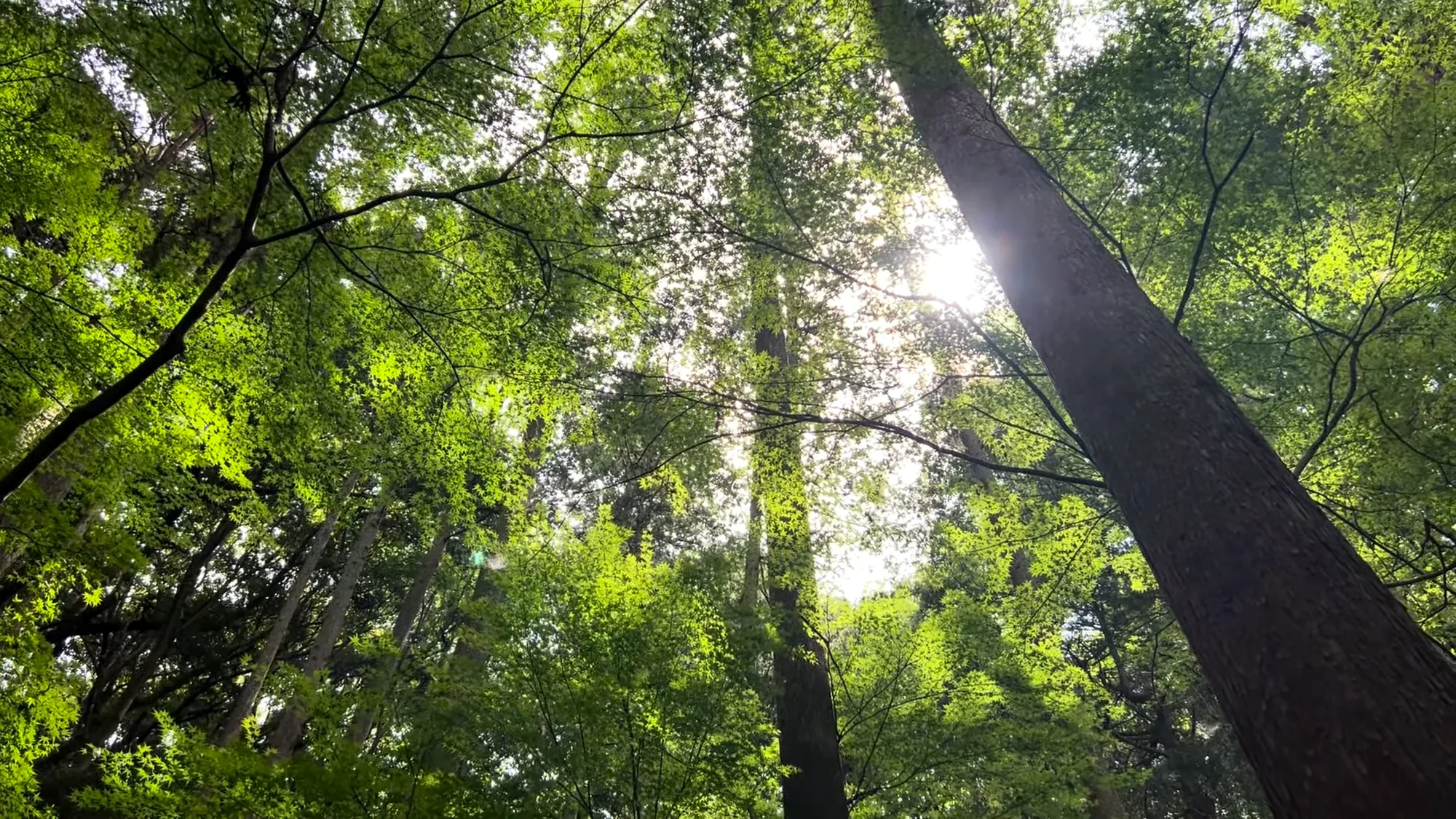
Early May, about ten days after the leaves came out.
It is not a biodiverse forest and nobody should claim it is. But it is, specifically and measurably, a forest high in the volatile compounds that forest therapy research is actually about. Conifers are the strongest emitters of the terpenes that the Japanese literature calls phytoncides, and a dense cedar stand on a warm still morning is about as concentrated a dose of them as the country offers. Takashima in Shiga brews you a tea from one of those compounds to demonstrate the point. Atsugi just has fifteen hundred hectares of the trees that make them.
So the honest framing of Nanasawa is this. The roads give you the chemistry and the scale. The park gives you the species and the light. They are twenty minutes apart and the base contains both, and a visitor who understands the difference will plan a far better day than one who expects ancient forest and finds a plantation.
The reason the plantation is there at all is the same reason it is everywhere in Japan: a vast national afforestation program after the war, planting cedar and cypress on cutover hillsides for a timber market that then collapsed under cheap imports. Much of it has never been economically thinned. The country is now full of dense, dark, underworked conifer stands — and a certified therapy base on one of them is, among other things, somebody finding a use for ground that stopped paying for itself decades ago.
Four hot springs and a boar
There is a great deal of hot water here, and it comes in two clusters.
The Higashi-Tanzawa Nanasawa hot spring district (東丹沢七沢温泉郷) is the near one, and it is a composite: Nanasawa Onsen (七沢温泉) with five inns, plus the single-inn Kōtakuji Onsen (広沢寺温泉) and the single-inn Kabutoyu Onsen (かぶと湯温泉). The water is alkaline, which in Japan means smooth on the skin, and the Society gives it the standard accolade: beauty water. And then the seasonal note that makes this base worth timing: the specialty is wild boar hotpot (猪鍋), available October to March.
The Iiyama hot spring district (飯山温泉郷) sits to the northeast with four inns, also alkaline. Its specialties are sweetfish (鮎) and pond snails (タニシ) — which is a genuinely old-fashioned river-and-paddy menu that has largely disappeared from Japanese restaurants and survives in places like this.
So the shape of a visit assembles itself without anybody having to suggest it. Walk in the morning on a plantation road or through the coppice park. Be in alkaline water by mid-afternoon. Eat boar, or sweetfish, depending on the month.

Looking up through the evergreens, which hold their leaves when nothing else does.
The town’s other food claim is worth repeating because of how specific it is: shirokoro horumon (シロコロホルモン), pork large intestine, grilled over a net and eaten with garlic miso, which won the Gold Grand Prix at the 2008 B-1 Grand Prix, Japan’s competition for regional cheap eats. It is sold in restaurants, to take away, and as a packet snack.
What alkaline water actually does, since four districts of it are the point
Both spring clusters here are described the same way, as an alkaline spring and beauty water, and since the water is half of what this base is selling, the mechanism is worth stating once.
High-pH water saponifies the sebum on the surface of the skin. That is a real chemical reaction and not a metaphor: the alkalinity converts surface oils into a soap-like compound, which is why the water feels slippery in the bath and why you come out feeling scoured rather than merely warm. It also softens the outermost layer of dead skin, which is where the smoothness afterward comes from. Beauty water is marketing language attached to a genuine physical effect, and the effect is a cleaning one rather than a nourishing one.
Which has a practical consequence nobody prints on the signs. A long soak in strongly alkaline water strips more surface oil than most people’s skin replaces quickly, so the standard advice is a shorter immersion than you would take in a neutral or acidic spring, and something on your skin afterward. Four districts of it in one valley is a lot of alkalinity within driving distance, and the sensible plan is one good bath rather than a circuit of three.
The pairing with boar is not incidental either. Wild boar is hunted in Japan through the cold months, and October to March is the season in which the animal carries enough fat to be worth stewing. A hotpot of it with miso, in a mountain inn, at the end of a cold walk, is a genuinely old piece of Japanese country eating that has survived here because the boar are still in the hills above the base. The forest, the hunt and the bath are the same economy, and the inns in this valley have been running it for a very long time.
The temple from 725, and the hill of cherries
One of the certified roads is the 白山順礼峠ハイキングコース, and what it runs through is Iiyama Hakusan Forest Park (飯山白山森林公園) — 330,000 m², about 33 ha (82 acres), of which the Society says almost all is protected forest, designated for its watershed or erosion-control function.
What it is famous for is three thousand cherry trees. There is also a small animal enclosure with monkeys, rabbits and birds.

The valley floor stays damp enough that nothing bare lasts long.
And the park wraps around Chōkokuji (長谷寺), known locally as Iiyama Kannon (飯山観音), whose dates the Society gives with real precision:
Founded in 725 — by the monk Gyōki, the great temple-building, bridge-building, well-digging monk of the Nara period who was eventually made head of the entire Buddhist establishment.
Rebuilt between 1190 and 1199, by Minamoto no Yoritomo, the founder of the Kamakura shogunate, whose capital was thirty kilometers (19 mi) from here.
The sixth station of the Bandō Thirty-Three Kannon pilgrimage (坂東三十三カ所), the thirty-three-temple Kannon pilgrimage of eastern Japan.
Its Kannon hall holds an eleven-headed Kannon, credited with efficacy for the binding of relationships.
A certified forest therapy road that climbs a protected hillside of three thousand cherry trees to a temple founded in 725 and rebuilt by the first shogun is, by any measure, a good walk. And it is one more certified road laid along somebody else’s older route — after Kōyasan’s pilgrim roads, Mizukami’s shrine approach and Kanra’s quarry track. The pattern is hard to miss.
What is not published, and it is a lot
For a base this large and this old, the gaps are serious and should be stated plainly.
No road is named. The Society records three and names none of them, although the 白山順礼峠 course is identified in passing as one. No length, time, gradient or surface is published for any. No elevation. All four seasonal fields are blank. No price. No fauna beyond the monkeys and rabbits in the small animal enclosure, which do not count. No access information: no station, no journey time, no fare, on a base whose chief selling point is that it is 46 km from Tokyo.

The clearing where the trails meet, mown once a year and no more.
What exists is the city’s own tourism page, and that is where all of it presumably lives. Open it before planning.
The base answers yes on barrier-free access, and with a prefectural urban park as the hub that is more plausible here than at most. But a yes remains a statement about a base rather than a measurement of a path, and the four questions go to the Atsugi commerce and tourism division (厚木市 商業観光課) on 046-225-2820: the surfaced width of the easiest route in the park, a step at the trailhead, the surface from the parking lot, and the accessible toilets.
The third Sunday
Go back to where this started, because it is the thing worth traveling for.
Every third Sunday, 10:30 a.m. to 3 p.m., ¥300 (about $2), canceled in rain. You go into the coppice at the prefectural park, you help tend it, and you cook and eat outdoors using the wood that came out of the work. The park’s name for it puts “food” in quotation marks at the front, as if slightly embarrassed to be leading with lunch.
It should lead with lunch. A satoyama is not a nature reserve and was never meant to be looked at. It is a system that only exists while people take things out of it on a schedule: firewood, charcoal, leaf litter, mushrooms, poles. The biodiversity everyone now admires is a side effect of that constant moderate disturbance. Stop the cutting and it closes over into something darker and poorer. Which is what has happened to most of Japan’s satoyama since the fuel changed.
So a monthly working party that cuts the coppice and then eats over the output is not an activity bolted onto a forest therapy base. It is the forest therapy base’s actual maintenance regime, opened to the public, with the fire at the end as the fee. Three hundred yen, third Sunday, bring a coat.
Walk the plantation roads if you want the distance and the quasi-national park scenery. But if you want to understand what a Japanese forest is and why anyone thinks walking slowly in one is good for you, go on the third Sunday, pick up a saw, and stay for lunch. Then drive ten minutes and get into the boar hotpot and the beauty water, which have been the reward for a day’s work on this hillside for a very long time.
Nearby and alike

Kanagawa · Certified 2020
Hadano
Five roads on the near face of Tanzawa, an hour from Tokyo, with the most complete commercial terms in Japan’s certified forests — and no description of the forest at all.

Kanagawa · Certified 2011
Yamakita
Ninety percent mountain, eighty kilometers from Tokyo, with every road published to the minute — and a cedar the program tells you to touch rather than photograph.

Saitama · Certified 2019
Kitamoto
The nearest certified forest to the capital, on flat ground, where the shortest road takes fifteen minutes to walk and the session built on it runs two hours.

Forest Bathing in Japan
Japan named forest bathing in 1982, then measured it. The practice, the places, and what the studies show.

Forest and Onsen
Two old Japanese ways of resting the body meet in the Kiso valley. Cypress air, hot water, and what is known.

Choosing a Base
Eight forests, from Kusatsu to Yakushima. Which fits your days, your season and the onsen waiting after.