
Forested slopes and a wooded island mirrored in the still water of a reservoir at Yamakita, Kanagawa
Step-free
Partly step-free
A short course from the health centre
The main road
Hōkisugi and Ōtaki
2.5 km (1.6 mi) · three to four hours
Open
Year-round
Colour around the falls in autumn
Nearest station
Yamakita
JR Gotemba Line, a short walk to the start
The record
What you need to go
Open season
Cherry around the railway park in spring, cool wind at Shasui falls in summer, color around the falls in autumn, the Ashigara plain visible from the bare castle site
Getting there
No station or fare published. The Society puts the town 80 km (50 mi) west of Tokyo
Fees
Not published. A forest hospitality bentō is offered, devised for promoting health and preventing illness, with no price given
Onsen
Buna no Yu (ぶなの湯) at Nakagawa Onsen, alkaline and called a hidden spring of Takeda Shingen. Sakura no Yu at the health center is an artificial mineral bath
The walk
Main trail
The Hōkisugi and Ōtaki course, 2.5 km (1.6 mi) over three to four hours, with hammocks slung between the cedars and the old tree at its heart
All trails
5 trails, 2.5 to 6 km (1.6 to 3.7 mi), each one published with a walking time, from two to five hours
The step-free road
Barrier-free is marked no, yet a short course from the health center to the castle site is described as one anyone can walk easily, and three roads start at that center
The forest
Forest type
A town of 224.61 km² (86.7 sq mi), ninety percent of it mountain land inside a quasi-national park and prefectural nature parks
What grows
Cedar · Hinoki cypress · Kunugi oak · Konara oak · Zelkova, with a cherry avenue, mandarin orchards and kerria and fringed iris beneath
What lives
Char swimming at your feet in the Nishizawa gorge, and birdsong. Nothing else is named
Certified since
2011
All figures updated 5 October 2026
The forest, before the facts
There is a cedar in this town that was already a thousand years old when the Mongols tried to invade, and the forest therapy program’s instruction for it is to touch it.
Hōkisugi (箒杉), the broom cedar, named for the shape of its crown, is given by the town at an estimated two thousand years, which makes it older than anything else on these pages by a margin of a millennium. And the published session on the road it stands beside does not say view or photograph. It says you will experience it by touch and by sight, in that order.
That is the register of Yamakita, and it is unusually precise throughout. Five certified roads, every one of them published with a distance and a walking time, which no other base in Japan manages. Five programs, each written out as a sequence of things you will actually do: the scent of mandarin leaves, lying down at a castle ruin, seated observation of Mount Fuji from a tea field, hammocks strung between cedars, the sound of a stream.
The town is eighty kilometers (fifty miles) west of Tokyo and ninety percent mountain. Somewhere in it, a stream runs with char at your feet up to a waterfall that falls sixty meters (197 ft). And the whole operation is run by the town’s health insurance section.
Five reasons to come
A cedar the town estimates at two thousand years old, which you are told to touch.
Five roads, every one published with its distance and its walking time.
A waterfall on both the hundred-waterfalls list and the hundred-famous-waters list.
Hammocks, seated observation and lying down, written into every program.
A steam locomotive that runs on compressed air, the only moving one in Japan.

Shasui Falls, 69 meters, and the red bridge that has been the view of it for a century.
A town that is ninety percent mountain
Yamakita (山北町) sits at the western edge of Kanagawa, 80 km (50 mi) west of Tokyo, in the deep green of the Tanzawa range. The Society gives its area as 224.61 km² (86.7 sq mi), of which 90 percent is mountain land inside the Tanzawa-Ōyama Quasi-National Park and the prefectural nature parks.
What that produces, in the Society’s own list: magnificent mountains, a beautiful lake, the view of Fuji, and the clear rush of rivers coming down out of Tanzawa — close to the capital region and still holding this much nature, with old hot springs and local history besides.
It was certified in April 2011, and it is marked yes for corporate training and children, no for barrier-free and for overseas visitors.
The tree list is ordinary (cedar and cypress above, kunugi and konara oak and zelkova below) until the Society’s list of notable trees, which names a cherry avenue and then, unexpectedly, mandarin orchards. Yamakita is far enough south and sheltered enough to grow citrus on its lower slopes, and as will become clear, that fact has been written into one of the walks. The understory is yamabuki (kerria) and shaga (fringed iris), which are the plants of a damp shaded edge.
Five roads, all measured
Yamakita is the only base to publish both a distance and a time for every certified road, and the spread between them is the useful part.
The Kawamura castle site and Shasui Falls course (河村城跡・洒水の滝コース) — 6.0 km (3.7 mi), 4.0–5.0 hours. The long one. From the town’s health and welfare center, up to the Kawamura castle site (河村城跡), a prefecturally designated historic site, and on to Shasui Falls (洒水の滝). That waterfall holds two national listings at once: the hundred waterfalls of Japan, and the hundred famous waters — which is a rarer double than it sounds, because one list is about the fall and the other is about the water. From the top of the castle site you see the town and the whole Ashigara plain.

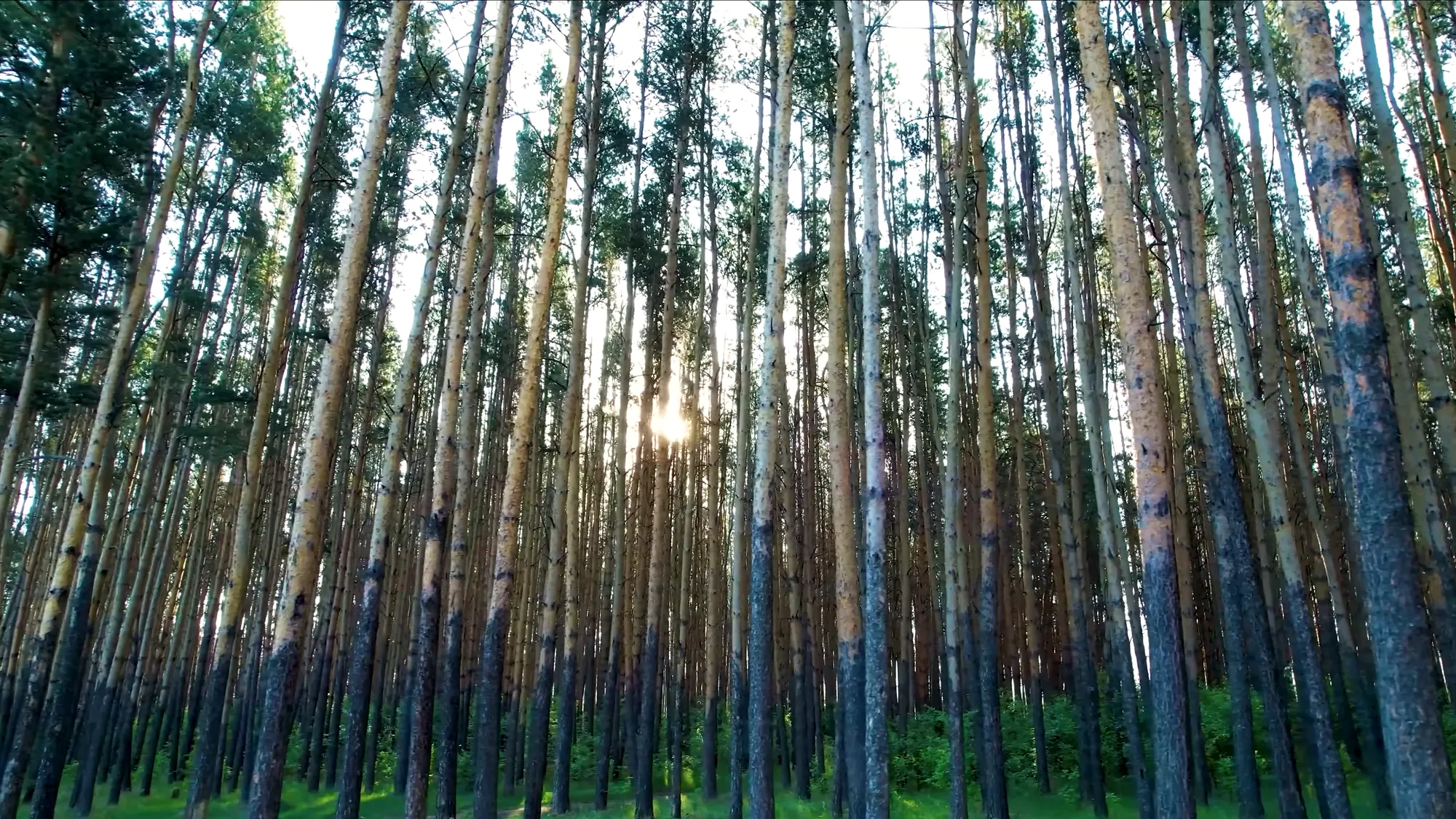
Late light through a thinned stand, which is the only time the floor gets any.
And the Society adds the sentence that matters most on this page: a short course is also laid out, from the health center round to the castle site, which anyone can walk easily. On a base marked no for barrier-free, that is an easy option buried inside a long listing. Ask about it.
The Nishi-Tanzawa and Nishizawa course (西丹沢・西沢コース) — 4.2 km (2.6 mi), 4.0–5.0 hours. Up the Nishizawa gorge to two waterfalls: Shitadana Falls (下棚の滝), a 40 m (131 ft) drop, and Hondana Falls (本棚の滝), 60 m (197 ft). The Society marks this one for the fit. Four and a bit kilometers in four to five hours is a gorge, not a path.
The Tsubura Park course (つぶらの公園コース) — 3.0 km (1.9 mi), 2.0–2.5 hours. In the prefectural park on the mid-slope of Mount Ōno (大野山). Fuji from the viewing plaza is magnificent, and there are hammocks among the trees.
The Lake Tanzawa and dam plaza course (丹沢湖・ダム広場コース) — 2.5 km (1.6 mi), 2.3–3.0 hours. Around the lake and the dam plaza.
The Hōkisugi and Ōtaki course (箒杉・大滝コース) — 2.5 km (1.6 mi), 3.0–4.0 hours. The cedar, and the Ōtaki stream.
Note the arithmetic on those last two. Two and a half kilometers in three to four hours is under a kilometer (0.6 mi) an hour — the same deliberate crawl that Okukuji in Ibaraki publishes. These are not walks with stops in them. They are stops with walking in between.
A waterfall on two national lists at once
Shasui Falls is worth stopping on, because holding both designations is rarer than holding either.

Old coppice, cut and recut until the trunks gave up growing straight.
The hundred waterfalls of Japan is a selection made in the 1990s, judged on the fall itself — height, volume, setting, how it looks. The hundred famous waters is an environment ministry selection judged on something else entirely: the quality of the water, the condition of the environment producing it, and whether local people are actively conserving it. One list is about the spectacle; the other is about the catchment and the community.
A fall that appears on both is telling you that the water arriving over the lip is as good as the drop is impressive — which, on the southern face of a mountain block that supplies a large part of Kanagawa’s drinking water, it ought to be. The Society’s seasonal note for summer at this base is simply the cool wind at Shasui-no-taki and the stream below it, and for autumn, the color around it. Two of the four seasons here are organized around one waterfall.
The Society also attaches the familiar negative-ion claim to it — that you can bathe in negative ions there. That is the Society’s claim, not ours: negative-ion health effects are not part of the evidence base forest therapy rests on, which is built on volatile terpenes, heart-rate variability and stress-hormone measures. What is true, and is the better reason to stand there, is that the air below a waterfall is cold, wet, loud and moving, and that twenty minutes of it does something a view does not.
What each walk actually consists of
Yamakita publishes a program for every road, and together they are the most detailed account of what forest therapy actually involves anywhere on these pages, after Oguni’s timetables.
On the castle and waterfall road, you start at the health center and begin with the scent of mandarin leaves, and forest rest. Then the castle site, with an explanation of it, and forest rest, lying down. Then the satoyama landscape, then the falls, where what you are there for is the sound of the stream.
On the Nishizawa gorge road, you start at the visitor center and walk for the stream sound, the dappled light and the scent of the trees. Lunch, and then the two waterfalls.
On the Tsubura park road, the practice is seated observation of Fuji and the tea fields, then hammock forest rest among the trees, and sometimes tea-picking.
Bamboo grows a meter a day in May, then stops for the rest of its life.
On the lake and dam road, it is hammocks, seated observation and lying down on the grass, for the sway of the trees, their scent, and birdsong.
And on the Hōkisugi road: hammocks slung between the cedars, the sound of the Ōtaki stream, dappled light, cool air — and the two-thousand-year tree, by touch and sight.
Read those five together and a method emerges that no single page states outright. Every one of them includes lying down. Four of the five include hammocks. Three name seated observation as a distinct activity. The walking is the connective tissue; the practice is being still in a specific place, with a specific sense nominated in advance — scent here, sound there, touch at the old tree.
The therapy lunchbox has its own name: the forest hospitality bentō (森林のおもてなし弁当), devised explicitly for promoting physical and mental health and preventing illness, so that visitors take the therapy in from the inside as well. That is the town’s intention for the lunchbox, not a medical claim.
Two thousand years
The Society gives Hōkisugi as an estimated two thousand years. That is the town’s estimate, and it is worth being honest about what such a figure means.
Ages of very old Japanese cedars are estimated rather than counted, because you cannot ring-count a living tree without coring it and the oldest specimens are frequently hollow. Published ages for famous cedars are traditional, generous, and not independently verified. Two thousand years is at the extreme end even by those standards. What is not in doubt is that it is enormous and very old, that it has a name, and that the town has built a certified therapy road to it.

The stream below the falls, which never stops being loud.
The instruction is the best of it. Touch it. Not a viewing platform, not a rope barrier at four meters (13 ft), not a sign about preservation. The published program says you will experience the tree by touch and by sight, and puts touch first.
The water, and the lake, and the artificial spring from Hokkaidō
Two baths serve this base and one of them is a genuine curiosity.
Buna no Yu (町立中川温泉ぶなの湯) is the real one: a municipal day-use bath at Nakagawa Onsen (中川温泉), which the Society says is called a hidden spring of Takeda Shingen — the sixteenth-century warlord whose territories are full of springs claimed as his secret convalescent baths, a genre of attribution that is charming and rarely documented. The water is alkaline simple, and the town credits it with easing stomach and intestinal complaints and helping cuts heal — the town’s claim, not a medical finding. It is positioned as the recovery after a walk or a climb around Lake Tanzawa.
Sakura no Yu (さくらの湯), inside the health and welfare center where three of the five roads start, is the odd one. It is an artificial carbonate-calcium hot spring, made using 100 percent limestone sinter ore brought from Futamata Radium Onsen (二股ラジウム温泉) in Oshamanbe, Hokkaidō — a famous travertine spring a thousand kilometers (620 mi) north. The facility has a large bath, an open-air bath, a sauna, and an exercise pool measuring 15 m × 7 m (49 × 23 ft).
That is a town that wanted a mineral bath where its therapy roads start and, not having one, imported the mineral. That is more interesting than a natural spring would have been, and it is exactly the sort of thing a health insurance section does.
The locomotive that runs on air
Beside the health center is the Yamakita railway park (山北鉄道公園), and in it a D52 steam locomotive that worked the old Gotemba line — the main line west out of Tokyo before the Tanna tunnel moved the route.
It has been preserved in an unusual way: it runs on compressed air, and the town states that it is the only D52 in Japan that moves. Not steamed, since steaming a preserved locomotive is a major undertaking, but driven on air, which gets the rods turning and the wheels rolling without a fire.

You hear it from the car park and see it twenty minutes later.
The town also keeps a railway museum by the station with material from the national railway era. And the spring entry in the seasonal list is the cherry avenue around the railway park, together with the new green at the castle ruin.
So the first thing you see at this base, before any forest, is a preserved locomotive turning its wheels on compressed air under cherry trees. Yamakita is a railway town that became a forest therapy base, and it has not pretended otherwise.
Lake Tanzawa (丹沢湖) has its own identity too: the town promotes itself as a canoe town, runs a canoe marathon on the lake, and allows canoes and stand-up paddleboards brought in by visitors.
The health section, and what it tells you
The contact for this base is the town’s health insurance section (山北町 保険健康課), inside the health and welfare center, on 0465-75-0822. The health insurance section.
Not tourism. Not industry. Not a forestry cooperative, an NPO or a board of education. The department that administers the town’s health insurance is the department that runs the certified forest, and once you notice it, the whole place reorganizes around that fact.
Three of the five roads start at the health and welfare center. The bath and the exercise pool are in the same building. The lunchbox is justified in the language of disease prevention. The programs are built around lying down, seated observation and specified sensory attention rather than distance covered.

The spring itself, which people still come with bottles for.
This is a municipality treating forest walking as a preventive health service it provides to residents, which happens to be certified nationally and happens to be open to visitors. Of all the ways these bases are run, it is arguably the model closest to what forest therapy was invented to be.
Getting there, and the honest caveats
No station, journey time, bus route or fare is published. Yamakita is in far western Kanagawa, eighty kilometers (fifty miles) from Tokyo by the Society’s own figure.
Two caveats before you go.
It is marked no for overseas visitors. A program built on spoken explanation at a castle ruin and nominated sensory attention is not going to survive without Japanese, and the town has said so. Write ahead.
And no for barrier-free — on a base where one of the five roads carries a short option the Society itself says anyone can walk easily, and where three roads start inside a health and welfare center with an accessible pool. That combination does not add up. Four questions go to the health section: the surfaced width of the short castle course, whether there is a step at the trailhead, the surface from the parking lot, and the toilets at the center.
The guide message is signed not with a name but with a title, the forest hospitality guide leader, and what it chooses to tell you about is a full-width view of Fuji, the cool air coming off the face of a rockfill dam, and char swimming at your feet in the gorge on the way to a sixty-meter (197 ft) waterfall. The guides, it says, work so that the visitor’s five senses and nature can synchronize.
Go in late autumn for the castle ruin and the plain spread out below it. Or go to the cedar, and do what the program tells you, which is put your hand on something that has been standing there since before anyone in Japan was writing anything down.
Nearby and alike

Kanagawa · Certified 2020
Hadano
Five roads on the near face of Tanzawa, an hour from Tokyo, with the most complete commercial terms in Japan’s certified forests — and no description of the forest at all.

Kanagawa · Certified 2007
Nanasawa (Atsugi)
A plantation forest the size of a city on the foot of Tanzawa, with four onsen districts beneath it, boar hotpot from October, and a coppice working party on the third Sunday.

Gunma · Certified 2006
Uenomura
Twelve and a half kilometers along a headwater of the cleanest river in the Kantō, in a village that is 96 percent forest — with vehicle restrictions and a cap on entry.

Forest Bathing in Japan
Japan named forest bathing in 1982, then measured it. The practice, the places, and what the studies show.

The Walk
A measured forest walk is about thirty minutes and no destination. Here it is, sense by sense, step by step.

Choosing a Base
Eight forests, from Kusatsu to Yakushima. Which fits your days, your season and the onsen waiting after.