
Open trail. Fresh air. One step at a time
First, the smell
In Kiso the smell reaches you before the trees do. You step out of the car at Akasawa and it is already there, a sharp green sweetness coming off three hundred years of cypress, and the first thing that happens is involuntary: you breathe in deeper than you meant to. Nobody instructed you. You have already started.
That is the whole practice, and everything below is a way of making it last longer than four seconds.
What follows is a method, not a doctrine. Eight steps, about sixty-five minutes, built from what the Japanese experiments actually measured and from the way certified guides in Japan structure a walk. It is ours. The Forest Therapy Society publishes its own guidance and it is more generous with time; where the two differ, that is said plainly.
Nothing here requires a certificate, a guide, or a Japanese tree.
Before the steps: the five senses
Japanese practice names the senses — 五感 (gokan, the five senses) — and certified guides organise a walk around them. It is a frame, and a good one. The Forestry Agency’s own one-line description of forest bathing is taking in the forest through the five senses and letting body and mind loosen. The 2025 Tokyo trial had its guides instruct both the forest group and the city group to attend to what they could see, hear and smell.
The frame is simple. Smell first, because in cypress country it arrives before the trees do. Then sight, sound, the walk, touch, the sit, and taste.
What the measured version actually was
Half an hour. That is the dose.
In the Japanese field experiments a session ran about fifteen minutes of sitting and looking, then about fifteen minutes of walking, on a wide path. There is no evidence that more is better, and none that less is useless.
STUDY Park, Tsunetsugu, Kasetani, Kagawa, Miyazaki (2010)
SAMPLE 280 male university students, 24 forests
DESIGN Randomised crossover against a city site
LIMITATION Every subject a young Japanese man. The authors say so themselves.

There is also evidence that not everyone responds the same way.
STUDY Kobayashi and colleagues (2018), pooling the field programme
SAMPLE 485 men, 57 paired forest and city sites
DESIGN Counterbalanced crossover, roughly fifteen minutes’ walking at each
LIMITATION Every subject a young Japanese man. 65.2 percent showed higher
parasympathetic activity in the forest — which means about a third did not.
A walk is not a switch. About one person in three got no measurable shift at all, and there is no way to know in advance which one you are. Go anyway. The reason to walk in a forest was never the number.
The Society’s own how-to page is more generous than the experiments were. It gives a full day as about four hours and 5 km (3.1 mi), a half day as about two hours and 2.5 km (1.6 mi), says the time should not be watched, and recommends two nights and three days for anyone interested in the immune measures — the length of the Nippon Medical School trips. It tells a visitor to rest when tired, drink when thirsty, find a view and stay with it, and sharpen the five senses.
Those are the Society’s words. What follows is a shorter version of them, because most people will not sit as long as the studies had them sit.
The eight steps
1. Arrive and stop — 5 minutes
Do not start walking. This is the step everybody skips and it is the one that makes the rest work.
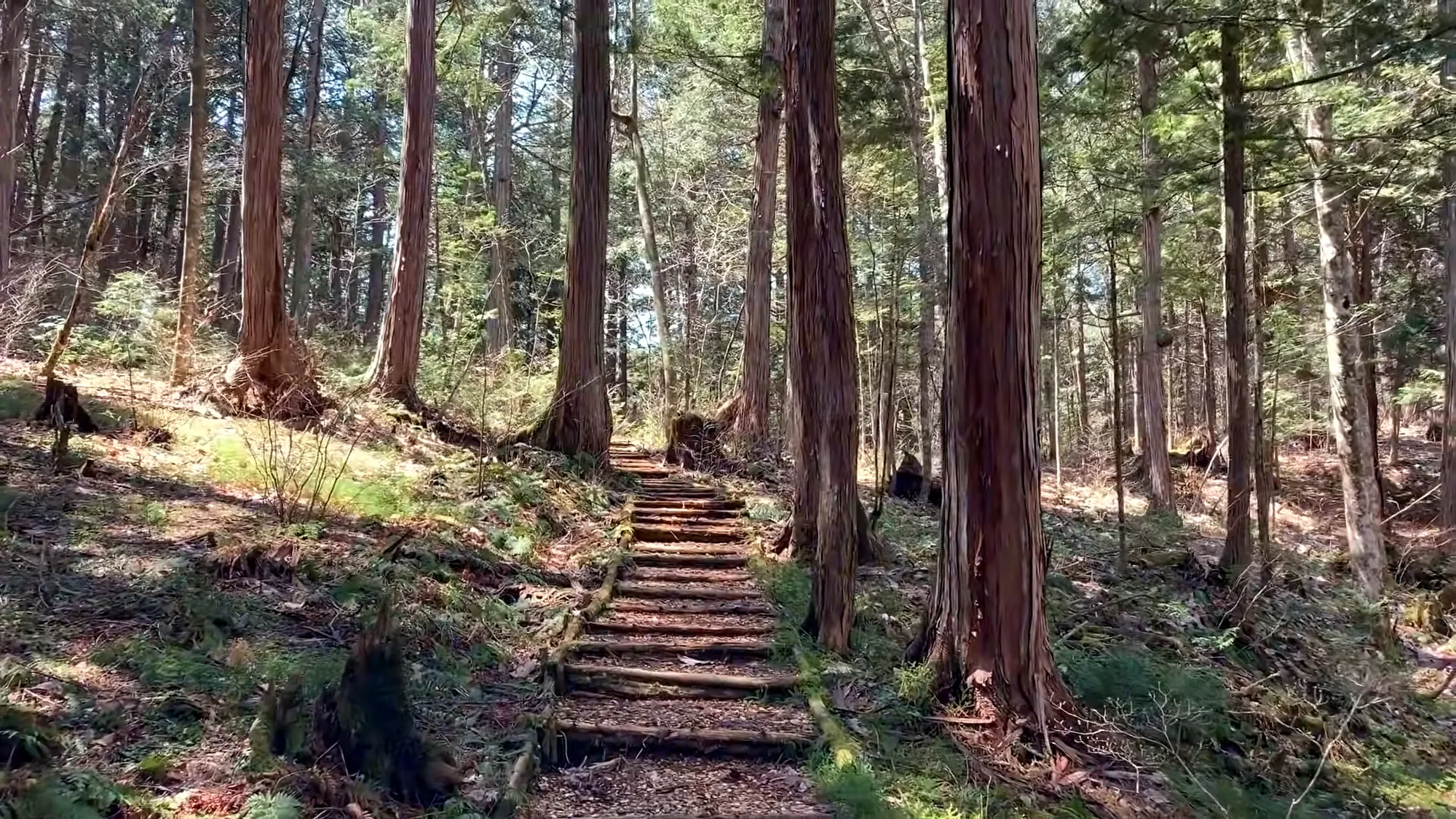
Most of Akasawa's walking is this: a graded path, soft underfoot.
Stand where you parked. Let the engine noise leave your ears, which takes longer than you expect — somewhere near ninety seconds before the ringing settles and you start hearing the wood instead of the road. Put the phone away now rather than later, because later never comes.
You are waiting for a specific moment: the one where you stop checking whether you have started.
2. Breathe — 5 minutes
Smell first, because it is the sense that needs no instruction.
Breathe through your nose, slowly, four or five times. In cypress country you will get resin and something almost citrus. In a beech wood like Nukumidaira it is damp earth and leaf, cooler and heavier. After rain everything doubles.
The old chemistry claim — that the compounds trees release into the air are doing the work — is why the Forestry Agency reached for the word in 1982. The claim is thinner than it was then, and the science record explains how much thinner. The smell is real regardless, and it is the fastest route into the wood there is.
3. Look — 10 minutes
Find one thing and stay with it longer than is comfortable.
Not the view. A view is a photograph waiting to happen and it pulls you straight back out of the wood. Pick something small and close: water over one stone, the grain on a single trunk, light coming through a gap and moving. Ten minutes on one small thing does something a hundred photographs do not.
Look up at some point. In an old cypress stand the canopy is forty metres over your head and most visitors never once raise their chin.
4. Listen — 10 minutes
Close your eyes if you are somewhere you can.
Birdsong arrives first and is the least interesting thing available, because it is the one you were already listening for. Go under it. There is water somewhere almost always. There is wind in the canopy that does not reach you at ground level, arriving as a sound with no breeze attached. There is the wood itself, ticking and settling.

The cradle path starts here, and goes up.
Then notice what is absent. No engines, no compressor, no notification. That absence is not nothing — it is most of what you came for, and it is the only part of this you cannot get at home.
5. Walk — 15 minutes
Slower than feels right. Half your normal pace, and then slower again.
The certified roads are built wide and gentle on purpose: flat enough that nobody has to watch their feet. That is the entire design intent. Your feet are freed so your eyes and ears and nose can keep working while you move. This is why forest bathing happens on an easy path and hiking does not.
Do not finish anything. There is no summit, no loop to close, no distance to cover. If you reach a bench at eight minutes, that is where this step ends.
If you are walking with someone, agree beforehand to stop talking. It is much easier agreed in advance than attempted halfway.
6. Touch — 5 minutes
Put your hand on a tree. It is the most self-conscious thing in this list and it takes about four seconds to stop feeling foolish.
Cypress bark is dry, fibrous, warm in the sun. Beech is cool and almost smooth. Moss holds water like a sponge and gives under your fingers. Crush a needle or a leaf and smell your hand — that is step two arriving again, stronger, because you broke the cell walls yourself.
If the water is accessible and the season allows it, put your hand in a stream. Mountain water in Nagano in May is cold enough to be a genuine event.
7. Sit — 15 minutes
Fifteen minutes on a bench or a root, doing nothing.
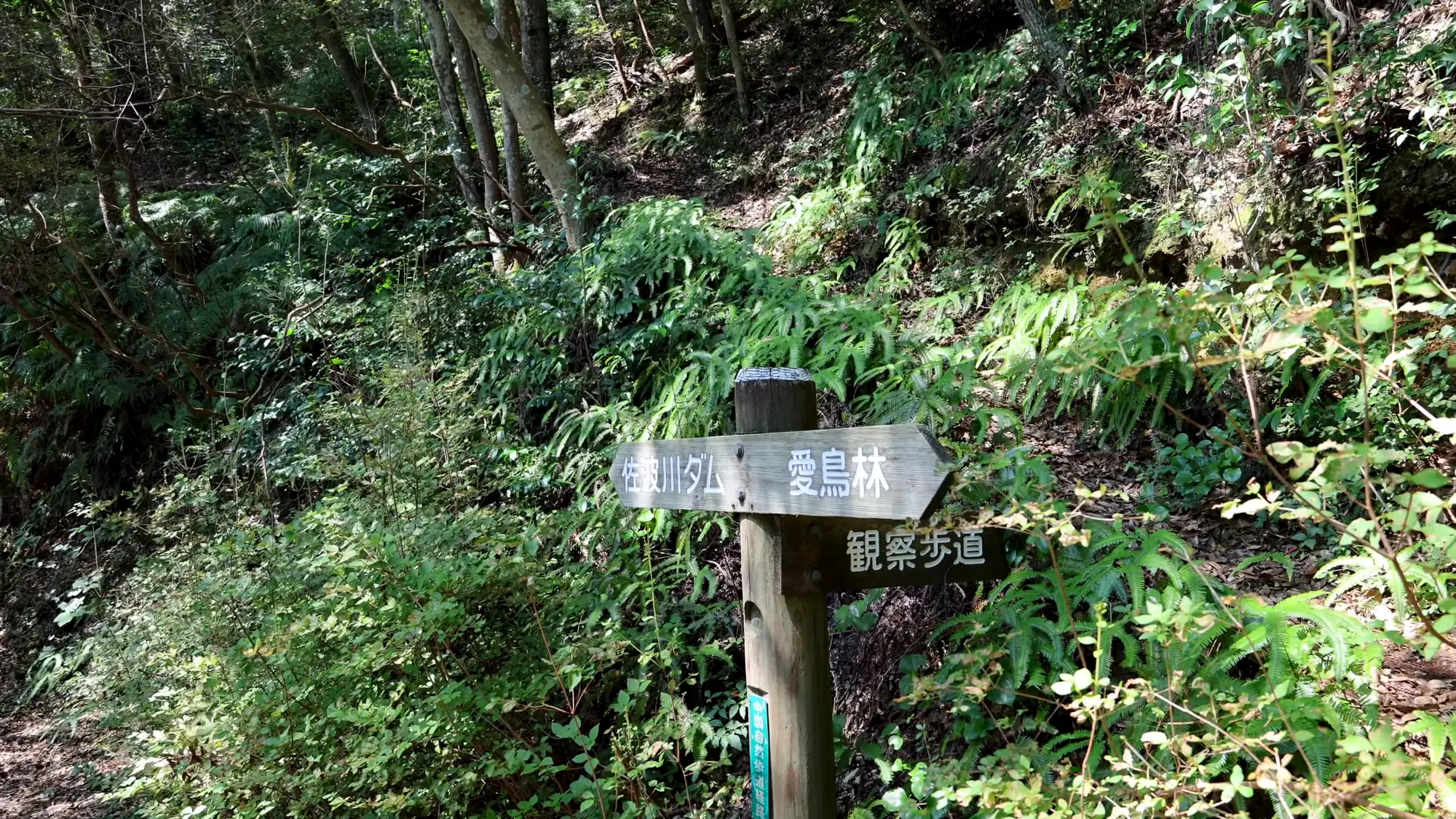
The post for the bird forest trail. Japan's first certified therapy base starts about here.
This is half of what the experiments measured, and it is the step most visitors skip. The sitting is not a rest before the walk resumes. It is the walk.
Fifteen minutes of nothing is longer than it sounds. Minutes three to seven are the hard ones, where the mind reaches for the phone and starts drafting the day’s remaining tasks. Somewhere past that it usually stops. If it does not stop, the fifteen minutes were still fifteen minutes spent sitting in a forest, which is not a failure of any kind.
No counting, no watching the time, no device on the wrist. The science record explains why a wrist reading is not a measurement.
8. Return and taste — 5 minutes, then as long as you like
Walk out at the same slow pace. Then eat something, sitting down, outside if you can.
In Japan this part is not an afterthought. Several of the certified forests run a seasonal lunchbox eaten beside the wood after the session, and the ones that do treat it as part of the walk rather than the end of it. Eat slowly. It is the fifth sense and the only one the previous seven steps left out.
Before you reach the car, write three lines. What you smelled first. What you heard under the birdsong. Where you stopped.
That note is the one addition that is purely ours, and it is not a measurement of anything. It is how the walk is still with you on the train home, three hours later, when it would otherwise have gone.
After the walk: the bath
In Japan the water comes next, and the order matters: walk first, bathe after. That sequence is older than forest bathing by about a thousand years and the forest-and-onsen record sets out the whole day.
The short version is that a hot spring after a slow walk does something a hot spring on its own does not, and the country worked this out long before anyone measured a cortisol level.
With a guide, or without
Nobody needs a guide. Most people who forest bathe in Japan do it alone, unmeasured, on a Sunday, and the Forestry Agency proposed the word in 1982 for exactly that. The certified roads were built so a first-time visitor can walk them without instruction. That is what wide, gentle and easy means.

The path crosses and recrosses, and the steps are wet from October to June.
A guide changes the walk in three ways, and they are worth knowing before you decide.
The pace is set for you, and it is slower than you would set it. The stops are chosen, and they are the places someone who knows the wood in every season would choose — which is not where you would have stopped. And the silence is permitted: a guided group in Japan walks with conversation kept to a minimum, and having a guide present makes that ordinary rather than awkward.
The 2025 Tokyo trial is the clearest description in the literature of what a Japanese guided walk actually is. Guides with more than ten years’ experience, trained in the Society’s methods, leading 1.1 km (0.7 mi) courses at about 45 minutes each, adjusting pace and rests, pausing for the group to attend to the senses without sitting, and asking participants to keep talk to a minimum. Accelerometers put the effort at 2.2 METs, lighter than ordinary walking.
STUDY Tokyo guided-walk trial (2025)
SAMPLE 84 healthy men aged 40 to 70; 78 completed
DESIGN Randomised, unblinded, single exposure
LIMITATION One walk, one day, men only. The science record reads it in full.
What a guide does on the ground is mostly what a good host does. They meet you at the station or the trailhead, ask how you slept, set off slowly, and stop before you would have. They name what you are smelling, hand you a leaf to crush, and go quiet for long enough that you do too. At Shinano-machi the guide is called a 森林メディカルトレーナー (shinrin medikaru torēnā, forest medical trainer) and meets you the evening before for an assessment, then walks with you the next morning.
The Society certifies guides as well as forests, in two grades, and the certification record covers what each one means and what it costs to hold. Fees for a guided walk vary by forest and by season, and each forest’s own record carries its current arrangements — which is where they are kept up to date.
The forest was there before the guides, and it will not mind if you go without one.
Nearby and alike

Forest Bathing in Japan
Japan named forest bathing in 1982, then measured it. The practice, the places, and what the studies show.

Forest and Onsen
Two old Japanese ways of resting the body meet in the Kiso valley. Cypress air, hot water, and what is known.

Origins
A forestry bureau named shinrin-yoku in 1982. The manners it asked for are older, and they are still kept.
Verified by The Japan Onsen Society
林野庁「森林浴」 (Forestry Agency, “Forest Bathing”: the five-senses description of the practice) — rinya.maff.go.jp
森林セラピーソサエティ「森林セラピーの楽しみ方」 (Forest Therapy Society, “How to Enjoy Forest Therapy”: full day 4 h / 5 km, half day 2 h / 2.5 km, two nights and three days for the immune measures; read 29 September 2026) — fo-society.jp
森林セラピーソサエティ「資格・通信教育」 (Forest Therapy Society, “Qualifications and Correspondence Courses”: the two guide grades, their definitions, the scope statement, and the absence of published hours or holder counts; read 29 September 2026) — fo-society.jp
森林セラピーソサエティ online shop, 通信教育課程2級 (level-two correspondence course, ¥50,000) — fo-society.stores.jp
森林セラピーソサエティ online shop, 通信教育課程1級 (level-one correspondence course, ¥25,000) — fo-society.stores.jp
上松町観光協会「ガイド散策のご案内」 (Agematsu Tourism Association, guided walks at Akasawa: the three formats and fees revised 1 June 2026, and the ¥550 stress check) — kiso-hinoki.jp
なべくら高原・森の家「森林セラピー散策」 (Nabekura Kōgen Mori no Ie, the Iiyama three-hour walk: ¥7,000 for two, ¥6,000 for three or more, May to November) — nabekura.net
信州信濃町 癒しの森 料金表 (Shinano-machi Healing Forest price table: per-trainer fees for up to five guests, and the lunchbox prices) — iyashinomori.main.jp
志賀高原ビジターセンター (Shiga Kōgen Visitor Center and guide association: the therapist-led walk, listed without a price) — visitor-center.shigakogen.gr.jp
霧島市「森林セラピー」 (Kirishima City, forest therapy: the ¥800 monthly guided walk) — city-kirishima.jp
Park BJ, Tsunetsugu Y, Kasetani T, Kagawa T, Miyazaki Y. Environ Health Prev Med. 2010;15:18–26 (the fifteen-minute sit and fifteen-minute walk) — link.springer.com
Kobayashi H, Song C, Ikei H, et al. Front Public Health. 2018;6:278 (485 analyzed; 65.2 percent showed higher parasympathetic activity in the forest; young Japanese men only) — frontiersin.org
Ochiai H, Inoue S, Masuda G, et al. Sci Rep. 2025;15:3272 (the guided-walk method: 1.1 km courses, about 45 minutes, 2.2 METs; 84 randomized, 78 completing) — nature.com
Yen figures are converted at roughly ¥150 to the US dollar. Verified 18–29 September 2026. The eight-step sequence and its times are this property’s house method, not a Forest Therapy Society document.