
Yamakita Lake, also known as Tanazawa Lake, in the summer
A word from an office: 1982
Forest bathing has a birth certificate. The 林野庁 (Rinya-chō, Forestry Agency), a bureau of what is now the Ministry of Agriculture, Forestry and Fisheries, proposed the word 森林浴 (shinrin-yoku), “forest bathing,” in 1982, and the Agency’s own page still says so in plain language. It was to be a way of getting close to the forest casually, on the model of 温泉浴, 海水浴 and 日光浴, hot-spring bathing, sea bathing and sunbathing. The director-general at the time was 秋山智英 (Akiyama Tomohide), and he is the man credited with the idea.
Two years earlier a slim paperback had appeared in Kōdansha’s Blue Backs popular-science series: 『植物の不思議な力=フィトンチッド』, “The Mysterious Power of Plants: Phytoncides,” co-written by the Soviet biochemist B. P. Tokin and his Japanese co-author 神山恵三 (Kamiyama Keizō). The National Diet Library’s record gives it as 196 pages, 18 cm (7 in) tall, ¥480, about $3 at roughly ¥150 to the dollar. Its subtitle promised to explore the riddle of trees that kill microbes.
A 2013 history of forest bathing by Kobayashi, Kondō and Takeda at Gunma Paz University describes the Agency’s concept as resting on exactly that notion: that forests hold unique fragrances with bactericidal properties, and that breathing them makes a healthier body. The Agency’s page today does not mention phytoncides at all. It speaks of taking in the forest’s healing power through the five senses and relaxing body and mind. The distance between those two descriptions is the distance the idea has traveled in four decades, from a chemistry claim to a sensory habit.
The first national forest-bathing gathering was held in 1982 at 赤沢自然休養林 (Akasawa Shizen Kyūyōrin, Akasawa Natural Recreation Forest) in the Kiso valley of Nagano, a stand of 木曽ヒノキ (Kiso hinoki, Kiso cypress) more than three hundred years old, which the Agency had already designated Japan’s first natural recreation forest in 1969. The Agency and the town of 上松 (Agematsu) both call Akasawa 森林浴発祥の地, the birthplace of forest bathing.
In 1986 the Agency, with the 緑の文明学会 (Midori no Bunmei Gakkai, Green Civilization Society) and the 地球環境財団 (Chikyū Kankyō Zaidan, Global Environment Foundation), chose 森林浴の森100選, the “100 Forests for Forest Bathing,” from public nominations. A Japanese dictionary of tourism resources gives the sponsoring bodies and the stated aim, which was to carry Japan’s forests into the twenty-first century. The list did what lists do: it gave the word a map.
What is worth noticing about all of this is how civil it is. There is no priest in the story, no doctor, no mystic. There is a forestry bureau, a popular-science paperback, a recreation forest that had a railway in it, and a list of a hundred places.
English-language accounts often garble the details, and we will not add to the pile. No precise date, no speech and no quotation is attributed to Akiyama here, because no Japanese primary source consulted carries one. The Agency proposed the word in 1982; Akiyama led the Agency; the first gathering was at Akasawa. That much holds.

The deeper question is why the word landed. A ministry can propose a term and have it die by autumn. Shinrin-yoku did not die, and the reason is that it named something Japanese people already did without a name.
The older habit: three ways of keeping trees
The oldest forest practice in Japan is not bathing but keeping. Trees around a shrine are left standing; a mountain is climbed as an act of devotion; a single tree older than the surrounding town is roped and bowed to. None of this was invented for health, and none of it was cited by the Forestry Agency in 1982. It is the ground the modern habit grew in, and it deserves to be described exactly.
The shrine grove: 鎮守の森
A 鎮守の森 (chinju no mori, “grove of the guardian deity”) is the wood that surrounds a shrine and is kept as sacred ground. The 神社本庁 (Jinja Honchō, Association of Shinto Shrines) puts it simply: many shrines have forest that grows up around the buildings, it is called the chinju no mori, and it has been protected and handed down as a divine precinct. The Association adds that the grove carries the Shinto disposition of protecting nature and living together with it. That is the institution’s own language, and it is enough.
The experience is more physical than the definition. Crossing the 鳥居 (torii, shrine gate) at a wooded shrine, the air cools a step, the traffic noise falls away behind the trunks within a few dozen meters, and the gravel of the approach starts to sound loud. That drop, and that quiet, are what a shrine grove is for a visitor before it is anything else.
The most instructive shrine grove in Japan is also the youngest of the great ones. The forest of 明治神宮 (Meiji Jingū) in central Tokyo, about 70 ha (173 acres), was created from scratch. The shrine’s own account is unambiguous: the grove was made by human hands before the enshrinement on 1 November 1920, from roughly 100,000 trees donated from across the country and its then territories, planted by some 110,000 young volunteers.

Plantation cedar, grown for Tokyo's timber and never cut.
The plan was by three specialists, 本多静六 (Honda Seiroku), 本郷高徳 (Hongō Takanori) and 上原敬二 (Uehara Keiji), for what they called an 永遠の杜, an “eternal forest.” They rejected the cedar-and-cypress model of Ise and Nikkō, judging Tokyo’s air and Kantō loam wrong for conifers, and planted shade-tolerant evergreen broadleaves, chinquapin and oak, expecting them to take over. They did.
The shrine’s comprehensive surveys record what a planted wood does as it becomes a forest: an initial 365 species and about 120,000 trees, and at a later survey 234 species and about 36,000. The shrine gives roughly 100,000 trees as the number donated before the enshrinement and about 120,000 as the number standing at the first survey, and it does not reconcile the two figures. We report both and do not reconcile them either.
A century on, the place looks primeval and is not. Anyone who has stood in it at seven in the morning knows the two facts do not cancel.
That matters for a reader who has been told that shrine groves are untouched fragments of ancient Japan. Some are remnants of regional vegetation. Some are managed. Some, like Meiji Jingū’s, are engineered.
And a great many are gone. From late 1906 the government pushed 神社合祀 (jinja gōshi, shrine mergers), a policy of consolidating the many small shrines of each district toward one per town or village, and Wakayama pursued it hardest. The naturalist 南方熊楠 (Minakata Kumagusu) fought it from around 1909, arguing in newspapers that merging shrines destroyed historic sites and old traditions, wrecked landscapes and pushed unstudied living things toward extinction, and he was jailed for it in 1910.

Three-hundred-year hinoki, grown straight in the Kiso valley and cut for Ise Shrine.
The House of Peers resolved in 1920 that the mergers were useless and the policy faded, but by the memorial museum’s own reckoning a considerable number of shrine buildings, groves and stands of old forest had already disappeared. The sacred grove is not an unbroken inheritance. It is something the country nearly threw away, and partly did.
The other great institutional forest is at Ise. 伊勢神宮 (Ise Jingū) rebuilds its principal shrines every twenty years in the 式年遷宮 (shikinen sengū), a practice the shrine dates from 690. From the mid-Edo period the timber came from the Kiso forests, the same hinoki country as Akasawa.
In 1923 the shrine began a 200-year plan to grow its own cypress within the roughly 5,500 ha (13,600 acres) of the 宮域林 (kyūikirin, shrine-precinct forest), so that future rebuildings would draw on trees planted for the purpose. Here the sacred and the civil are the same act: silviculture as devotion, on a timescale no forestry ministry would attempt.
The mountain path: 修験道
修験道 (Shugendō) is a Japanese religion of mountain austerity. 金峯山寺 (Kinpusen-ji), the head temple of one of its main lineages, at Yoshino in Nara, defines it as a path in which the practitioner gains spiritual power through hard training and uses it to save others, and describes it as a blend of native nature worship with Buddhism, Taoism and yin-yang thought. Its practitioners are the 山伏 (yamabushi), literally “those who lie down in the mountains.”
Its founder is a figure at the edge of history. Kinpusen-ji tells the received story: 役行者 (En no Gyōja), born by tradition in 634 in what is now Gose, who meditated a thousand days on Mount Ōmine and there beheld 金剛蔵王大権現 (Kongō Zaō Daigongen), the wrathful deity enshrined in the temple’s 蔵王堂 (Zaōdō), a wooden hall 34 m (112 ft) high and a National Treasure. The temple itself notes that accounts of his death differ, and that a man of this name appears in the eighth-century court chronicle 続日本紀 (Shoku Nihongi).

Misugi cedar, planted for timber and thinned on a schedule since the Edo period.
That single chronicle entry is the historical kernel; the thousand days and the vision are tradition. A good historian keeps the two in separate hands, and so does the temple. He was given the posthumous title 神変大菩薩 in 1799, eleven centuries after he lived, which tells its own story about how legends accumulate.
Shugendō was also, for seventy-five years, illegal as an independent order. Suzuki Masataka of Keio University, writing in 宗教研究 in 2018, traces the 1872 修験宗廃止令 (Shugenshū haishirei, Edict Abolishing the Shugendō Sect) to the government’s 1868 separation of kami and buddhas. Yamabushi, who had served at shrines and mixed the two, were forced to affiliate with the Tendai or Shingon Buddhist schools, become Shinto priests, or return to lay life and farming, and the regional networks built over centuries were dismantled.
Kinpusen-ji records the postwar recovery: refounded on 10 April 1948 and renamed 金峯山修験本宗 in 1952. The 大峯奥駆道 (Ōmine Okugake-michi), the roughly 170 km (106 mi) ridge route from Yoshino toward Kumano that its ascetics walk, was inscribed in 2004 as part of the UNESCO World Heritage property 紀伊山地の霊場と参詣道, “Sacred Sites and Pilgrimage Routes in the Kii Mountain Range.”
The other great Shugendō landscape is in the north. At 出羽三山 (Dewa Sanzan) in Yamagata, the three mountains of 羽黒山 (Haguro), 月山 (Gassan) and 湯殿山 (Yudono) are framed by the Agency for Cultural Affairs’ Japan Heritage program as present, past and future, and the walk through them as a 生まれかわりの旅, a “journey of rebirth” undertaken while alive. Yamagata Prefecture’s tourism body gives the Haguro approach as 2,446 stone steps between about 600 cedars more than three hundred years old, past a five-story pagoda of unpainted wood and a single tree, 爺杉 (Jijisugi, “the grandfather cedar”), of about a thousand years.
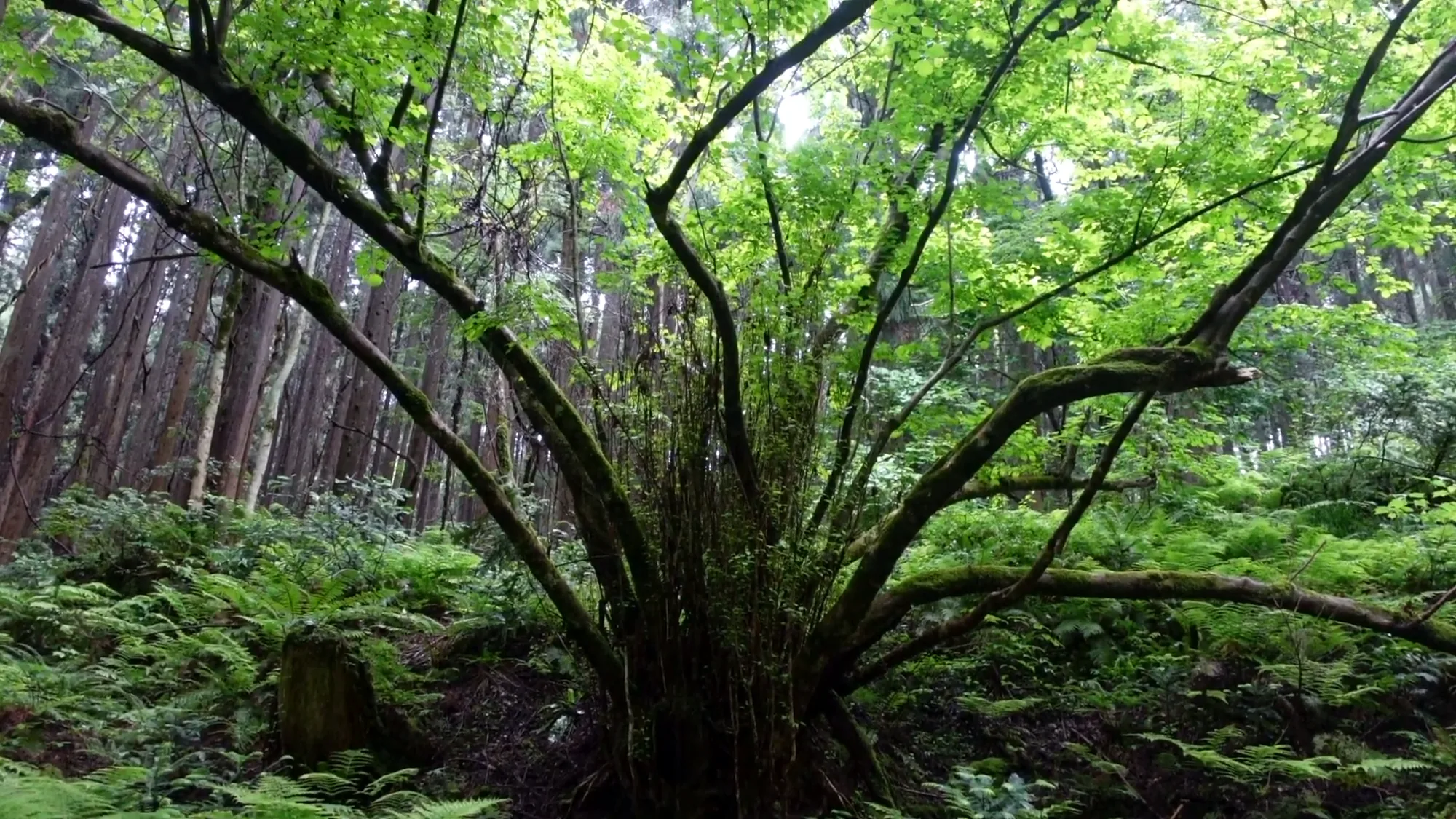
One broadleaf holding its ground in the middle of a plantation.
The winter peak, 冬の峰 (fuyu no mine), is undertaken by two yamabushi a year, the 松聖 (matsuhijiri) chosen from the 手向 (Tōge) district at the foot of Haguro, who keep a hundred days of abstinence and confinement from 24 September to New Year’s Eve. The shrine describes it as a rite of waiting for the grain spirit, and its close, the 松例祭 (Shōreisai), is when their power is tested. That is what mountain practice looks like when it is practice. It is not a stroll, and we will not pretend otherwise.
The single tree: 神木
A 神木 or 御神木 (shinboku, goshinboku, “sacred tree”) is an individual tree treated as sacred, usually within a shrine precinct, usually roped with a straw 注連縄 (shimenawa). The reverence is specific rather than general: this tree, not trees.
At 來宮神社 (Kinomiya Jinja) in Atami, the shrine’s sacred tree is a camphor the shrine describes as more than two thousand years old, about 24 m (79 ft) around, and a nationally designated natural monument. It is a good place to see what a shinboku is in practice: a rope, a small offering shelf, people standing still in front of it for longer than they stand in front of the main hall. Nothing about the scene requires belief. It requires only that the tree be older than everyone present, and it is.
The most famous old tree in Japan is not a shrine tree at all, and it belongs here for a different reason. 縄文杉 (Jōmon-sugi), the great cryptomeria of Yakushima, stands at 1,328 m (4,357 ft), 16.1 m (53 ft) around at chest height and 22.2 m (73 ft) tall, eight to ten hours’ round trip on foot from the Arakawa trailhead. Yakushima Town, which manages the approach, gives its age as “said to be 2,170 to 7,200 years.” That range is not a typo; estimates diverge by five thousand years, and honest sources print the spread.
The tree was brought to public attention only in 1966 and became an emblem after the island’s World Natural Heritage inscription in 1993, and it is viewed from a deck built to keep boots off its roots. The reverence here is civil rather than religious, a town and a nation deciding that one tree is worth a platform and a rule. It is continuous with the rope on the camphor at Atami in every way that matters to a visitor. The Yakushima site record carries the island itself.
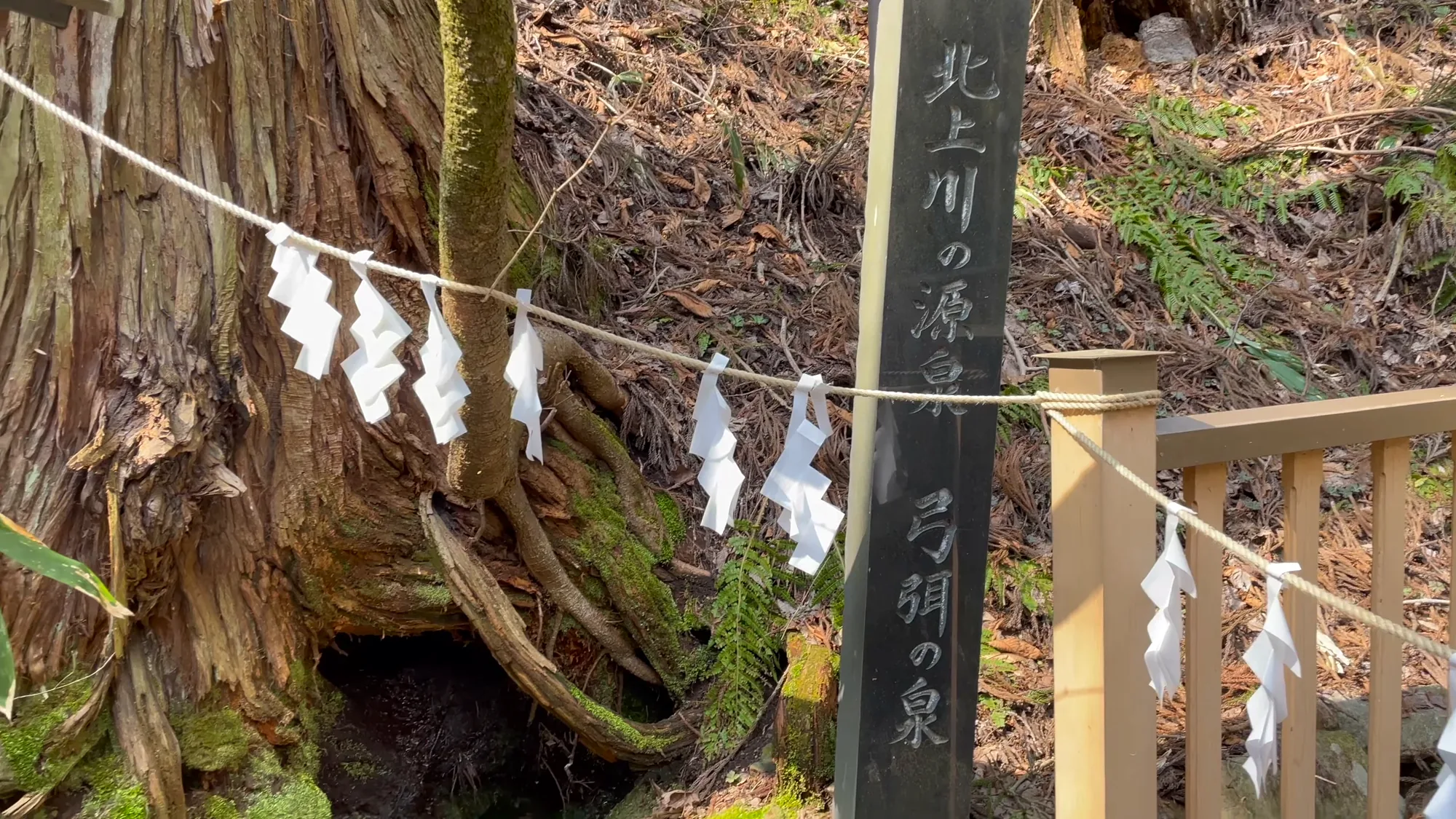
The spring here is counted as the source of the Kitakami river, and the tree above it is roped as sacred.
What the sacred gave the civil
None of these three strands, grove, mountain, tree, was mentioned by the Forestry Agency in 1982, and it would be a mistake to draw a straight line from the shimenawa to the ministry. The line is crooked and mostly unspoken.
What the sacred lineage gave the civil program was not doctrine but manners: the habit of entering trees slowly, of lowering the voice, of stopping in front of one of them. Shinrin-yoku asked for nothing more than that, and the country already knew how. That is why a word proposed by a forestry office in 1982 is still in use, and why it traveled.
The reader who has followed this far now has the two halves of the word. The sacred half is the grove, the mountain, the roped tree: the country’s long habit of keeping certain trees and entering them with manners. The civil half is a ministry, a paperback and a list of a hundred forests. Shinrin-yoku is what happened when the second half gave the first half a name that fit on a poster.
What forest bathing is not
Forest bathing is slow, sensory and short-distance, and it has no destination; the pillar gives that definition in full, and the protocol record gives the walk. This section is about the things it is not, because they share its mountains and are easily confused with it.
It is not hiking. Hiking has a summit or a hut, and the point is to reach it. Trail running has a pace and a time. Both are exercise that happens to be in a forest, and both are worth doing.

Kengo Kuma built six buildings here out of local cedar. This one is a bridge you can walk through.
It is not austerity. The Ōmine Okugake is 170 km (106 mi) of ridge undertaken as religious discipline, and the Haguro winter peak is a hundred days of confinement. All of these happen among trees, and none of them is shinrin-yoku, for the same reason that swimming laps is not a bath.
The measurements the science record reports were taken from people sitting still or walking gently for a quarter of an hour. In the largest of the Japanese field experiments, Park, Tsunetsugu, Kasetani, Kagawa and Miyazaki’s 2010 study, 280 male university students across 24 forests in a randomized crossover against a city site, each subject sat and looked at the forest for about fifteen minutes and then walked in it for about fifteen. Every subject was a young Japanese man, which is the study’s own stated limit.
Nothing in the Japanese literature licenses transferring those findings to a ten-hour day on Yakushima or a hundred days on Haguro. Whether a hard mountain day does something different, or better, or nothing measurable at all, is a separate question that the forest-bathing studies did not ask.
The distinction is easier to feel than to argue. On a certified road the path is wide and gentle enough that no one needs to watch their feet, which is the whole idea: the feet are freed so the eyes and ears and nose can work. On the Haguro steps the feet are everything, and that is the whole idea there too.
One practice empties the body of task; the other fills it. Both are old, both are Japanese, and only one of them was named by a forestry office in 1982. The forests themselves did not notice. They are still there, wide and gentle at Akasawa, steep and cedar-dark at Haguro, engineered and enormous behind the torii in the middle of Tokyo, and the invitation in every case is the same and very old: come in slowly, and stay a while.
Nearby and alike

Forest Bathing in Japan
Japan named forest bathing in 1982, then measured it. The practice, the places, and what the studies show.

The Science
The studies are real, small and oversold. What was measured, in how many people, and what was never shown.

The Walk
A measured forest walk is about thirty minutes and no destination. Here it is, sense by sense, step by step.
Verified by The Japan Onsen Society
林野庁「森林浴 ―いつでも森と、心をほどく。」 (Forestry Agency, “Shinrin-yoku”) — rinya.maff.go.jp
林野庁「赤沢自然休養林」 (Forestry Agency, Akasawa) — rinya.maff.go.jp
赤沢自然休養林の森林浴「森林浴・森林セラピーとは」 (Akasawa, the operator’s own page) — shinrinyoku.kiso-hinoki.jp
小林功・近藤照彦・武田淳史「森林浴の歴史について」群馬パース大学紀要 15 (2013) — cir.nii.ac.jp
国立国会図書館サーチ: B. P. トーキン・神山恵三『植物の不思議な力=フィトンチッド』講談社ブルーバックス (1980) — ndlsearch.ndl.go.jp
事典・日本の観光資源「森林浴の森100選」 via コトバンク (secondary) — kotobank.jp
神社本庁「境内について」 (Association of Shinto Shrines, on shrine precincts) — jinjahoncho.or.jp
明治神宮「明治神宮とは」 — meijijingu.or.jp
明治神宮「杜(もり)・見どころ」 — meijijingu.or.jp
明治神宮 Q&A (grove surveys) — meijijingu.or.jp
伊勢神宮「永遠の森」 (Ise Jingū, the shrine-precinct forest) — isejingu.or.jp
南方熊楠記念館「神社合祀反対運動」 (Minakata Kumagusu Memorial Museum, on the shrine mergers) — minakatakumagusu-kinenkan.jp
金峯山寺「金峯山寺について」 (Kinpusen-ji, on Shugendō and En no Gyōja) — kinpusen.or.jp
鈴木正崇「明治維新と修験道」宗教研究 92(2) (2018) (secondary) — jstage.jst.go.jp
文化庁 日本遺産ポータル「自然と信仰が息づく『生まれかわりの旅』」 (Agency for Cultural Affairs, Japan Heritage) — japan-heritage.bunka.go.jp
出羽三山神社「四季の峰」 — dewasanzan.jp
出羽三山神社「松例祭」 — dewasanzan.jp
來宮神社 (Kinomiya Jinja, Atami) — kinomiya.or.jp
屋久島町「縄文杉」 (Yakushima Town) — town.yakushima.kagoshima.jp
森林セラピーソサエティ「基地認定について」 (Forest Therapy Society, certification criteria) — fo-society.jp
Park BJ, Tsunetsugu Y, Kasetani T, Kagawa T, Miyazaki Y. Environ Health Prev Med. 2010;15:18–26 — link.springer.com
Yen figures are converted at roughly ¥150 to the US dollar. Verified 18–29 September 2026.