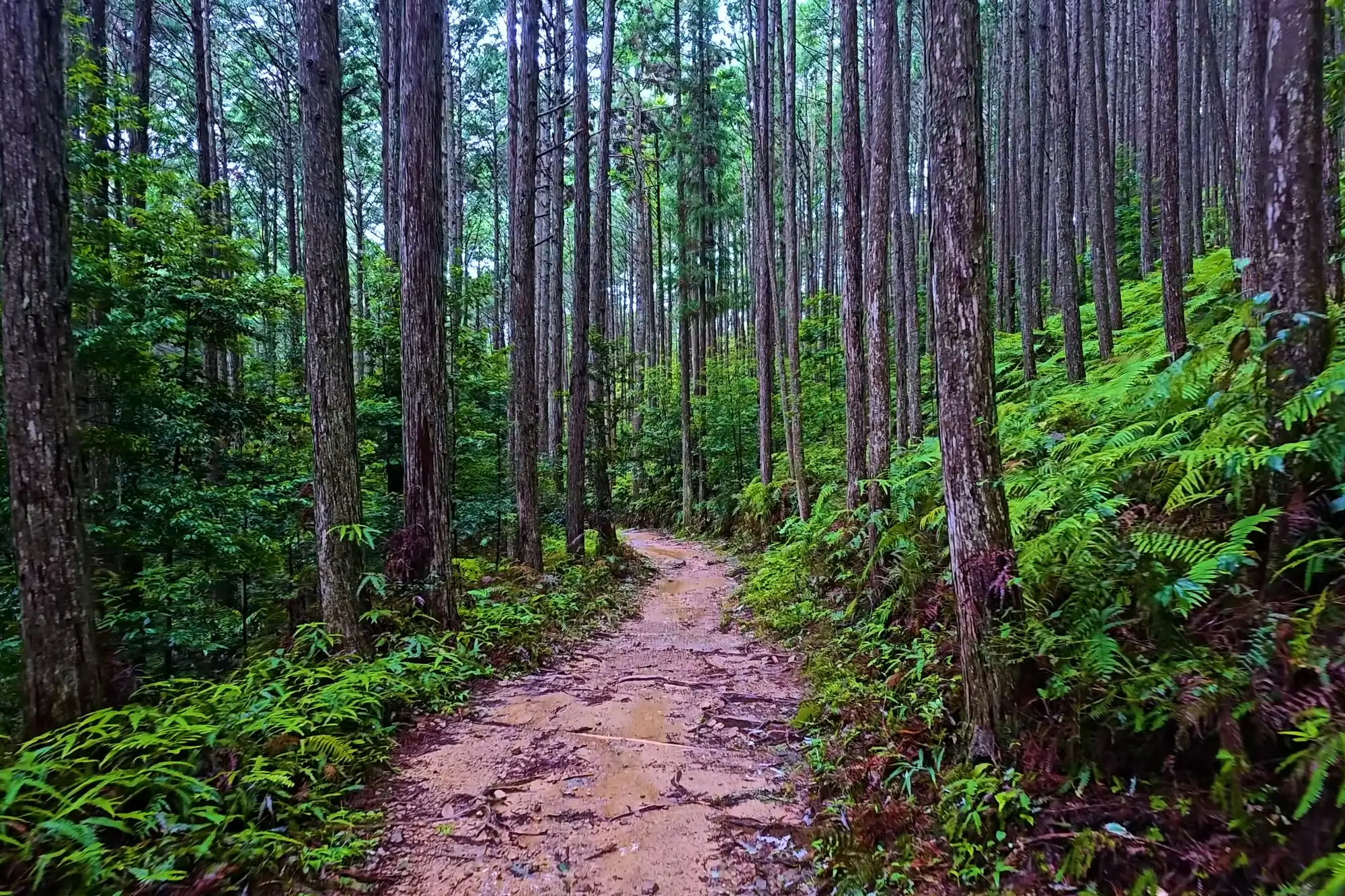
Stone-set trail running between tall cedar and dense fern on the Kumano Kodo at Nakahechi, Wakayama
What you walk into
The Kumano Kodō is not a forest therapy road and holds no Society certificate; it is absent from the Society’s list read on 28 and 29 September 2026, and this record says so first. It is a pilgrimage route, or rather a network of them, through the Kii mountains of Wakayama to the three grand shrines of Kumano, walked since at least the Heian period and inscribed by UNESCO in 2004 as part of the Sacred Sites and Pilgrimage Routes in the Kii Mountain Range. The 中辺路 (Nakahechi) is the imperial route, the one the retired emperors took from Kyoto, and the one most walkers take now.
The Tanabe City Kumano Tourism Bureau, the official body for the route, describes the main walk in two day-sections. From 滝尻王子 (Takijiri-ōji), where the mountains begin, to 継桜王子 (Tsugizakura-ōji) is about 17 km (10.6 mi) and seven to ten hours; from Tsugizakura to 熊野本宮大社 (Kumano Hongū Taisha) is about 21 km (13 mi) and eight to eleven hours. That is about 38 km (24 mi) over two long days, and the bureau’s first segment sheet gives the shape of the climbing: from about 85 m (280 ft) at Takijiri to about 370 m (1,210 ft) at the first pass within the opening 3.9 km (2.4 mi). This property’s earlier draft said forty kilometres; the bureau’s own sections add to thirty-eight, and thirty-eight is what is printed now.
The forest is mostly planted cedar and cypress, which is the honest description of most Japanese mountainside, with broadleaf remnants around the shrines and the old settlements. What the route has that no therapy road has is the 王子 (ōji), the small subsidiary shrines every few kilometres where pilgrims stopped, and a thousand years of people having walked it slowly for a reason.
After the walk
The route ends at the sea. From Hongū the pilgrims continued to 熊野速玉大社 (Hayatama) at Shingū and 熊野那智大社 (Nachi) above the great waterfall, and the modern walker takes a bus to 那智勝浦 (Nachi-Katsuura), where the baths are on the water and one of them is a cave open to the Pacific. In the middle of the route the springs at 湯の峰 (Yunomine) and 川湯 (Kawayu) have bathed pilgrims for centuries, and Yunomine’s small stone bath, the つぼ湯, is itself part of the World Heritage inscription.

The Kii peninsula gets four meters of rain a year, and the trail shows it.
There are no guides in the Society’s sense and no programme. What the bureau provides is maps, luggage transfer and a booking service for the mountain villages’ inns, and those inns are the practice: a long day, a bath, a meal, and another long day. The forest-and-onsen record sets out the order; here the route sets it for you.
Getting there, and when
The gateway is 紀伊田辺 (Kii-Tanabe) on the JR Kisei line. From Shin-Osaka the くろしお (Kuroshio) limited express takes 134 to 135 minutes, and from Tennōji about 115; from Tokyo the Tōkaidō Shinkansen to Shin-Osaka is the usual 2 hours 30 minutes, though this property could not confirm the figure from a current JR Central page in this pass and prints it as unverified. Call it about five hours from Tokyo to Kii-Tanabe with one change.
From Kii-Tanabe Station the 明光バス (Meikō bus) Kumano Hongū line reaches the 滝尻 (Takijiri) stop in 32 to 38 minutes, the first departures at 6:16, 6:38 and 6:55, for ¥630 (about $4); the same line continues to 本宮大社前 (Hongū Taisha-mae) for ¥1,310 (about $9), in 64 minutes on the express and about 1 hour 45 on the others, which is the way back for anyone who walks one section and rides the rest. The Ryūjin bus also serves the line and its timetable could not be reached. From Hongū to Shingū or Kii-Katsuura the 熊野御坊南海バス runs the 川丈 and 新勝 lines; the prefecture’s route map confirms them and no reachable page gave the minutes.
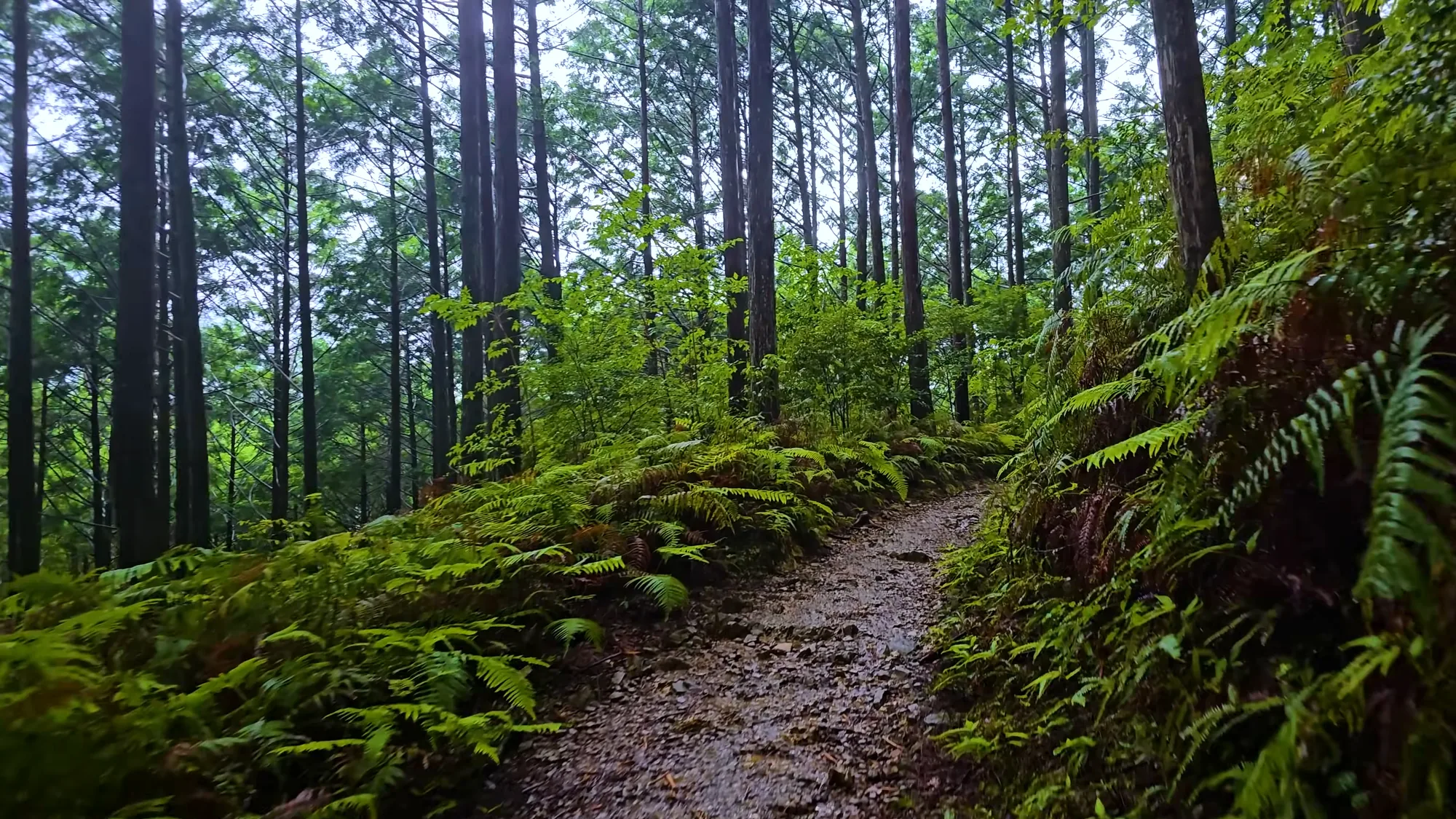
Moss on both banks, fern above it, and the path cut through the middle.
The route is walked year-round, with the rainy season from June to mid-July and typhoons in September as the reasons to avoid those months, summer heat on the ridges, and winter quiet and clear. Spring and autumn are when the inns fill, and the bureau’s booking service is the way to be sure of a bed.
The trail is free. What costs money is the bus, the inns and the luggage transfer, and the inns, in villages that exist because pilgrims needed somewhere to sleep, are where the tradition still lives.
Nearby and alike

Origins
A forestry bureau named shinrin-yoku in 1982. The manners it asked for are older, and they are still kept.

Choosing a Base
Eight forests, from Kusatsu to Yakushima. Which fits your days, your season and the onsen waiting after.

Forest and Onsen
Two old Japanese ways of resting the body meet in the Kiso valley. Cypress air, hot water, and what is known.