
Cherry blossom. Hadano
Akasawa, before the numbers
The smell arrives before the forest does. On the approach road into 赤沢自然休養林 (Akasawa Shizen Kyūyōrin, Akasawa Natural Recreation Forest) in the Kiso valley of Nagano, the air changes a few hundred meters before the parking lot: sharp, resinous, like the inside of a hinoki bath before the water goes in. That is 木曽ヒノキ (Kiso hinoki, Kiso cypress), some of it standing for more than three hundred years, across 759.56 hectares (1,877 acres) of national forest.
Nothing was measured here in 1982, when the word was proposed and the first gathering held; the origins record tells that story. The Forestry Agency was not making a medical claim, and it still is not. The medicine came later, and it is worth being precise about how much of it there is.
This is where we slow down and read the papers. What follows is a report of what was measured, in whom, under what conditions, and what was left unshown. It is a shorter list than the internet suggests, and a more interesting one.
What is actually in the air
Forest air over Japanese conifers carries measurable volatile terpenes, chiefly α-pinene and β-pinene, that are nearly absent from city air. That is the one part of the phytoncide story that is simply chemistry, and it holds up.
The word itself is older than shinrin-yoku by half a century. フィトンチッド (fitonchiddo, “phytoncide”) was coined by the Soviet biochemist Boris Tokin for the volatile substances plants release to defend themselves against rot, insects and microbes. The Greek root is “plant,” the Latin root is “to kill.” Nothing in the word implies a benefit to the animal breathing it.
In Japanese usage the term settled on the resinous fraction of forest air, the terpenes that hinoki, sugi and pine give off from bark, leaf and cut wood. When Qing Li’s group at 日本医科大学 (Nippon Ika Daigaku, Nippon Medical School) sampled forest and city air during the trips reported in Li et al. 2008, and room air in the 2009 hotel study, they detected α-pinene and β-pinene at the forest sites and in the treated room, and almost none in Tokyo street air.
That measurement is air chemistry rather than physiology, and it is the physical bridge between a walk under cypress and anything happening in the blood. It is why the group later tried to isolate the smell from the forest altogether, in a hotel room, which is described below.
What the air does not contain is anything that has been shown to work like a drug at forest concentrations. The step from “terpenes are present” to “terpenes cause the effect” is the step most popular writing takes without noticing. The studies below are the reason to walk it slowly.
The natural-killer-cell studies, read one at a time
Natural killer cells are a class of white blood cell that can destroy virus-infected and some tumor cells in the laboratory. “NK activity” is a bench measure of how efficiently a person’s isolated NK cells kill a target cell line in a dish. It is a real and reproducible measurement.

It is not the same thing as getting fewer colds or less cancer, and none of the studies below followed anyone long enough to look. That sentence is the floor of this section, and every paragraph under it stands on it.
2007: twelve men, three days, no control group
Li Q, Morimoto K, Nakadai A, et al. (Nippon Medical School), Int J Immunopathol Pharmacol 2007. Twelve healthy men aged 37 to 55, recruited from Tokyo companies, took a three-day, two-night trip to forests around 飯山 (Iiyama) in Nagano, walking about two hours on the first day and four hours across two sites on the second. Blood was drawn before the trip on a normal working day and again on days two and three.
Eleven of the twelve showed higher NK activity after the trip, along with higher counts of NK cells and of cells expressing perforin, granulysin and granzymes A and B. The design is a before-and-after comparison in a single group. There was no control condition.
Anything that happened over those three days, including a break from work, sleep, altitude, walking and company, is folded into the result. The subjects were also twelve middle-aged men, all Japanese, all healthy.
The group has also reported that the raised NK activity persisted for weeks after the trip. We do not repeat that figure. The review that carries it does not state how many of the subjects were sampled at the later draws, and a number without a sample size is not a number we print. What is known is that the group reported persistence; what is not known is in how many people, and that is why it is left out.
2008: the same trip, against a city trip
Li Q, Morimoto K, Kobayashi M, et al., Int J Immunopathol Pharmacol 2008. Twelve healthy men aged 35 to 56 took a three-day, two-night forest trip to hinoki forests near Agematsu, and separately a three-day, two-night city trip with matched activity levels; eleven completed the city arm. The forest trip raised NK activity, NK cell counts and the counts of cells expressing perforin, granulysin and granzymes, which the authors call anti-cancer proteins, and lowered urinary adrenaline.
The city trip did none of those things. The paper’s follow-up figures are left out here, for the reason given above.
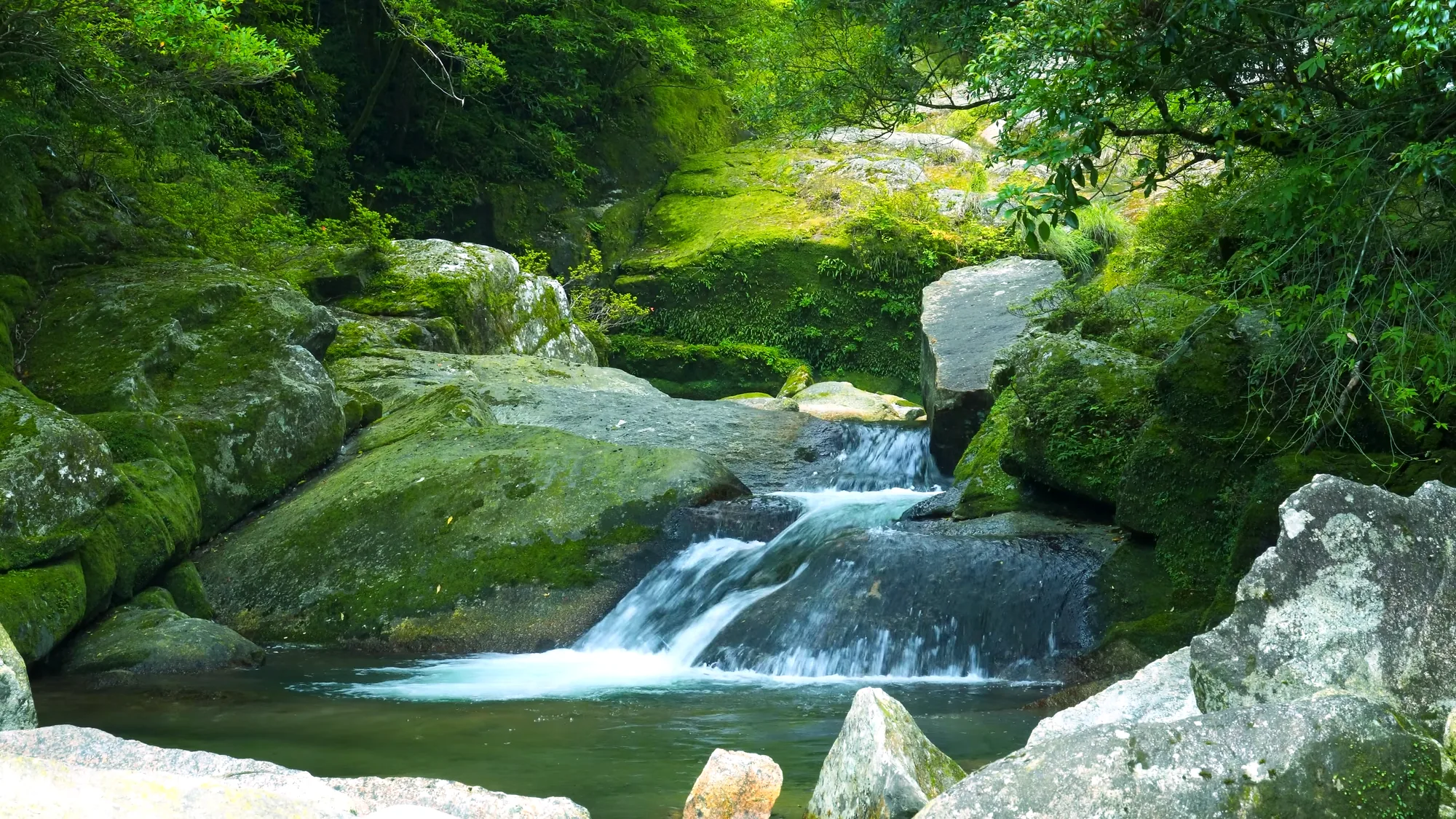
Granite below, rainforest above, and some of the clearest water in Japan between them.
This is the study that earns the phrase “forest, but not city,” and it is a real improvement on 2007 because the same men serve as their own comparison. It remains twelve people, not randomized, from a single laboratory, with participants who obviously knew which trip they were on. The Akasawa site record carries the forest itself.
2008: thirteen nurses
Reported in Li Q, Environ Health Prev Med 2010, the group’s own review of the three trips. Thirteen healthy female nurses aged 25 to 43 took a three-day, two-night forest trip to 信濃町 (Shinano-machi) in Nagano. NK activity and the related cell counts rose during the trip; the later follow-up figures are left out here, for the reason given above.
The review notes the extra care needed with female subjects because NK activity varies with the menstrual cycle. Again there was no control group, and the sample was thirteen women of one profession. The review also states that subjects did not take hot-spring baths or eat special foods during the trips, so as not to confound the result, which matters for the forest-and-onsen record.
2009: hinoki oil in a Tokyo hotel room
Li Q, Kobayashi M, Wakayama Y, et al., Int J Immunopathol Pharmacol 2009. Twelve healthy men aged 37 to 60 stayed three nights, from 7 p.m. to 8 a.m., in an urban hotel room where hinoki (Chamaecyparis obtusa) stem oil was vaporized by a humidifier overnight. α-pinene and β-pinene were detected in the room air.
Blood and urine before the stay and on the last day showed higher NK activity and higher counts of the same protein-expressing cells, and lower urinary adrenaline and noradrenaline. The authors’ own conclusion is careful: phytoncide exposure and lower stress hormones “may partially contribute” to the NK change.
This is the study most often quoted as proof that phytoncides “boost immunity.” Read plainly it is twelve men in one room, compared with themselves before the stay, without a matched no-oil condition in the same design. It shows that the smell alone, in a city, tracked with the same laboratory shift the forest did.
It does not show what dose matters, whether the effect survives ordinary life, or that it changes anyone’s health. Taken together, four small studies from one laboratory point in the same direction, and as of September 2026 no independent group has reproduced the NK-cell result at scale. That is the honest sentence, and it is a more compelling one than “forest bathing fights cancer,” because it is true.

The stream runs warm here, which is not something you get anywhere else in Japan.
Cortisol, pulse and blood pressure: the field experiments
The most robust body of Japanese evidence is not about immune cells at all. It is about what happens to stress physiology in the first fifteen minutes.
24 forests, 280 young men
Park BJ, Tsunetsugu Y, Kasetani T, Kagawa T, Miyazaki Y (Forestry and Forest Products Research Institute and Chiba University), Environ Health Prev Med 2010. Across 2005 and 2006 the team ran the same experiment in 24 forests around Japan, 12 subjects at each site, 280 healthy male university students in all, mean age 21.7. On day one six subjects went to the forest site and six to a nearby city site; on day two they swapped, a randomized crossover.
Each subject sat and viewed the landscape for about 15 minutes and walked for about 15 minutes, in both environments. The viewing period averaged 14 minutes, give or take 2, and the walk 16, give or take 5; the subjects’ mean age was 21.7 with a standard deviation of 1.5 years, and all were screened for physical and psychiatric history.
Salivary cortisol was 13.4 percent lower after viewing and 15.8 percent lower after walking in the forest than in the city; pulse rate 6.0 and 3.9 percent lower; systolic pressure 1.7 and 1.9 percent lower; diastolic 1.6 and 2.1 percent lower; high-frequency heart-rate variability 56.1 percent higher after viewing and 102.0 percent higher after walking; and the sympathetic ratio LF/HF 18.0 and 19.4 percent lower, every one of those at p below 0.05 and most below 0.01. On the mood questionnaire the forest lowered tension, depression, anger, fatigue and confusion scores and raised vigor, while the city moved each the other way.
The authors’ own limitations are stated in two sentences: the findings rest on “short-span exposures to stimuli, approximately 15 min of viewing and approximately 15 min of walking,” and “no evidence from field experiments conducted on other natural environments” was available to compare them with. A two-percent fall in blood pressure is a few millimeters of mercury. A doubling of HF power is a real shift in the balance of the autonomic nervous system, for a quarter of an hour, in a young man sitting still.
This is the anchor of the Japanese literature. It is controlled, crossed over, and repeated across sites. Its limit is written into the sample: every subject was a young, healthy Japanese man. Whether a 60-year-old woman on medication responds the same way is not something this study can say.
57 forests, 485 young men
Kobayashi H, Song C, Ikei H, et al. (Chiba University), Front Public Health 2018. Pooling the field program further, 485 men aged 19 to 29 walked about 15 minutes in a forest and 15 minutes in an urban site, in counterbalanced order, across 57 paired sites. Mean ln(HF), the parasympathetic index, was 4.33 in the forest against 3.93 in the city; the sympathetic index ln(LF/HF) was 1.96 against 2.16.

The stream that runs the length of the walk, boulder to boulder, the whole way down.
The attrition and the proportions are given exactly: 684 men enrolled, 520 completed both conditions, 35 outliers were removed, 485 were analyzed; 316 of them, 65.2 percent, showed higher lnHF in the forest, and 325, 67.0 percent, showed lower ln(LF/HF). The other third did not, which the authors report rather than hide, and they note that the distributions were no more skewed in one environment than the other, so the average is not being dragged by a few strong responders. Their stated limitation is the same one: “it included only Japanese young male subjects,” and the tendency toward or away from nature “may be affected by difference in age, gender, and ethnicity.”
A smaller viewing study from the same program is often cited beside these. Tsunetsugu and colleagues, Landscape and Urban Planning 2013, had 48 young men view forest and urban landscapes at four paired sites in central and western Japan and reported lower diastolic pressure, lower heart rate and higher parasympathetic activity in the forest, with better mood scores. Its full text is behind a publisher paywall, and we report only what its abstract says, which includes neither the viewing time nor the numbers.
Not only young men
The young-men problem is real and it is not the whole literature, and the smaller studies in other people are worth reading precisely because they are small. Three of them were run at Akasawa.
Song and colleagues, IJERPH 2015, had 20 men with high or high-normal blood pressure, mean age 58, walk seventeen minutes in the Akasawa forest and seventeen minutes in the town of Ina at matched intensity in a within-subject crossover, with 19 analyzed: lnHF was 3.9 in the forest against 3.5 in the town, heart rate 77.1 against 78.6 beats a minute, both at p below 0.05, and mood scores moved the same way. The authors’ own limitation: the results “cannot be extrapolated to the female population and people of different age groups.”
Ochiai and colleagues, IJERPH 2015, ran a single pre-post day at Akasawa in nine men aged 40 to 72 with high-normal blood pressure, a program of four hours and thirty-five minutes of strolling, sitting, lying, breathing and the forest railway, and reported systolic pressure falling from 140.1 to 123.9 mmHg and diastolic from 84.4 to 76.6, with lower urinary adrenaline and serum cortisol. Nine people, no control group, one afternoon, and we print the numbers with that beside them, because sixteen millimeters in nine people is the kind of figure that gets repeated without its denominator.
The same group’s companion study, IJERPH 2015, took 17 women with a mean age of 62 through a similar 4-hour-41-minute program at Akasawa: pulse 69.1 against 73.1 beats a minute the day before, salivary cortisol 0.124 against 0.168 micrograms per deciliter, both significant. The authors’ own limitations were “the lack of a control group performing similar activities in an urban environment” and that “the limited number of subjects in this study decreased the significance of the analysis.”
Older people appear in one Japanese study and one Chinese one. Kondo and colleagues, in the balneology society’s journal in 2011, had 48 healthy people in their mid-sixties, 24 women and 24 men, spend two hours in a forest against two hours resting indoors, in August, and found lower adrenaline and cortisol and modestly lower blood pressure in the forest and no change in natural killer activity; the design split subjects into groups with sight or smell blocked, and the English abstract gives no p-values.

The moss holds the water and lets it go slowly, which is most of what moss does.
Mao and colleagues, Journal of Cardiology 2012, randomized 30 hypertensive people aged 60 to 75 in Zhejiang, 24 analyzed, to seven days in a forest park or seven days in Hangzhou, with 90-minute walks, and found lower systolic and diastolic pressure and lower inflammatory and vasoconstrictive markers in the forest group; the authors write that “the results cannot be extrapolated to different age groups or ethnicities” and ask for a larger sample. A 2016 crossover by Li’s group in 19 middle-aged men reported no significant blood-pressure difference between forest and urban walking, which we take from a secondary review table because the paper itself could not be reached.
What the non-young-male studies add is a direction and a scale, not a proof. Blood pressure in people who start high tends to fall more, which the pooled analysis below confirms; nobody has yet followed any of these people past the week; and every one of the authors says so.
The Forest Therapy Society summarizes the whole program on its Japanese site as comparison experiments in forest and city, run by 森林総合研究所 (the Forestry and Forest Products Research Institute), 千葉大学 (Chiba University), 日本医科大学 and the 日本衛生学会・森林医学研究会 (Japanese Society for Hygiene, Forest Medicine Research Group). In an interview with the Cabinet Office’s Highlighting Japan, Yoshifumi Miyazaki gave a running tally of the program: 63 forest and city locations and 756 participants between 2005 and 2018, with a team of roughly 50 people descending on each site for four to six days. That is a program count offered in conversation, not a result from any single paper, and it is reported here as such.
The anticipation problem
Antonelli, Barbieri and Donelli’s 2019 meta-analysis of salivary cortisol (Int J Biometeorol; 22 studies reviewed, 8 pooled) found something the field experiments themselves half-noticed. The review’s abstract gives no combined participant count for the pooled studies and the full text is paywalled, so we report the study count and the figures the abstract carries, and no more.
Forest groups had lower cortisol than urban groups before the intervention as well as after, a mean difference of −0.08 μg/dl before and −0.05 μg/dl after. The authors read this as an anticipation or expectancy effect: knowing you are about to walk in a forest already lowers cortisol. Heterogeneity after intervention was high, I² 88 percent, and the review closes by asking for more data.
That does not undo the field results. It does mean part of “the forest effect” may begin in the mind before the first step under trees, which is either a limitation or the most human finding in the literature, depending on what you were hoping for.
What the pooled evidence says
Meta-analyses agree on small, short-term shifts in blood pressure, cortisol and mood, and agree just as clearly on the weakness of the studies underneath.

Ninety-five per cent of this village is forest, and most of it is this damp.
Ideno Y et al., BMC Complement Altern Med 2017, pooled 20 trials from 15 distinct studies with 732 participants, sample sizes from 6 to 268 with a median of 12, and found systolic blood pressure 3.15 mmHg lower after forest exposure than control (95% CI −4.12 to −2.18), diastolic 1.75 mmHg lower (95% CI −2.38 to −1.13), and pulse 3.84 beats per minute slower (95% CI −5.27 to −2.40).
The search ran to May 2016 across PubMed, the Cochrane Library, CINAHL and the Japanese medical database Ichushi, in both languages; 15 of the 20 trials were crossovers and 5 parallel-group, and heterogeneity was low for systolic pressure, I² 1 percent. The subgroups are the useful part. Participants whose baseline systolic pressure was under 130 mmHg, 253 people in 10 trials, showed a 3.85 mmHg difference, and those at or above 130, 136 people in 8 trials, showed 6.33 (95% CI −9.35 to −3.31). Young men, 445 in 8 trials, showed 2.53 mmHg; middle-aged and older men, 42 in 4 trials, 4.27; and middle-aged and older women, 84 in 4 trials, 7.16 (95% CI −10.88 to −3.45). Walking trials and sitting trials gave similar differences, 3.48 and 2.99.
The authors’ own limitations, in their words: “most trials investigated only immediate effects of the forest environment, we could not evaluate long-term effects”; “we could not characterize individual differences in responses”; and “we did not consider antihypertensive medication in this review.” Their funnel plot showed “weak evidence of publication bias.” Fifteen of the 20 were small crossover designs and only two ran longer than a day. Three millimeters of mercury, measured the same afternoon, in mostly healthy people, is the finding. It is not nothing. It is not a treatment.
Kotera Y, Richardson M, Sheffield D, Int J Ment Health Addict 2022, pooled 20 studies with 2,257 participants (1,478 men, 779 women, ages 18 to 79) on mental-health measures and found short-term reductions in symptoms, most clearly for anxiety. Twelve of the twenty were randomized and eight were not; ten were Japanese, four Korean, two Taiwanese, and one each from China, Poland and Serbia; nine in ten were walking-based, with exposures from fifteen minutes to nine days; depression was measured in 19 comparisons, anxiety in 22 and anger in 14, mostly on the POMS. The authors’ conclusion is that the practice “can be effective in reducing mental health symptoms in the short term, particularly anxiety,” and their ask is for “longer follow-up with participants from a range of countries along with greater examination of potential mechanisms” before it is “accepted into mainstream interventions.”
Hansen, Jones and Tocchini’s 2017 state-of-the-art review in IJERPH, 64 studies from 2007 to 2017, is the plainest audit of the field’s habits, and it is worth quoting because its authors are sympathetic. “An overwhelming number of studies included homogenous gender sampling”; sample sizes “were often limited to less than 20 participants, with the inclusion criteria of primarily of healthy, young, male university students, making results difficult to generalize”; “most studies offer little distinction among senses used”; “publication bias must be acknowledged as most of the studies reviewed demonstrate a positive correlation”; and “it is difficult to truly separate the raw effects of experiencing nature from confounding factors, such as physical activity performed.” Song, Ikei and Miyazaki’s 2016 review of the Japanese work, 52 papers, says the same from inside the program: “most of the studies use short time periods of stimulation,” “there are many studies on men and women in their 20s,” and “studies in people with premorbid conditions are also required.”
The most rigorous single Japanese trial to date is Ochiai H, Inoue S, Masuda G et al., Sci Rep 15:3272, 2025 (NHO Tokyo Medical Center and Tokyo Medical University). Eighty-four healthy men aged 40 to 70, recruited from the Kantō region and excluding smokers and anyone on immune-active medication, were randomized by age band into two groups of 42; five withdrew from the forest arm and one from the urban, leaving 37 and 41 in the analysis.
Each walked twice, 1.1 km (0.7 mi) in the morning and 1.1 km in the afternoon, at a leisurely 45 minutes a course, with guides of more than ten years’ experience trained in the Forest Therapy Society’s methods pacing both groups and asking both to use their five senses on their surroundings. The forest group walked a certified therapy road in Hinohara, western Tokyo; the urban group walked Ginza on a car-free weekend day. Accelerometers put the effort at 2.2 METs, lighter than ordinary walking.

The river comes off the Shikoku Karst cold and fast and does not slow down.
Salivary secretory IgA, a mucosal-immunity marker, rose by 14.4 μg/mL in the forest group and fell by 28.9 μg/mL in the urban group, an adjusted difference of 32.1 μg/mL (95% CI 2.3 to 62.0); plasma cortisol fell in the forest arm, dopamine rose, and the vigor score on the POMS-2 mood scale rose while total mood disturbance fell. White blood cell counts and CD4 and CD8 T-cell counts moved the other way, rising in the urban group, which the authors tentatively link to city air.
Participants and on-site staff were not blinded, the two groups walked on different days so weather was only approximately matched, and it measured one acute exposure in healthy men of one age band; the authors list all of these themselves, and add that the design deliberately removed the benefit of the walking itself. It is a step toward the kind of design the field has lacked, and its own authors say so. Where their discussion reaches toward disease prevention, we do not follow.
What has not been shown, and how to read a claim
No published study has shown that forest bathing treats, cures, prevents or reduces the risk of any disease. Everything above is a short-term change in a physiological marker in a healthy volunteer.
That sentence is our floor, and it is worth saying what would have to exist for it to change. A claim about disease would need people followed for years, not days, and an outcome that matters to a life, not to an assay. A claim about a dose would need forest exposure varied deliberately, by minutes, by species, by season, and measured against a matched indoor or urban control.
A claim about phytoncides as the cause would need the smell separated from the light, the quiet, the walking, the leave from work and the expectation of pleasure, in more than twelve people. None of that exists yet in the Japanese literature or elsewhere. Some of it may never, because a three-day trip to Nagano is not a pill and cannot be blinded.
The useful habit, for a reader and for a writer, is to ask four questions of any sentence that begins “studies show.” Who was measured, and how many. Compared with what. Over how long, and what, exactly, was the number.
The NK-cell literature answers those questions with “twelve men,” “themselves, before the trip,” “three days,” and “NK activity in a dish.” The field-experiment literature answers “several hundred young men,” “a city street,” “fifteen minutes,” and “cortisol, pulse, blood pressure, heart-rate variability.” Both answers are worth having. Neither is what the spa brochure said.

The trail gains height in short flights of stone, each one greener than the last.
The words forest bathing and forest therapy are not interchangeable in Japan, and the difference is a certificate; the certification record explains who issues it and what it does and does not promise. Our job is the studies, and it stops here.
Can you measure it on yourself?
A consumer watch that reports heart-rate variability is measuring something real, and it is measuring it worse than the field experiments did. The Japanese studies used chest electrodes and controlled sitting periods, compared the same person against a city site on a matched day, and still found that a third of subjects did not show the parasympathetic rise. A wrist device on an uncontrolled morning cannot separate the forest from the coffee, the sleep, the climb from the parking lot or the pleasure of a day off.
That does not make the number useless. It makes it a diary entry rather than a result. If a reading after a forest walk pleases you, the honest interpretation is that something about that morning pleased your nervous system, and the forest was part of the morning.
What a watch cannot do is answer the four questions above. It measures one person, against no control, over one session, in units the device’s maker chose. We therefore report no self-measurement figures, recommend no device, and treats the whole subject as a curiosity rather than evidence. The half-hour the studies measured does not need a screen to confirm it.
Back under the cypress
The forest railway at Akasawa runs on a narrow gauge through the hinoki, a diesel now where a steam engine used to be, and the Forestry Agency, with a straight face, suggests you can forest-bathe from the carriage. The forest itself is free; the ride, the parking and the guides are on the site record, with the season and the bus. None of that is medicine either.
What is true is this. Somewhere in these hinoki, where the moss takes the print of a boot and gives it back slowly, and the resin smell thickens in the cold pocket under the oldest trees, twelve men from Tokyo once walked for a few days and afterward found their blood a little different than it had been at their desks. Two hundred and eighty students sat still for fifteen minutes in two dozen forests and their pulses slowed by a few beats.
That is the whole of it, and it is enough of a reason to go. The forest was not waiting for the numbers. It will not mind if you leave them at the parking lot.
Nearby and alike

Forest Bathing in Japan
Japan named forest bathing in 1982, then measured it. The practice, the places, and what the studies show.

Certification
Over sixty Japanese forests hold a therapy certificate. What the test involves, and what it does not promise.

Forest and Onsen
Two old Japanese ways of resting the body meet in the Kiso valley. Cypress air, hot water, and what is known.
Verified by The Japan Onsen Society
林野庁「森林浴 ―いつでも森と、心をほどく。」 (Forestry Agency) — rinya.maff.go.jp
林野庁「赤沢自然休養林」 (Forestry Agency, Akasawa) — rinya.maff.go.jp
森林セラピーソサエティ「森林セラピーとは」 — fo-society.jp
森林セラピーソサエティ「生理実験の効果」 — fo-society.jp
政府広報オンライン, Highlighting Japan, interview with Miyazaki Yoshifumi (2024) — gov-online.go.jp
国立国会図書館サーチ: Tokin & Kamiyama, 『植物の不思議な力=フィトンチッド』 (1980) — ndlsearch.ndl.go.jp
Li Q, Morimoto K, Nakadai A, et al. Int J Immunopathol Pharmacol. 2007;20(2 Suppl 2):3–8 — pubmed.ncbi.nlm.nih.gov
Li Q, Morimoto K, Kobayashi M, et al. Int J Immunopathol Pharmacol. 2008;21(1):117–127 — journals.sagepub.com
Li Q. Environ Health Prev Med. 2010;15:9–17 (abstract only; full text not reached) — link.springer.com
Li Q, Kobayashi M, Wakayama Y, et al. Int J Immunopathol Pharmacol. 2009;22(4):951–959 — journals.sagepub.com
Park BJ, Tsunetsugu Y, Kasetani T, Kagawa T, Miyazaki Y. Environ Health Prev Med. 2010;15:18–26 (full text read) — link.springer.com
Kobayashi H, Song C, Ikei H, et al. Front Public Health. 2018;6:278 (full text read) — frontiersin.org
Tsunetsugu Y, et al. Landsc Urban Plan. 2013;113:90–93 (abstract only; paywalled) — doi.org
Song C, Ikei H, Kobayashi M, et al. IJERPH 2015;12(3):2687–2699 (n=19, Akasawa vs Ina; full text read) — doi.org
Ochiai H, et al. IJERPH 2015;12(3):2532–2542 (n=9 men, Akasawa) — doi.org
Ochiai H, et al. IJERPH 2015;12(12):15222–15232 (n=17 women, Akasawa; full text read) — doi.org
近藤照彦ほか, 日本温泉気候物理医学会雑誌 2011;74(3):169–177 (n=48, English abstract) — doi.org
Mao GX, et al. J Cardiol. 2012;60(6):495–502 (n=24 analyzed, randomized, 7 days, China; full text read) — doi.org
Li Q, et al. Evid Based Complement Alternat Med. 2016;2016:2587381 (not reached; cited via Yau KK-Y, Loke AY, Environ Health Prev Med. 2020;25:23, table 2)
Ideno Y, Hayashi K, Abe Y, et al. BMC Complement Altern Med. 2017;17:409 (full text read) — link.springer.com
Antonelli M, Barbieri G, Donelli D. Int J Biometeorol. 2019;63:1117–1134 (abstract only; full text paywalled) — link.springer.com
Kotera Y, Richardson M, Sheffield D. Int J Ment Health Addict. 2022;20:337–361 (full text read) — link.springer.com
Hansen MM, Jones R, Tocchini K. IJERPH 2017;14(8):851 (full text read) — doi.org
Song C, Ikei H, Miyazaki Y. IJERPH 2016;13(8):781 (full text read) — doi.org
Ochiai H, Inoue S, Masuda G, et al. Sci Rep. 2025;15:3272 (full text read; citation verified 28 September 2026) — nature.com
Full texts read 29 September 2026: Park 2010, Ideno 2017, Kobayashi 2018, Ochiai 2025, Kotera 2022, Hansen 2017, Song 2016, Mao 2012, Song 2015, Ochiai 2015 (women). Not reached: Antonelli 2019, the Li 2007, 2008 and 2009 full texts, Li 2010, Li 2016. Verified 18–29 September 2026.