
A broad volcanic plateau falling away under a pale sky, a crater lake sitting in the middle distance.
Step-free
Not step-free
Stone paving, but access answered no
The main road
Maruo nature trail
丸尾自然探勝路 · 2.5 km (1.6 mi)
Open
Year-round
Part of the Maruo course closed after a landslide
The record
What you need to go
Open season
No closure published. Nokaidō and miyama-kirishima azalea in spring, pampas grass and color in autumn, rime ice in winter
Getting there
not published
Fees
A guided session runs about once a month, 9:30 to 14:00, for ¥800 (about $5) per person. The cheapest guided forest walk in Japan
Onsen
Kirishima Onsen-kyō (霧島温泉郷), nine springs on the southern foot of the mountains, plus a second district by the shrine
The walk
Main trail
Maruo nature trail (丸尾自然探勝路), laid in stone paving under trees more than two hundred years old
All trails
4 trails, 3 of them described. No lengths or times published
The step-free road
One course is laid in stone paving, the most wheelchair-plausible surface here, but the base answers no on barrier-free access. Call first
The forest
Forest type
Forest inside Kirishima National Park, designated in 1934 among Japan’s first. Volcanic massif, trees over two hundred years old
What grows
Japanese fir · Red pine · Hemlock · Tabu · Sawtooth oak · Maple
What lives
Wild deer and forest birds along the Maruo nature trail
Certified since
2007
All figures updated 5 October 2026
The forest, before the facts
The locals call one of these paths the place where you launder your life.
It is the Yanagigahira walking course: broadleaf forest, bright and open, and from the top of the hill a full-circle panorama. Because of the grandeur of that view and the exhilaration it gives, the people who live here named it so.
Inochi no sentaku is an ordinary Japanese idiom for a thoroughly refreshing break, washing the dust off your life. Turning it into a place, the laundering ground, is the best piece of language on any of these forests, and it was not written by a marketing department. It is simply what people round here affectionately call it.
And the ground it stands on has a date that matters. Kirishima was designated, in 1934, as Japan’s first national park.
Kirishima sits at one end of something, and Akasawa sits at the other. Akasawa is where forest bathing was named, in 1982. Kirishima is where Japan first decided a landscape was worth protecting at all, in 1934. Forty-eight years apart, and the same idea arriving twice.
The base calls itself the Healing Forest of Kirishima National Park, and its tagline is the promenade of the gods.
Five reasons to come
A path the locals call the place where you launder your life.
Japan’s first national park, designated in 1934.
Stone-paved forest with two-hundred-year-old trees, wild deer, and morning mist.
Columnar basalt and a concentrated geosite beside the shrine of the gods’ descent.
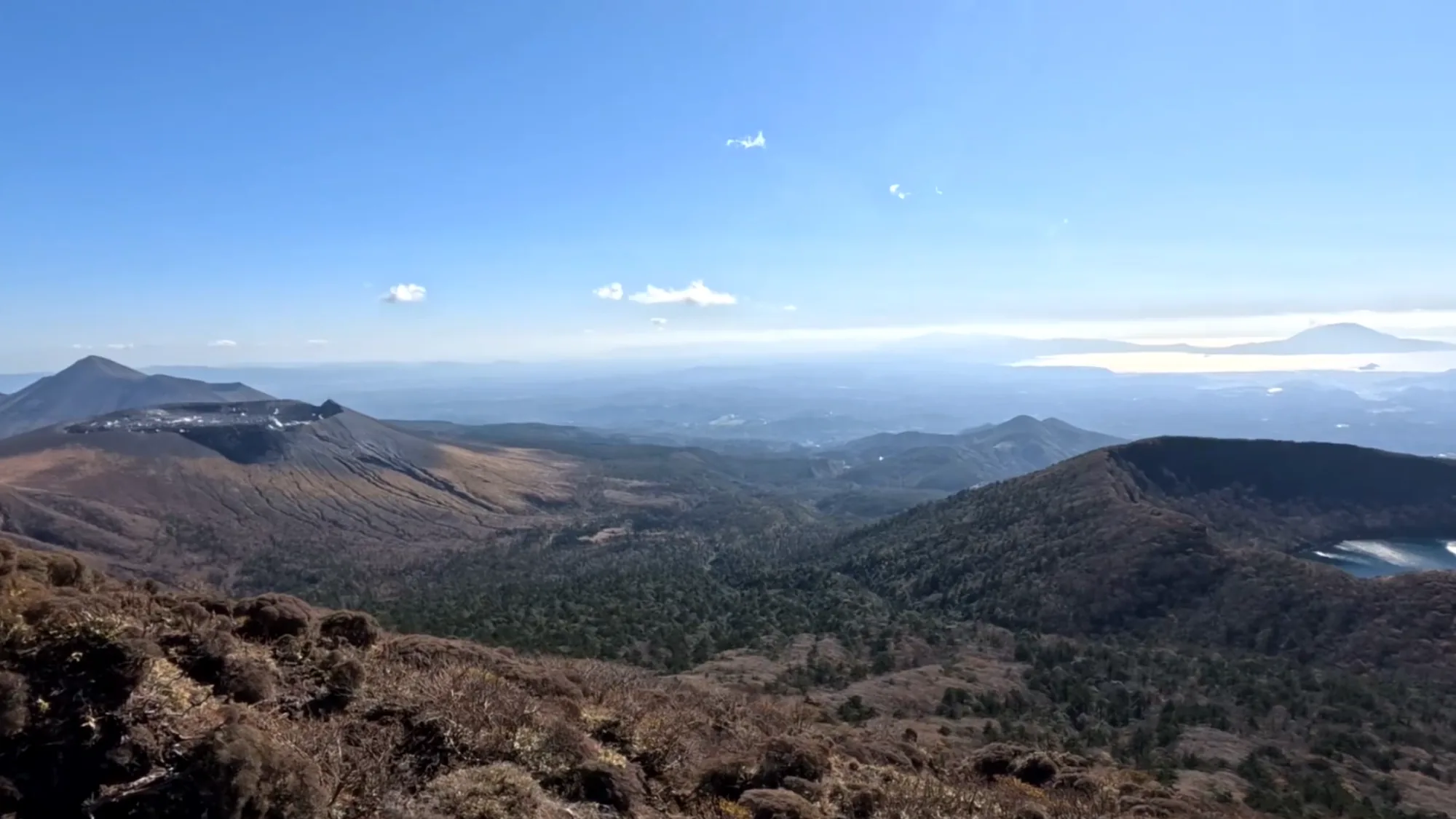
The Kirishima range is twenty-odd volcanoes packed together, and the walking goes between them.
A guided session, once a month, for eight hundred yen.
Four roads, three described, and all three are different
Kirishima City holds this base, certified in 2007. Four roads are recorded and three described, and they are unusually distinct from each other.
The Yanagigahira walking course. Broadleaf-dominated, bright, with good views. From the hilltop the 360-degree panorama, and the local name: the place where you launder your life.
The Maruo nature trail. A course laid in stone paving, where trees more than two hundred years old grow thickly and wild deer and birds live. Early in the morning, wrapped in mist, the atmosphere is all the more mysterious. And near the course is Kirishima’s oldest rock bath.
The stone paving is worth stopping on. It is the most durable and most wheelchair-plausible surface a forest path can have, better than wood chip, which compresses and needs topping up, and better than compacted earth, which turns to mud. It is also expensive and permanent, which means somebody built this deliberately and some time ago.
The Kirishima Shinsui Gorge promenade. It follows a clear stream near Kirishima Jingū, a prepared, easy-to-walk course. And then the geology: columnar jointing, the natural sculpture lava makes as it cools, and a magnificent artificial waterfall. The geosites are concentrated here. Healing of course, the town says, but also ideal as a place of learning.
Columnar jointing is what lava does when it cools slowly and contracts: it cracks into regular polygonal columns, usually five- or six-sided, standing in ranks like organ pipes. In a volcanic landscape it is the most legible possible evidence of what happened, and a therapy road that walks past it is doing both jobs at once — healing and learning on the same stretch of path.
And the mist on the Maruo course is not incidental. Kirishima means mist island. A place named for its fog, advertising its forest at the hour the fog is in it, is being consistent.

The forest floor on the therapy road, thin-soiled over volcanic rock.
No length, time, gradient or surface measurement is published for any of the four roads. Stone paving is named, which is more than most manage.
Four noes, and what they actually mean here
Kirishima answers no to all four service questions: barrier-free access, corporate training, overseas visitors, children.
It is one of four bases out of sixty-two that decline everything, alongside Iwate in the northeast, Kijimadaira in Nagano and Yoshino in Nara. And it is the one that shows the pattern has nothing to do with obscurity.
This is Japan’s first national park. It holds Kirishima Jingū, one of the significant shrines of southern Kyūshū. It has two hot spring districts with nine springs between them, hotels, a roadside station with a chairlift and a slide, and a city-run mineral water plant with a drive-through. It is a major destination with a city tourism division behind it, and it says no to all four.
Which tells you what a no means here. It is not a statement about a forest. It is a municipal department declining to guarantee a service. A city tourism division, asked whether it can promise wheelchair access, a corporate program, foreign-language support and a children’s offer across four roads inside a national park, has answered no four times, because it runs a monthly event with volunteer guides and does not operate any of those things as a standing service.
And the evidence that the forest itself is not the problem sits right beside it. One of the roads is stone-paved. Another is prepared and easy to walk. Those are two of the most promising accessibility descriptions on any certified forest in Japan, on a base that answers no.
Which makes the four questions worth asking more than usual, on 0995-45-5111 or kirikankou@city-kirishima.jp: the width and condition of the stone paving on the Maruo course, whether there is a step at its trailhead, the surface of the approach from parking, and the accessible toilet. Chizu answers yes to wheelchairs and ask-us to companies. Kirishima could almost certainly do the same.
Eight hundred yen, once a month
The program is one line, and it is the cheapest anywhere on this list.

Autumn comes late and low here, in the scrub rather than the canopy.
A regular forest therapy event, held roughly once a month. Reception at nine, activity from half past nine to two, with some events finishing at noon. ¥800 a person.
Eight hundred yen. About $5, for four and a half hours with a guide.
Set that against the rest of the country. Akasawa’s certified therapist costs ¥15,000 (about $100) per guide for four hours. Taruda is ¥8,000 (about $53) a head including a lunchbox. Achi is ¥33,000 (about $220) for one guide, divided however you like. Shisō’s bentō alone is ¥1,630 (about $11). Kirishima is ¥800.
That price tells you what this is. It is not a product. It is a standing monthly event, run by a guide club whose message says simply that walking with a forest therapy guide produces a higher healing effect, so please make use of it. A club, a monthly date, a nominal fee.
Which also explains the four noes completely. A monthly volunteer event cannot promise a corporate program, English-language guiding, a children’s offer or wheelchair provision, because it is twelve days a year. It can, however, walk you round Japan’s first national park for five dollars.
No therapy bentō. No lunchbox at all, on a 9:30-to-14:00 activity, so bring your own.
Trees, including one that is simply mysterious
The tree list is a warm-temperate Kyūshū set, and the special-tree entry is the best anywhere on this list.
Conifers: Japanese fir, red pine, hemlock. Broadleaves: tabu, the Japanese bay tree; sawtooth oak; maple.

Susuki takes the open ground above the tree line.
Tabu is the marker. Machilus thunbergii is a large evergreen broadleaf of the warm coastal forests of southern and western Japan (glossy, dense, salt-tolerant), and a signature of the laurel-forest belt that also runs through Kunigami in Okinawa and Minami-Bōsō in Chiba. Finding tabu alongside fir and hemlock, which are cool-montane conifers, tells you Kirishima spans a serious altitude range, which on a volcanic massif it does.
And the special trees:
The mysterious tabu tree.
That is the entire entry. No measurement, no age, no location, no explanation of what is mysterious about it. Other towns fill the same slot with girths and ages and prefectural designations. Kirishima has written “the strange one” and moved on. It is either the most charming entry in the scheme or the least useful, and it is probably both.
The other two are a red pine avenue and a maple avenue. An avenue means a planted roadside row, so both are deliberate plantings rather than natural stands: a therapy road’s notable trees turn out to be a row somebody laid out.
All four seasons are described, and they make a proper volcanic-highland year: in spring the nokaidō crab apple and the miyama-kirishima azalea, in summer new green, in autumn pampas grass and color, in winter rime ice.
Two of those deserve a note. The miyama-kirishima, Rhododendron kiusianum, is the azalea named for this very massif, and it covers the volcanic slopes of Kyūshū in dense pink in late spring. The nokaidō is a wild crab apple, and the town names it first, ahead of the famous one.
And rime ice in winter, the frozen fog that coats trees into white sculptures. On a mountain called Mist Island, in Kagoshima. Rime-ice country usually means Shiga Kōgen in Nagano; finding it this far south is an altitude statement.

First light on the ridge.
The gods, and the ground they came down on
The second thing the town says about itself is mythology, and it is not decoration.
Takachiho-no-mine is known as the place of the tenson kōrin, the descent of the heavenly grandchild, which appears in the Kojiki and the Nihon Shoki. Kirishima Jingū, which enshrines that grandchild, Ninigi-no-Mikoto, is among Kirishima’s foremost famous places.
Note the verb: is known as. Nobody is asserting the descent happened here. What is being reported is what the mountain is known for, and that is the right register to keep.
Which is why the tagline is the promenade of the gods. And it is why the Shinsui gorge road matters more than its geology alone would suggest: it runs along a clear stream beside the shrine that enshrines the god said to have landed on the mountain above it. Shinsui means sacred water.
Elsewhere a therapy road follows a pilgrim route at Kōyasan, a shrine approach at Mizukami, a Kamakura-era pilgrimage at Nanasawa, an Ise highway at Tsu, and the ground where Ise’s sacred trees were felled at Akasawa. Kirishima makes the oldest claim of the set. Not a route to a sacred place, but the place itself, as recorded in the oldest books Japan has.
And the oldest rock bath in Kirishima is beside the Maruo course. A volcanic massif, nine hot springs, a bath cut into stone before anybody was counting, and a national park designation from 1934. The sequence runs: the gods, the water, the park, the therapy road.
Nine springs, and world-class silica
The facilities here are unusually rich, and the hot springs come in two districts.
Kirishima Onsen-kyō, the Kirishima hot spring village, is a spa village made of nine hot springs on the southern foot of the Kirishima mountains. Maruo Falls and Senjōjiki are nearby, there are many inns and hotels, and it is the base of Kirishima tourism, with a tourist information office at its center.

The range at dawn, before the cloud fills in.
Kirishima Jingū Onsen-kyō, the shrine hot spring village, spreads around Kirishima Jingū. Mainly ryokan, and close to the mountains, so it serves both shrine pilgrims and climbers. There is an information office near the great gate.
Nine springs in one district and a second district beside the shrine puts Kirishima among the most hot-spring-dense forests in the country, alongside Shiga Kōgen’s eight districts and Otari’s ten village springs.
The Kirishima Myth Village Park and roadside station uses the natural terrain and holds a sightseeing chairlift, a super slide and putting golf, with a souvenir corner and a large restaurant. A chairlift and an alpine slide beside a certified forest therapy base raises the usual question of the commercial attraction that pays for the ground, and here the answer is a mythology-themed family park.
And the last facility is the strangest and most specific of the lot. The municipal mineral spring works (関平鉱泉所) is run directly by the city, a sales outlet for a mineral water whose content of silica, the beauty mineral, is world top class. You buy it drive-through. Factory tours are available. There is a hot spring and a local-products shop nearby.
A municipal drive-through mineral water plant with factory tours, listed as a facility of a forest therapy base. The beauty mineral is the city’s phrase, not ours, and we pass it on without endorsing it. But the water is real, the plant is city-owned, and this is the only certified forest in Japan whose nearby facilities include a drive-through.
What is not published
For a base with four described seasons, three described roads and a mythology, the gaps are concentrated in the measurements.
No length, time, gradient or surface width for any of the four roads; stone paving is named on one, and that is all. The fourth road is not named at all. No elevation. No base area. No bentō, on a four-and-a-half-hour activity. No animals beyond the deer and the unnamed birds on the Maruo course, in a national park, which is a real loss. No guide-club name, no membership figure, no annual numbers. And no access information: no station, no journey time, no fare.
The operator is Kirishima City’s Commerce and Tourism Department, Tourism PR Division, on 0995-45-5111 or kirikankou@city-kirishima.jp. The city files its forest page under tourism, nature.

Weather moves fast over the caldera.
That filing is worth noting. Saku files its forest under health promotion. Kusatsu files it under health and welfare. Chizu files it under mountain-village regeneration. Kirishima files it under tourism, nature. Four towns, four theories of what a forest is for.
Go on the monthly date, early, in mist
The recommendation is unusually easy, because the program decides it for you.
Find out when the monthly event is and go on that day. Eight hundred yen for four and a half hours with a guide is the best value in Japan’s certified forest system by a very wide margin, and there are only about twelve chances a year.
Ask for the Maruo course, and go early. Stone paving, trees over two hundred years old, wild deer, and the promise that when the mist closes in at dawn the atmosphere is all the more mysterious, on a mountain whose name means mist. Kirishima’s oldest rock bath is near the course; find out whether you can get into it.
Then walk the Shinsui gorge by the shrine for the columnar basalt and the concentrated geosites. It is the one road here explicitly offered as a place of learning as well as healing, and it runs beside the shrine of the god who is said to have come down onto the mountain above you.
And climb the hill on the Yanagigahira course for the 360-degree view, because the people who live here call it the place where you launder your life, and that is a recommendation from a better source than any brochure.
Come in late spring for the miyama-kirishima, the azalea named after this mountain, or in deep winter for the rime ice, which should not be possible this far south and is.
Nine hot springs are waiting at the bottom. A city-run drive-through will sell you water with world-class silica in it on the way home. And the park you have been walking in has been protected since 1934, which makes it the oldest decision of its kind in Japan — taken, as it happens, on the ground where the country’s oldest books say everything started.
Nearby and alike

Nagano · Certified 2006
Akasawa
Four hundred years of protection, the cypress that rebuilds Ise Shrine, Japan’s first recreation forest, and the 1982 gathering that gave forest bathing its name.

Ōita · Certified 2012
Ōita
Ten certified roads within an hour of Ōita, from a flat museum loop to a five-star ridge, with guides at ¥3,000 a group.

Okinawa · Certified 2007
Kunigami
A subtropical broadleaf forest where seven trees in ten are the same species. Five certified roads, World Heritage since 2021, and cherry in January.
Verified by The Japan Onsen Society
Sources
森林セラピー「鹿児島県 「いやしの森」国立公園霧島」— https://fo-society.jp/facility/kirishima/ (神々のプロムナード; 霧島市; 認定 2007年; 🔴 barrier-free 否 · corporate 否 · inbound 否 · children 否 — ALL FOUR; 霧島は昭和9年に日本で最初に国立公園に指定された地。春にはノカイドウやミヤマキリシマをはじめとした花々が咲き、夏は新緑、秋はススキと紅葉、冬は樹氷と、四季折々の自然が山肌を彩り、登山やトレッキングで訪れる人々を魅了する; 高千穂峰は「古事記」や「日本書紀」に登場する天孫降臨の地として知られ、神話の主人公である天孫・ニニギノミコトを祭神として祀る霧島神宮は霧島屈指の名所として知られている; ロード数 4, 3 described, nothing measured; ⭐ 柳ヶ平散策路 — 広葉樹林を主体とした明るく見晴らしの良いコース。丘の上からは360度の大パノラマが広がり、その雄大な眺めで爽快感が味わえることから、地元では「命の洗濯場」として親しまれています; ⭐ 丸尾自然探勝路 — 石畳で整備されたコースで、樹齢200年以上の大木が生い茂り、野生のシカや野鳥が生息しています。早朝、霧に包まれると一層神秘的な雰囲気が漂います。また、コース近くには霧島最古の岩風呂があります; 霧島神水峡遊歩道 — 霧島神宮近くの美しい清流に沿って霧島の自然を感じられる整備された歩きやすいコース。溶岩が作り出した自然の造形美「柱状節理」や豪快な人工滝があり、ジオサイトが凝縮されています。癒しはもちろん、学びの場としても最適です; セラピー弁当 無; conifers モミ・アカマツ・ツガ, broadleaves タブノキ・クヌギ・モミジ, 特徴木: 不思議なタブの木 · アカマツ並木 · モミジ並木; all four seasonal fields filled — 春 ノカイドウ・ミヤマキリシマ / 夏 新緑 / 秋 ススキ・紅葉 / 冬 樹氷; ⭐ 森林セラピー定期イベント — 〇月に1回程度開催。セラピーロードなどをガイドと散策します。〇9:00受付 活動9:30~14:00(12:00終了のイベントあり)〇一人800円; guide message from a ガイドクラブ; 霧島温泉郷 — 霧島山の南麓にある9つの温泉からなる温泉郷。丸尾滝、千畳敷等の名所、旅館・ホテル等も多く霧島観光の拠点; 霧島神宮温泉郷 — 主に旅館、霧島神宮への参拝や霧島山への登山の拠点、大鳥居の近くに観光案内所; 霧島神話の里公園 道の駅霧島 — 遊覧リフトやスーパースライダー、パターゴルフ; ⭐ 関平鉱泉所 — 霧島市直営の関平鉱泉水の販売所。美のミネラル「シリカ」含有量世界トップクラスのミネラルウォーターをドライブスルー形式で購入できます。工場見学も可能; contact 霧島市 商工観光部 観光PR課, kirikankou@city-kirishima.jp, 0995-45-5111; official site https://www.city-kirishima.jp/kirikan/kanko/shizen/shinrintherapy.html)
森林セラピーソサエティ「森林セラピー基地 検索・一覧」— https://fo-society.jp/base-road_list/ (Kirishima = No. 61, 鹿児島県; all four columns BLANK. Enumerated: the rows with all four blank are No. 2 岩手町 · No. 28 木島平村 · No. 42 吉野 · No. 61 霧島 — four bases, counted)
Verified: 2026-10-05