
Slender beech trunks in fresh spring green above a bare leaf-covered floor at Hadano, Kanagawa
Step-free
Unverified
Answered yes, nothing published on surface
Open
Year-round
On request
The record
What you need to go
Open season
Walks run year round on request. Nothing is published about the seasons here
Getting there
not published
Fees
A two-hour guided walk, per person: ¥10,000 (about $67) alone, ¥5,500 (about $37) for two, ¥2,500 (about $17) for six. Plus a 20 percent planning fee and ¥100 a head for woodland conservation
Onsen
not published
The walk
Main trail
Not published. The five run to Togawa Park and its Bridge of Wind, the Kuzuha spring, the Harudake spring water, the Kuzuha gorge and Kōbōyama park
All trails
5 trails, named but not measured. Each has a downloadable route map from the city
The step-free road
All four service questions are answered yes, including barrier-free, but no path width, gradient or surface is published anywhere
The forest
Forest type
Five roads on the near face of the Tanzawa range, three named for springs or a gorge where the mountain’s groundwater comes out
What grows
not published
What lives
not published
Certified since
2020
All figures updated 5 October 2026
The forest, before the facts
Hadano publishes nothing at all about its forest.
Every tree field on its page is blank. Every seasonal field is blank. There is no description of what grows there, nothing about spring or winter, no named waterfall, no old cedar, not one species. Among Japan’s certified bases, it stands alone in declining to describe itself.
What it publishes instead is the complete commercial terms of a guided walk, in more detail than anything else in Japan’s certified forests. A price table by party size, from one person to six. A guide ratio. An options menu of ten items. A twenty percent planning fee, stated as a percentage and worked through in an example. A one-hundred-yen-per-person conservation levy paid to the local satoyama conservation council. A three-tier cancellation policy. And a rule for calling off a walk because of weather that is tied to a specific probability in a specific forecast issued at a specific hour.
That is a strange and rather wonderful thing to find. Hadano is the most professionalized forest therapy base in Japan and it will not tell you what the trees are.
Which turns out to be useful in its own way. This is the base you book when you know what you want and need to know exactly what it will cost.
Five reasons to come
The only base in Japan that publishes its full price table by party size.
A compulsory hundred-yen levy that goes to local woodland conservation.
Stress measured by salivary amylase, and blood pressure, as a bookable extra.
Listening to a stream through a bamboo tube, which is on the menu.
Five roads an hour from Tokyo, each with a downloadable map.
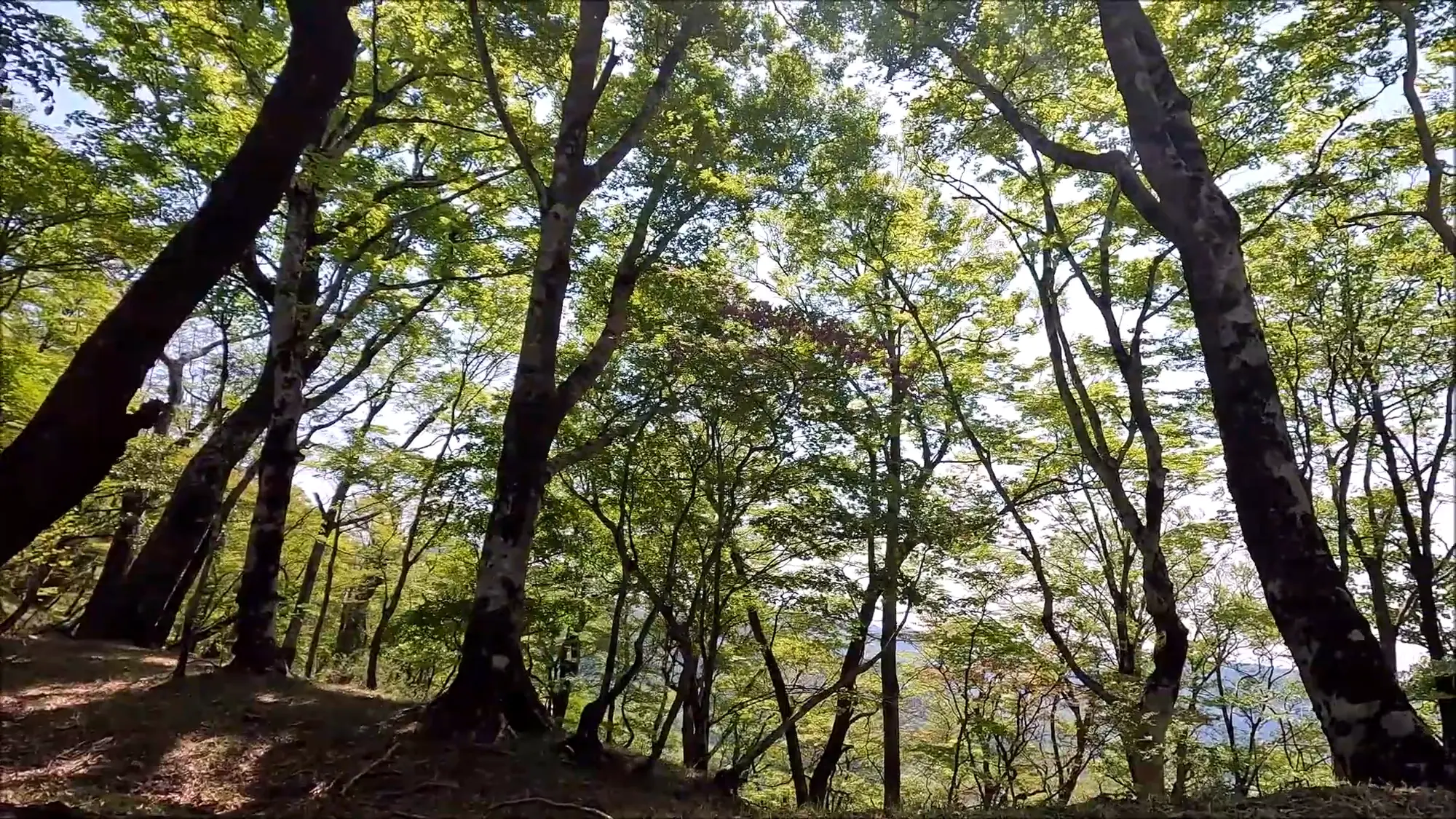
Looking up, which is what the ridge is for.
Five roads and five PDFs
The Hadano Omote-Tanzawa Forest Therapy Base (はだの表丹沢森林セラピー基地) sits in Hadano city, western Kanagawa, on the front face of the Tanzawa range — Omote-Tanzawa, the near side, as against the Nishi-Tanzawa of neighboring Yamakita. It was certified in April 2020, which makes it among the most recently certified bases in the country, newer even than Kitamoto’s 2019.
Wheelchairs and strollers, corporate training, overseas visitors and children are all accepted.
Five roads are listed, by name only, each with a downloadable route map from the city:
Hadano Togawa Park and the Bridge of Wind (秦野戸川公園・風の吊り橋コース)
The outdoor activity center and the Kuzuha spring (表丹沢野外活動センター・葛葉の泉コース)
Minoge and the Harudake spring water
The Kuzuha gorge (くずは峡谷コース)
Kōbōyama park (弘法山公園コース)

The steps up the first ridge, held together by roots and not much else.
No length, time, gradient or surface is published for any of them. Those figures are presumably on the five PDFs. Download them before you plan.
But look at what the names are telling you. Three of the five are named for water — a spring, spring water, and a gorge. Hadano sits on the southern foot of the Tanzawa massif, where the groundwater that has soaked through that whole mountain block comes out at the base, and the city is known for it. Whatever else is published, this is a base organized around where the water emerges.
What it costs, exactly
Here is the thing nobody else does, in full, because its completeness is the point.
A guided forest walk (森林散策) of about two hours. One guide handles up to seven participants. The price is per person and falls steeply with party size:
Guided walks are priced per person, and the rate falls as the party grows:
1 person — ¥10,000 per person (about $67)
2 people — ¥5,500 per person (about $37)
3 people — ¥4,000 per person (about $27)

Late winter on the ridge, when the light gets all the way to the ground.
4 people — ¥3,200 per person (about $21)
5 people — ¥2,800 per person (about $19)
6 people — ¥2,500 per person (about $17)
Seven or more, you ask. And one person is enough to run it — the base states a minimum of one, like Takashima on Lake Biwa, though here the solo walker pays for the whole guide.
Then the options, priced on inquiry:
Forest yoga (45 or 60 minutes) · aroma-making: an aromatic product, either with a still set up on site or blending only · a health measurement: specifically a stress check by salivary amylase and a blood-pressure reading · plant dyeing · roasting your own hōjicha · wooden magnets · scent boards · a forest therapy bentō · a hammock · and listening to the stream through a bamboo tube.
Then a 20 percent planning fee on the total of walk plus options. Then ¥100 per person to the satoyama council. The city works the arithmetic for you: two people, walk only, is ¥11,000 (about $73) plus ¥2,200 (about $15) planning plus ¥200 (about $1.30) levy — ¥13,400 (about $89) for two.
Cancellation: free up to three days before; the cost of the lunchbox from two days out; the full fee on the day.

Tanzawa paths are steep, and most of them end up as stairs.
Nothing else comes close. Most bases publish no price at all. Hadano publishes a table, a ratio, a fee structure, a levy and a worked example, and you could budget a trip from it without making a single phone call.
Where that price sits, across the whole country
Because almost nobody else publishes a figure, Hadano’s table is the only place in Japan’s certified forests where you can see what guided forest therapy actually costs. It is worth setting against the few other numbers that exist.
A solo guided walk runs ¥20,000 (about $133) at Okutama in Tokyo and ¥10,000 (about $67) here. A party of five pays ¥2,800 (about $19) each here, against ¥7,000 (about $47) each at Okutama and something around ¥3,000 (about $20) each at Okukuji in Ibaraki, depending on how that base counts a booking. And at Nukumidaira in Yamagata, on Sundays in autumn, an attendant stands at the trailhead and will walk you for ¥1,000 (about $7) an hour, no reservation.
So the national spread for essentially the same product (a certified guide, a couple of hours, a forest) runs from a thousand yen to twenty thousand (about $7 to $133), a factor of twenty, with no published comparison anywhere and no visible logic beyond what each operator decided. Hadano sits in the middle and is the only one you can budget from.
The 20 percent planning fee is the unusual mechanism. Most operators fold their overhead into the headline price; Hadano itemizes it, which makes the number look larger and the operation look more honest. On the worked example, two people walking only, the fee is ¥2,200 (about $15) — and because it applies to options as well, a party that adds yoga, aroma-making and the health measurement will pay a fifth again on all of it. Budget accordingly, and ask for the quotation in writing, which the city offers to provide.
Two things in that list that matter more than they look
The ¥100 levy. It goes to the Hadano liaison council of satoyama conservation groups, and the city states what it is for: to be useful to Hadano’s satoyama conservation activities. A hundred yen is sixty-seven cents. It is not a revenue stream; it is a principle, written into the invoice, that walking in a managed woodland incurs an obligation to the people who manage it.
Nothing like it exists anywhere else in Japan’s certified forests, and it is the kind of mechanism that scales. Uenomura protects its forest by capping entry. Hadano does it by charging a visible, itemized, almost insultingly small amount and telling you where it goes. Both are local inventions; neither is required by the certification.
And the health measurement. The option is salivary amylase stress check plus blood pressure — which are, precisely, two of the measures the Ministry-adjacent certification experiments use, and two of the five that Ōita publishes as its own certification methods. Hadano has taken the research instrument, put it on a menu, and priced it.

Up here the trees thin out and the wind does the pruning.
That makes it the fourth base to hand the measurement back to the visitor (after Oguni’s before-and-after stress check, Kazuno’s self-service equipment at the forest station, and Akagi’s self-assessment sheet) and the first to make it a line item you can buy. The pattern holds right across the country: the certification regime measured once and published nothing; the bases measure continuously and let you keep your own number.
Water, in three of the five names
With no vegetation, no seasons and no measurements published, the names of the five roads are the best clue to the character of this forest — and names in Japanese are unusually informative, because they are descriptive rather than commemorative.
Three of the five are water. The Kuzuha spring (葛葉の泉) is a spring — groundwater emerging. Harudake (春嶽湧水) is welling water, the specific term for a spring with enough flow to be a named feature. The Kuzuha gorge (くずは峡谷) means a stream has cut down through rock. That is three separate certified roads organized around where water comes out of or runs through the ground, in one small city.
There is a straightforward reason. Hadano sits in a basin at the southern foot of the Tanzawa massif, and the rain that falls on that whole block of mountains travels down through it and emerges at the base. The city is locally known for its spring water. So expect a basin-edge forest full of emerging groundwater — cool, wet, and loud in the way only running water makes a wood loud.
The other two names point elsewhere. Hadano Togawa Park (秦野戸川公園) is a large riverside prefectural park with a well-known suspension footbridge, the Bridge of Wind (風の吊り橋) — which suggests the easiest and most family-oriented of the five. Kōbōyama Park (弘法山公園) is a hill park named for Kōbō Daishi, the monk who founded Kōyasan, whose name is attached to hills and springs all over Japan; it is a known local walking and cherry-blossom spot.
None of that is a substitute for a published length and gradient. Download the PDFs.
The weather rule
The single most unexpected sentence Hadano publishes is its cancellation trigger.
Rough weather: cancelled. Light rain: may go ahead, and they will tell you in advance which events those are. And then:

The grassy saddle between two summits, which holds frost until midday.
If the Japan Meteorological Agency forecast issued at 11:00 two days before gives a 40 percent or higher chance of precipitation between 06:00 and 18:00, the event is cancelled.
A named forecaster, a named issue time, a named threshold, a named window. There is no judgment call, no waiting to see, no disappointed phone call at seven in the morning. You will know two days out, and so will they, and the rule is the same for everybody.
It is a small administrative thing and it tells you more about how this base is run than any amount of prose about healing would. Somebody sat down and decided that ambiguity was the problem, and removed it.
Booking is asked three weeks ahead as a rule, though the city says shorter notice can sometimes be accommodated. Requests go to the Forest Engagement Section (森林ふれあい課) on 0463-82-9631 or by email, and the city’s own framing is the opposite of exclusive: we can run an event to suit what you want, so please just get in touch.
Who runs it, and the fifth model
The contact is Hadano City Hall, Environment and Industry Department, Forest Engagement Section, Forest Engagement Unit.
That is a municipal department with forest engagement as its actual job title, which is different again from the other models around the country. Iwate’s base is run by a board of education. Yamakita’s, next door, is run by a health insurance section. Tome’s is run by a forestry cooperative. Kitamoto’s by a registered NPO. Akagi’s by a private company. Hadano has a section whose entire remit is the relationship between the city and its woods, and it is the one that produced the price table, the levy and the weather rule.
The organizational shape keeps turning out to predict the product better than the landscape does. A tourism department sells a destination. A health section sells prevention. A forestry cooperative sells the forest’s own output. A forest engagement section sells access, honestly priced, with the conservation cost on the receipt.
What is missing, and how to get it
The limitation here is severe.

The whole Kanto plain is down there, usually under haze.
Hadano publishes nothing about its forest. No tree species. No seasonal note. No road length, time, gradient or surface. No elevation, no area, no fauna, no climate. You cannot learn from the certified listing what kind of wood this is, when to come, or how hard the walking is.
What exists instead is five PDF route maps on the city’s website, one per road, and they are almost certainly where the distances, the times, the terrain and the points of interest live. Open those before planning anything. They are the whole missing half of this base and they are two clicks away.
The other thing to ask the Forest Engagement Section, given the blanket yes on barrier-free access, is the same four questions worth asking everywhere: the surfaced width of the easiest road, whether there is a step at the trailhead, the surface of the approach from parking, and the nearest accessible toilet. Hadano’s yes is more credible than most, since this is a city base with a staffed section and a park with a famous suspension bridge in it. But a one-word yes is still a statement about a base rather than a measurement of a path, and Kanra in Gunma has already shown that such an answer can be flatly wrong in either direction.
Getting there, and what to make of a base that will not describe itself
No station, journey time, bus route or fare is published. Hadano is in western Kanagawa on the southern face of the Tanzawa mountains, inside the belt the Tokyo rail network reaches comfortably, and the city runs its own forest therapy pages.
So what do you do with a certified forest that has published its cancellation policy and not one tree?
You read it as what it is: a base built for people who have already decided. If you want to be persuaded that forest bathing is worth doing, go to Nukumidaira and walk with a bear hunter, or stand in the boneset meadow at Akagi in late September and wait for the butterflies. Hadano is not making the case. It assumes you have heard the case, and it has organized itself around the next question, which is how much, with how many people, on what date, and what happens if it rains.
Those are the questions of somebody who intends to actually go. And the answers are all on one page, in a table, with a hundred yen added at the bottom for the people who keep the woodland standing.
Book three weeks out. Take the salivary amylase test at both ends if you are curious. Add the bamboo tube — two hours is a long time to listen to a stream, and somebody in Hadano worked out that it is better through a piece of bamboo, and put it on the menu at a price.
Nearby and alike

Kanagawa · Certified 2011
Yamakita
Ninety percent mountain, eighty kilometers from Tokyo, with every road published to the minute — and a cedar the program tells you to touch rather than photograph.

Kanagawa · Certified 2007
Nanasawa (Atsugi)
A plantation forest the size of a city on the foot of Tanzawa, with four onsen districts beneath it, boar hotpot from October, and a coppice working party on the third Sunday.

Saitama · Certified 2019
Kitamoto
The nearest certified forest to the capital, on flat ground, where the shortest road takes fifteen minutes to walk and the session built on it runs two hours.

Forest Bathing in Japan
Japan named forest bathing in 1982, then measured it. The practice, the places, and what the studies show.

The Walk
A measured forest walk is about thirty minutes and no destination. Here it is, sense by sense, step by step.

Choosing a Base
Eight forests, from Kusatsu to Yakushima. Which fits your days, your season and the onsen waiting after.