Kanagawa · Certified 2018
me-byo valley BIOTOPIA: The One Forest in Japan Where You May Pick a Leaf
A privately owned therapy road on a Jomon spring plateau, in a valley named for the state between health and illness — where the guides invite you to crush leaves as you walk.

Avenue of metasequoia in full golden autumn color above a leaf-covered slope at BIOTOPIA, Oiso, Kanagawa
Step-free
Not step-free
Barrier-free marked no
The main road
Healing Forest route
いやしの森コース · length not published
The record
What you need to go
Open season
Not published. The bamboo stays green, and the ginkgo avenue turns in the second half of November into early December
Getting there
not published
Fees
not published
Onsen
not published
The walk
Main trail
The Healing Forest route (いやしの森コース), built around sitting in a bamboo grove. Length not published
All trails
3 trails, none of them measured or timed
The step-free road
Barrier-free is a flat no. Support for overseas visitors is in English only, and children are taken from elementary school age upward
The forest
Forest type
Privately owned woodland on a spring-fed Jomon plateau at the end of the Koyurugi hills, with Fuji, Hakone and Sagami Bay in view
What grows
Hinoki cypress · Cedar · Konara oak · Kunugi oak, with a bamboo grove, a ginkgo avenue and a married pair of ginkgo
What lives
not published
Certified since
2018
All figures updated 5 October 2026
The forest
Here you are allowed to pick things.
The guides say so themselves, and they give the reason in the same breath: because this is a privately owned therapy road, you can pick leaves and branches as you go and smell them.
Set that against everywhere else. At Tsubetsu in Hokkaidō the nature center states plainly that individuals may not gather plants, because what grows is finite and the balance has to hold. At Iwate you file a form at the municipal gym before entering national forest. Elsewhere the forest belongs to the state, a prefecture, a temple or a cooperative, and the understood answer to may I take a leaf is no.
At BIOTOPIA the land is owned by a coffee company, and the answer is yes. Crush a bay leaf between your fingers, pull a cypress sprig down to your face, take a piece of bamboo leaf and roll it. The single most direct sensory instruction in Japanese forest therapy, and it exists because of a property deed.
What you are picking in is a bamboo grove and a ginkgo avenue on the end of a geological ridge, above a Jomon plateau full of springs, with Fuji and Hakone and Sagami Bay in view. And the valley it sits in is named after a medical concept.
Five reasons to come
A private forest where you are invited to pick leaves and smell them.
Meditation in a bamboo grove, with the light coming through in pieces.
A herb garden whose own herb water you drink at the end.
A married pair of ginkgo, and an avenue of them yellow in November.

The hill path, which is short and worth doing slowly.
Fuji, Hakone and the sea from a plateau people have lived on since the Jomon.
A valley named for the state between health and illness
me-byo valley BIOTOPIA sits in Ōi (大井町), western Kanagawa, and was certified in 2018.
The name is the first thing to explain, because it is not decorative. Mibyō (未病) is a term from classical Chinese medicine for the condition between being well and being ill: the body already changing, the illness not yet arrived. Kanagawa prefecture adopted it as a public-health framing, and this site is built around it. A valley named for pre-disease, with a certified forest in it.
What the forest sits on is more interesting than a wellness campus has any right to be. The Koyurugi hills (こゆるぎ丘陵) are the trace of crustal movement in the deep past, and the base occupies the end of them: a spring-rich Jomon plateau forest. On it are a shrine to Yamato Takeru, the legendary prince of the Kojiki and Nihon Shoki, and Jomon archaeological sites — people were living on this ground ten thousand years ago, for the straightforward reason that the springs are here.
From it you see Fuji, the Hakone massif, and Sagami Bay.
The base’s own statement of purpose is two phrases, and they are better than most: to gently open the five senses, and to reset your own time and space. That is what the paths are for. Not a destination. A verb.
Why there are springs here, and why that brought people ten thousand years ago
The phrase for this ground is a spring-rich Jomon plateau forest, and the three parts of it are causally linked in a way worth unpacking, because it explains everything else here.

Late afternoon in November, when the ground is brighter than the sky.
The Koyurugi hills are the trace of ancient crustal movement, and what that produces, geologically, is layered ground: permeable material sitting over something that water cannot pass through. Rain soaking into the top of such a formation travels down until it meets the barrier, then sideways, and comes out in a line of springs where the layer reaches daylight — typically along the edge of a terrace or the foot of a ridge. That line is where the springs are, and it is where this base sits.
Which is, in turn, exactly why there are Jomon sites on it. The Jomon period runs from roughly fourteen thousand to three hundred years BCE, and its settlements are found with great regularity on terrace edges above reliable water: you want to be dry, defensible and above the flood line, with a spring you can walk to. A spring-rich plateau edge is one of the most predictable places in Japan to find Jomon material, and the base has it.
So the archaeology is not decoration layered onto a wellness campus. The springs chose the site, the springs brought the people, and ten thousand years later the springs are still the reason the forest here is what it is. The shrine to Yamato Takeru sits in the same logic — the legendary prince’s progress through eastern Japan is marked by shrines at exactly this kind of place, and whatever one makes of the legend, the shrines are sited where the water and the ground made settlement possible.
Walking a plateau-edge spring line is also, practically, a particular kind of walk: cool, damp underfoot, with the vegetation changing as you cross the seep line, and water audible where there is no stream on the map.
Three roads, and one of them is for sitting in bamboo
The Healing Forest route (いやしの森コース) is the easy introduction: forest paths, and at its center meditation in a beautiful bamboo grove.
The Satoyama and Power Spot route (里山・パワースポットコース) runs to a shrine inside its guardian grove (the woodland that surrounds a Shinto shrine, and in Japan frequently the oldest and least disturbed stand in a district, precisely because nobody has ever been allowed to cut it) and on to an aroma garden. Powerful healing is promised, in the operator’s own words.
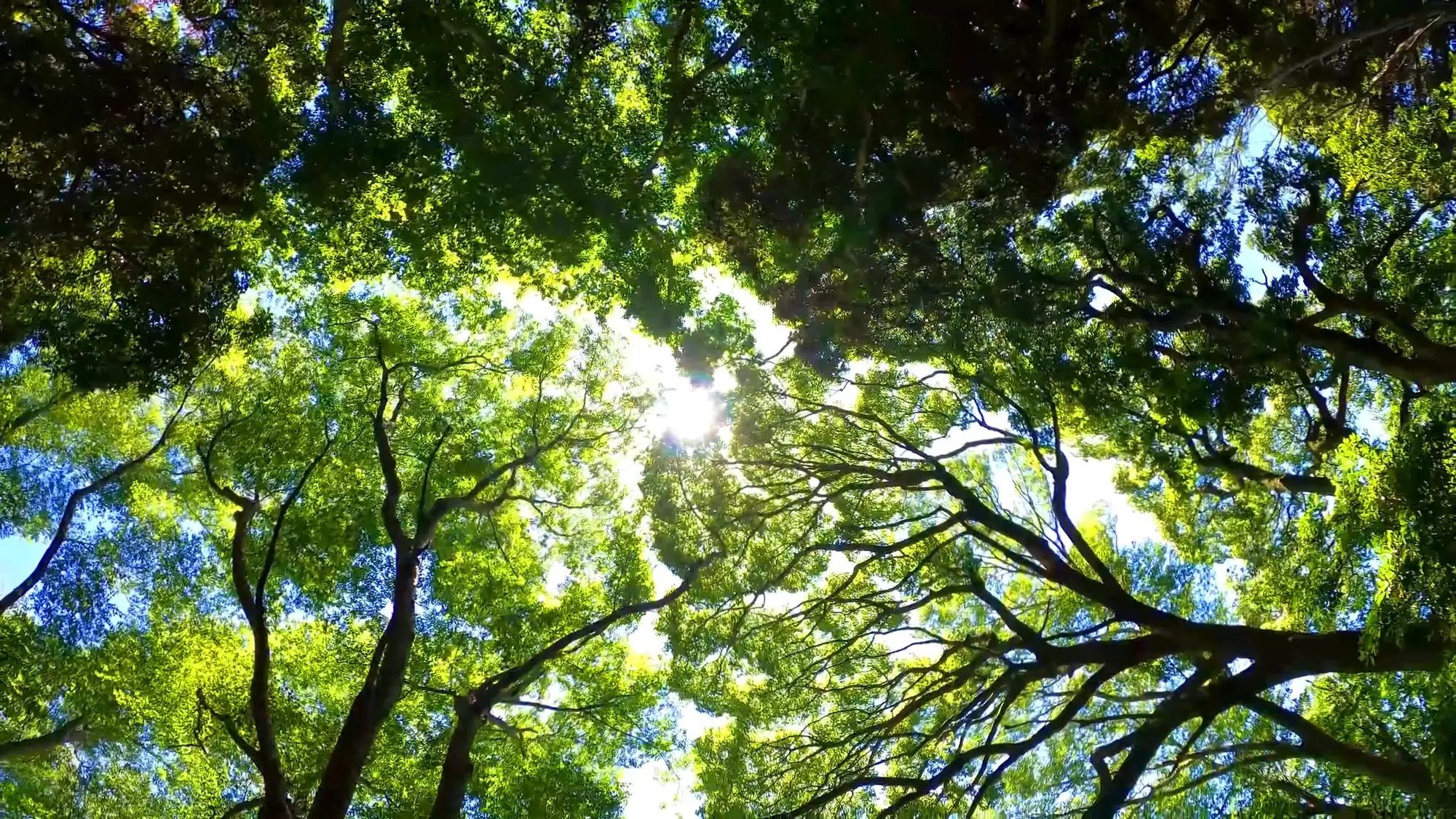
The same avenue in June, when none of the ground gets any light at all.
The Ginkgo Avenue route (銀杏並木コース) is for people who want to walk properly. Its sequence: a forest of old cherry trees, the view of Hakone, the ginkgo avenue, satoyama — scenery turning one thing into the next.
No length, time, gradient or surface exists for any of the three, which on a site this organized is a surprising gap and the first question for the operator.
The tree list is ordinary above and unusual below. Cypress and cedar; konara and kunugi oak. And then the three singled out: the married ginkgo (夫婦銀杏), a paired male and female tree, the bamboo grove, and the ginkgo avenue.
Nobody has written down what each season brings. But the description fills part of the gap on its own: fresh green bamboo, and the magnificent yellow of the ginkgo avenue, which in this part of Japan means the second half of November into early December.
Bamboo, and why sitting in it is different
The bamboo grove is named twice, once as a road’s centerpiece and once in the guides’ message, and it is worth understanding why a Japanese operator would build a meditation practice around one rather than around trees.
A mature moso grove is unlike any other kind of wood to stand in. The culms are evenly spaced, almost identically thick, and completely bare for most of their height, so there is no understory and nothing at eye level; the canopy is high, thin and continuous, so the light arrives in small moving pieces rather than in beams. It is quiet in a very specific way, because the leaves are small and stiff and the sound they make in wind is a dry hiss rather than a rustle. And bamboo moves: the culms are flexible along their whole length, so in any breeze the entire grove sways together, at a frequency slow enough to watch.
The guides call it forest rest in a bamboo grove into which gentle dappled light falls, and they say to expect deep relaxation. It is an unusually architectural claim: not the forest is calming but this particular structure of vertical lines, high thin canopy and continuous slow movement does something.

The steep route up the back of the hill, which the roots are slowly taking over.
Whether it does is a question for the literature. That somebody chose the grove deliberately, and built the sitting into the route, is the point.
The herb water, and what private operation buys
At the end there is something to drink. Herb water made on site, from herbs grown in their own garden — well received, the guides say, and it lets you take the place in through taste as well.
Put that together with the permission to pick, and a proposition emerges that no public forest can match. BIOTOPIA may be the only certified forest in Japan where all five senses are genuinely available. You can look and listen anywhere. You can smell deliberately only where you are permitted to crush a leaf. And you can taste the forest only where somebody grows, harvests and distills it for you.
Takashima in Shiga comes closest, with its kuromoji tea — but that is one plant, served, on a public road. Here the garden, the picking and the glass at the end are a single owned system.
This is one of very few privately operated bases. Akagi Shizen-en in Gunma is another, and both do things that public land cannot. Akagi can maintain sixty hectares (148 acres) by hand daily and cap a program at twelve people. BIOTOPIA can let you take a leaf and can grow its own herbs for the drink. Public ownership gives you scale, free access and permanence. Private ownership gives you the things that require somebody to be in charge of the ground. Both are worth having, and you should know which one you are standing in.
The operator is Brook’s Holdings (ブルックスホールディングス), a coffee business, on 0465-85-1113. Which is worth saying plainly: the forest you are walking in is a corporate asset, and the permission to pick a leaf is a commercial decision rather than a right.
The two qualified yeses, and why they matter more than they look
The quietest thing here is the most useful.
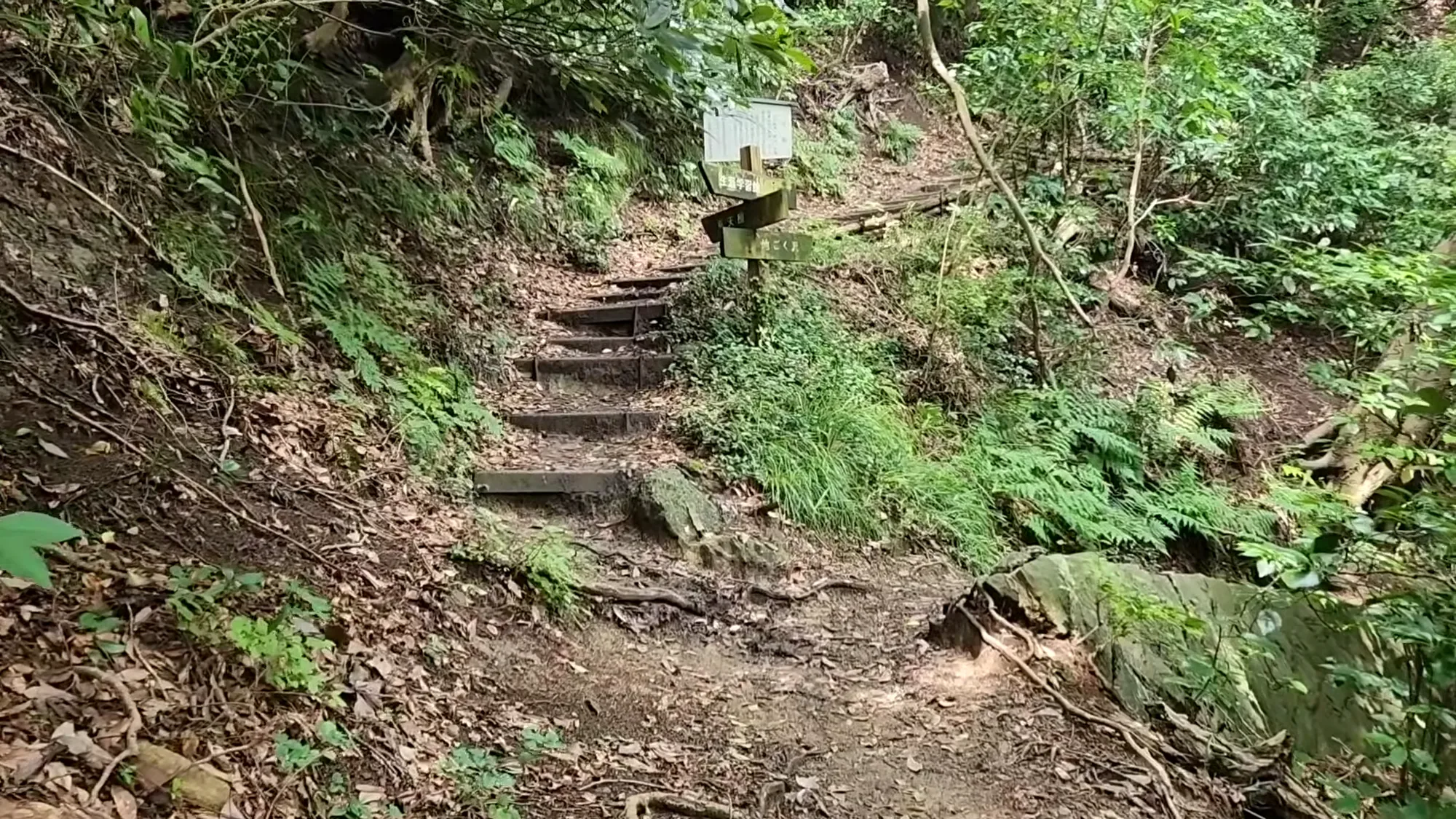
Off the mown ground the paths narrow and get steep quickly.
Almost every certified forest answers the Society’s four service questions with a single word. Yes or no. Nothing else. That one word is what you have to work from if you are planning around a wheelchair, a language or a child — and it is sometimes flatly wrong in one direction or the other.
BIOTOPIA is the only base that writes conditions into the answer.
Overseas visitors: yes — but the support is in English only.
Children: yes — but from elementary school age upward.
Those are two sentences. They took somebody thirty seconds to write. And they turn a binary into something you can act on: a French-speaking visitor knows to bring English; a family with a four-year-old knows to wait a couple of years.
The field can carry nuance. Nearly everywhere else has simply not used it. Which means the service answers across the whole scheme are thin by convention rather than by design — and it is why the four questions are always worth asking yourself.
The one straightforward no
Barrier-free access is a flat no, with no qualification, and here that is credible rather than suspicious. The roads run over the end of a geological ridge to a shrine, a bamboo grove and a ginkgo avenue; nothing suggests a surfaced route, and an operator demonstrably willing to write caveats into the other fields has not written one here.

The track along the shoulder of the hill, mown rather than surfaced.
The four questions are still worth putting to them, because the site is a developed campus and the approaches to the gardens are likely to be better than the forest paths: the surfaced width of the easiest route, a step at the trailhead, the surface from the parking lot, and the accessible toilets. But do not expect the answer to change. Better to say that than to imply otherwise.
Corporate training is a yes, which given the valley’s framing and its corporate ownership is unsurprising, and is probably a significant part of the business.
Getting there, and what to do with a forest you may touch
There is no published station, journey time, bus route or fare; the operator’s own site has them. Ōi is in western Kanagawa, in the country between Odawara and the Tanzawa foothills, inside the belt Tokyo reaches on a day trip.
So here is how to use this place, which is different from how to use anywhere else.
Go in the second half of November, when the ginkgo avenue is yellow and the bamboo is still green behind it. Take the easy forest route first and sit down in the bamboo grove for longer than feels reasonable — twenty minutes, watching the culms move together and the light come through in pieces. Then the shrine route, for the guardian grove and the aroma garden. Then, if the legs are willing, the ginkgo road, past the old cherry forest with Hakone in front of you.
And the whole way: pick things. A bay leaf, a cypress sprig, a bamboo leaf, whatever the guides point at. Crush it, smell it, drop it. You are standing on a plateau people chose ten thousand years ago because of the water coming out of it, in a valley named for the condition of not yet being ill, on ground somebody bought — and the owner has decided you may put your hands on it.

A water basin nobody has emptied in a long time, and all the better for it.
That is a smaller thing than a two-thousand-year cedar or a bear hunter. It is also, for a practice whose entire instruction is use your senses, the only base that lets you finish the sentence.
What a wellness valley is, and the honest question it raises
One more thing needs saying, so you can place this base against the others rather than take it on its own terms.
BIOTOPIA is a developed site: a valley with facilities, gardens, a herb operation, a café business behind it, and a therapy road running through the woodland at its edge. That is a different object from Uenomura’s twelve-kilometer (7.5 mi) headwater path, or Mizukami’s three-and-a-half-hour shrine ascent, or Nukumidaira’s five and a half kilometers (3.4 mi) of two-hundred-year beech.
Which raises a fair question: is a corporate wellness campus with a woodland on it the same kind of thing as a mountain village’s forest?
The certification says yes — the same standard, the same required physiological experiment, the same character fields. And on the standard’s own terms it is probably right: the Society asks for two or more paths that are wide, gently sloped and easy to walk, with lodging, and an experiment showing measurable effect. BIOTOPIA clears that. The bamboo is real bamboo, the ginkgo avenue is real, the springs have been coming out of that plateau since the Jomon, and the Yamato Takeru shrine was not built by a coffee company.
But the texture is different and a reader should know it in advance. You are not escaping to a remote place here. You are visiting a well-run site, forty minutes from Odawara, where the healing is the product and the ground has been arranged to deliver it. The permission to pick a leaf is generous and genuine and it is also, unmistakably, a service.
Both belong on the list of Japan’s certified forests, and the useful thing is to label them accurately rather than rank them. If what you want is a bear hunter and a thousand-year cedar, go north. A person who wants two hours of deliberately designed sensory attention within an easy drive of Tokyo, with a drink made from the garden at the end, should come here — and will get something the mountain bases cannot offer, because the mountain bases do not own their ground.
Nearby and alike

Gunma · Certified 2014
Akagi Shizen-en
Sixty hectares of private park on Mount Akagi, maintained by hand daily, with a five-hour program built on a self-assessment sheet — and migratory butterflies in autumn.

Kanagawa · Certified 2020
Hadano
Five roads on the near face of Tanzawa, an hour from Tokyo, with the most complete commercial terms in Japan’s certified forests — and no description of the forest at all.

Shiga · Certified 2008
Takashima
Three roads on the hills that feed Japan’s largest lake, guides who start at half past nine and tell you exactly why, and a session they will run for one person.