
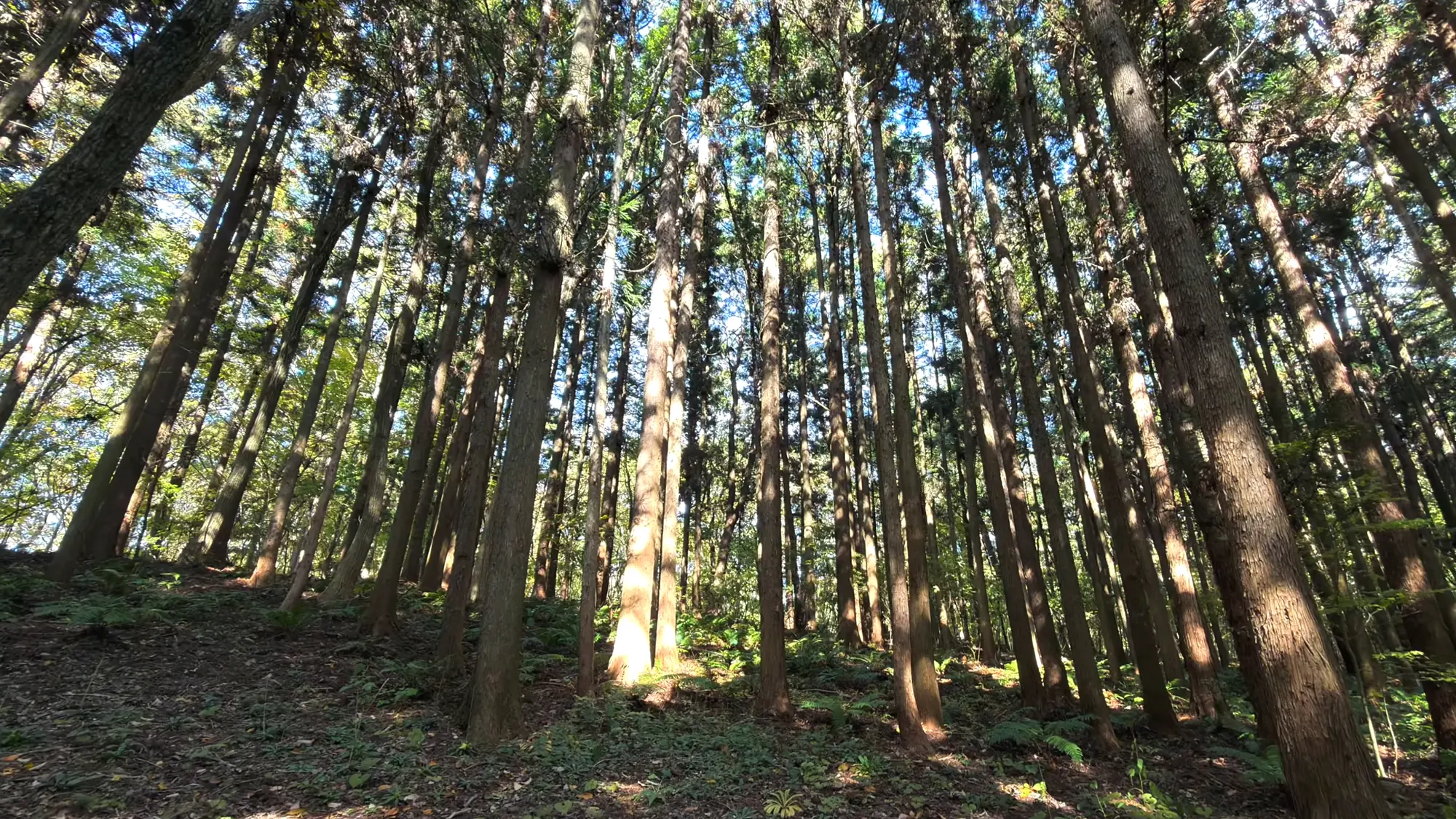
Earth path running through open woodland of slender trunks in fresh spring green at Akagi Shizen-en, Gunma
Step-free
Not step-free
Barrier-free marked no
The main road
Forest of Four Seasons
四季の森 · length not published
Open
May, Jun, Sep, Oct
Dec–Mar open Sat–Mon only
The record
What you need to go
Open season
Guided programs run on published dates in May, June, September and October. Winter brings bird watching and ice growing out of dead stems
Getting there
not published
Fees
Mori de Relax ¥3,000 (about $20) with a light meal and admission, though a second price of ¥2,000 (about $13) also appears. Mori de Retreat ¥9,000 (about $60) including admission and bentō
Onsen
not published
The walk
Main trail
The Forest of Four Seasons (四季の森), which holds the wild plants and the autumn flower meadow. Length not published
All trails
3 areas rather than numbered trails, across about 60 ha (148 acres). No lengths or times published
The step-free road
Barrier-free is marked no. The Saison Garden sits nearest the entrance and is the area the park recommends for anyone short of time or unsure of walking far
The forest
Forest type
A private park of about 60 ha (148 acres) on the lower slopes of Mount Akagi, part English garden and part native woodland, weeded by hand daily
What grows
Red pine · Cedar · Hinoki cypress · Konara oak · Maple · Kunugi oak, with a beech stand and a maple tunnel
What lives
Chestnut tiger butterflies, which cross open water, stop to feed on boneset in autumn. Forest green tree frogs, beetles, dragonflies and birds
Certified since
2014
All figures updated 5 October 2026
The forest
A psychiatrist designed the day you will spend here.
Not a wellness consultant and not a marketing department. Dr. Okudaira Tomoyuki (奥平智之), a psychiatrist specializing in nutrition, supervised both the lunchbox and the full-day program, and the shape of the day shows it. You arrive and fill in a self-assessment sheet. You watch a lecture by the doctor. You have an intake conversation. Then you walk for an hour and a half, eat, lie down among the trees for an hour and a quarter, walk again, make an aromatic spray, and sit through a structured review before you are dismissed at a quarter past three.
That is a clinical day with a forest in it, and there is nothing else quite like it. Everywhere else, forest therapy is a walk with a guide who is good at slowing you down. Here it is a protocol with a check sheet at the front and a debrief at the back, run for twelve people at a time, for people of high-school age and upward.
What it is run in is sixty hectares of private park on the skirts of Mount Akagi: part English garden, part native woodland, part deliberately managed wildlife ground. And the thing its own guides are proudest of is not the trees. It is the flowers. “Above all we are proud of the number of wild plant species,” they write, and they add that the staff maintain it by hand, daily.
Come in the last week of September, when the migratory butterflies arrive.
Five reasons to come
A full-day program designed by a psychiatrist, with a self-check sheet and a debrief.
Migratory butterflies that cross the sea, stopping here to feed in autumn.
A summer orchid the Japanese call the fairy of the forest, growing in colonies.
Ice that grows out of dead plant stems on winter mornings.

The floor is allowed to grow, which is the whole difference between this and a garden.
Sixty hectares maintained by hand, by staff, every day.
Three gardens that are not gardens
Akagi Shizen-en (赤城自然園) sits in Shibukawa, Gunma, on the lower slopes of Akagi, and covers about 60 hectares (148 acres) divided into three areas, which are its three certified roads. It was certified in 2014.
The Saison Garden (セゾンガーデン) is an English garden stocked with some of the finest rhododendron and azalea in Japan, planted alongside native mountain flowers: akayashio (Akebono azalea) and azuma-shakunage (East Japanese rhododendron), so that the showy and the understated sit in the same ground. The practical note matters: it is the area nearest the entrance, and it is the one recommended for people who cannot walk far or do not have long. From a lookout inside it, on a clear day, you can see Mount Haruna, one of the three mountains of Gunma.
The Forest of Four Seasons (四季の森) is where the wild plants are: shiraneaoi (Japanese wood poppy), yanagiran (fireweed), ominaeshi (golden lace). In spring kurinsō, the Japanese primrose, colors a stream running through it — the same flower that turns a Hokkaidō stream pink a thousand kilometers (620 mi) north. In autumn it holds the arrival described below. It also has a green clearing and a treehouse, and a forest therapy base with a treehouse in it is being honest about something.
The Natural Ecology Garden (自然生態園) is the one managed for animals rather than display: rhinoceros beetles and stag beetles, dragonflies, frogs, and a long list of birds. At its heart is the whirligig-beetle pond (ミズスマシの池), offered simply as a place to sit and be quiet. And in summer it carries colonies of renge-shōma (Anemonopsis macrophylla), which the Japanese call the fairy of the forest — a nodding, translucent, lilac-and-cream flower on a thin stem that grows in deep shade and looks, honestly, invented.
The butterflies that cross the sea
The single best reason to come to Akagi in autumn is a butterfly.
The chestnut tiger (asagimadara) is a large pale butterfly with glassy blue-white panels in its wings, and it migrates. Individuals marked in Japan have been recovered more than a thousand kilometers (620 mi) away; they move south in autumn across open water, which for an insect weighing less than a paperclip is an absurd thing to do. In autumn they come drifting, drifting into the Forest of Four Seasons to feed on the fujibakama, the boneset, in the flower meadow.

Unsurfaced the whole way, which is unusual for a garden and is the point of this one.
That is a specific, plannable, extraordinary thing. The park plants the boneset. The butterflies arrive to nectar on it before they go. If you stand in that meadow in late September or early October you are standing in a refueling stop on an intercontinental route, and the park has set the table.
The rest of the seasonal list is unusually rich, and all of it is this concrete.
Spring: abundant rhododendron and azalea, and colonies of Japanese wood poppy and yamashakuyaku, the woodland peony.
Summer: the renge-shōma colonies, the foam egg masses of the forest green tree frog slung in branches over water (the same frog that breeds in the beech of Yamagata), yamayuri, the golden-rayed lily, and the beetles.
Autumn: color, the butterflies, and a flower meadow of the seven autumn plants of classical Japanese poetry.
Winter: bird watching, and ice columns on the shimobashira stems.
That last one deserves its own sentence. Shimobashira is a mint-family plant, and on cold mornings after the stem has died, water drawn up through the dead stem freezes as it emerges and extrudes sideways in ribbons and curls of ice — ice that grows out of a plant, at ankle height, and melts by nine. People go out specifically to find it. It is the kind of thing a park maintained by hand, daily, knows exactly where to look for.

Early in the turn, when only the understorey has noticed.
The trees, and three named tunnels
The conifers are red pine, cedar and cypress; the broadleaves are konara oak, maple and kunugi oak. But the three trees the park singles out are not species at all, and the choice is revealing:
A beech stand, near the southern edge of where beech grows well.
A tunnel of Japanese maple near signpost 5, opened only for a limited period.
An Akebono azalea tunnel on the azalea hill.
A park that identifies two of its three notable features as tunnels is telling you how it wants to be walked: not to a viewpoint, but through enclosures. And a maple tunnel that is only open for part of the year is a piece of deliberate scarcity that is slightly irritating and entirely effective.
The two programs, and what they cost
Akagi publishes more operational detail than almost anywhere else: dates, capacities and prices.
Mori de Relax (森 de リラックス) is the short one — about two hours with a forest therapy guide, 10:00 to 12:30, meeting at the information center, capacity twelve, held in rain as well as fine weather. The 2026 dates are published in full: 17 and 25 May, 6, 15 and 21 June, 5, 11 and 20 September, 3 and 29 October. You are asked to bring rain gear, a picnic sheet, a towel and a drink.
Two different prices are in circulation for it, and they do not agree. One is ¥3,000 (about $20), light meal included, admission free, tax included. The other is ¥2,000 (about $13), tax included, admission separate. Most likely one is an old figure that was never taken down. Confirm before booking.
The conifer block at the top of the slope, dark even at midday.
Mori de Retreat (森 de リトリート) is the full day, and it is the one the psychiatrist designed. The 2026 date is Sunday 18 October, 10:30 for about five hours, capacity twelve, high-school age and above only, at ¥9,000 (about $60), including admission and the lunchbox. The published schedule:
On arrival — self medical check on the park’s own sheet
10:30 — Dr. Okudaira’s lecture, by video, and an intake
11:10 — forest walk, after a light warm-up, slowly, using the five senses
12:45 — lunch, then forest rest, which means lying down among the trees
14:00 — forest walk
14:35 — making an aromatic spray, and a review

The stream that runs the length of the lower loop, ankle deep all year.
15:15 — dismissal
Booking opens on the first of the month two months before, closes three days ahead, and cancellation from four days out costs half the fee. Those are the terms of an operation that has been burned by no-shows, and they are stated plainly.
The lunchbox is the argument
The food here is not an add-on, and it is the clearest expression of what makes this base different.
The bentō is supervised by the same physician, built for nutritional balance with, in the park’s own words, an expectation of raising immunity. It is made by Kitchen Kaze no Ho (キッチン風の穂), a Gunma restaurant that works specifically with kōji (the fermentation mold behind miso, soy sauce and sake) and gluten-free cooking. The retreat adds low-sugar sweets on the same logic.
Two things are true at once here.
The framing is commercial. “Immunity up” is a marketing phrase in Japan as much as anywhere, and no amount of a doctor’s name on a bentō makes “boosts immunity” a measurable claim about a lunchbox. The park also, in describing the retreat, reaches for negative ions alongside phytoncides, and negative-ion health effects are not part of the evidence base forest therapy actually rests on. Both are the park’s claims. Neither is ours.
And yet the structure underneath is more serious than most. A self-assessment at the start and a review at the end is the before-and-after shape the Society’s own certification experiments use. An intake conversation is what a clinician does before deciding what a person needs. A capacity of twelve means somebody is not trying to scale it. If you strip out the immunity language, what remains is a well-designed five-hour intervention with a meal and a nap in the middle, which is a reasonable thing to sell for ¥9,000 (about $60).

The pond takes the whole canopy and turns it upside down.
A private park, which changes everything
One structural fact sits underneath all of this: Akagi Shizen-en is a private park with an admission charge, not public land and not a municipal facility. The name of its first area, the Saison Garden, is the clue to its corporate origins.
That explains things that are otherwise puzzling. It explains why a forest therapy base can afford to maintain sixty hectares by hand, daily, when a village office running a base on national forest cannot even surface a path. It explains the capacity of twelve: a private operator can cap a program at the number that makes it good rather than the number that makes it pay. It explains the cancellation policy, the two-month booking window, and the fact that admission is folded into the retreat price and ambiguously into the shorter program. And it explains why a consultant psychiatrist was engaged at all, which is not a thing a town hall does.
It also sets a limit worth naming. Everything here happens inside a fence, on a schedule, for a fee. There is no equivalent of Iwate’s slip of paper, no walking in on a Tuesday because you felt like it, no twelve-kilometer (7.5 mi) headwater valley. What Akagi offers instead is the most carefully designed few hours you can buy in a Japanese forest, and a flower list nobody else can match, in ground that somebody is paid to look after every single day.
Both models are legitimate. But you should know which one you are buying.
What the certificate measures, and what Akagi measures instead
Nothing came out of the 2014 certification experiment that a visitor can read — no institution, no participant count, no measure. That is normal across the scheme.
What Akagi has instead is its own instrument: the original check sheet, filled in by every retreat participant on arrival and revisited at the end. It is not research — there is no control, no blinding, and the park has an interest in the answer. But it is one of only three bases that hand the measurement to the visitor rather than keep it, alongside Oguni’s stress check and Kazuno’s self-service equipment, and that is the most interesting thing about how these places actually operate. The Society measured once, a decade ago, and said nothing. The bases measure continuously, for the customer, and at least the customer sees their own number.
An honest note about who this is for
Akagi says no to three of the four things the Society asks about: barrier-free access, overseas visitors, and children. Only corporate training gets a yes.

Early November, and the maples go last.
The children one looks odd on a park with a treehouse, a beetle garden and a frog pond, and the likeliest reading is that it describes the therapy programs rather than the park — the retreat is explicitly high-school age and above, and a five-hour clinical protocol is not a children’s activity. The park itself plainly welcomes families.
The barrier-free no is the consequential one, and there is something to work with. The Saison Garden is the area closest to the entrance, and it is the one recommended for people worried about walking far or short on time. That is not an accessibility guarantee and it should not be read as one. But it narrows the question, and four things are worth asking on 0279-56-5211 about the Saison Garden specifically rather than about the base as a whole: the surfaced width, whether there is a step at the entrance, the surface of the approach from the parking area, and the toilet at the information center.
The overseas-visitors no is the flat one. A five-hour program built around a Japanese-language lecture, an intake interview and a written self-assessment is not going to work in translation, and the park has said so rather than letting someone find out on the day.
Getting there, and what sixty hectares by hand actually means
There is no station, journey time, bus route or fare to give you here; the park’s own site has them. It is in Shibukawa, Gunma, on the Akagi slopes, in the belt of country that Tokyo reaches on a day trip.
What is worth ending on is the sentence the guides chose to finish their own message with. The base is managed, they say, by staff, by hand, daily, in order to maintain a beautiful forest and let visitors feel its healing effect fully.
Sixty hectares is a hundred and forty-eight acres. Maintaining that by hand is not a romantic flourish; it is a standing payroll, every day, in a private park that charges admission and runs a twelve-person program ten times a year. It is also why the wild-plant list is as long as it is, why the maple tunnel can be opened and closed on a schedule, and why somebody knows which stems will grow ice on a cold January morning.
Go at the end of September. Stand in the boneset meadow and wait for the butterflies, which have come a very long way and are going further. Then walk back through the maple tunnel if it happens to be open, and have the lunchbox a doctor designed, and lie down for an hour in a forest that somebody weeded this morning.
Nearby and alike

Gunma · Certified 2013
Kanra
Five roads across four centuries of dug channels, silk-farm streets and stone-walled fields — run twice a year by a forest therapist who takes your blood pressure before and after.

Gunma · Certified 2006
Uenomura
Twelve and a half kilometers along a headwater of the cleanest river in the Kantō, in a village that is 96 percent forest — with vehicle restrictions and a cap on entry.

Ibaraki · Certified 2016
Okukuji
Forty-nine hectares planted in a single ceremony in 1976, listed among Japan’s hundred best forest-bathing forests a decade later. The guides stake it all on what grows on the floor.

Forest Bathing in Japan
Japan named forest bathing in 1982, then measured it. The practice, the places, and what the studies show.

The Science
The studies are real, small and oversold. What was measured, in how many people, and what was never shown.

The Walk
A measured forest walk is about thirty minutes and no destination. Here it is, sense by sense, step by step.

Choosing a Base
Eight forests, from Kusatsu to Yakushima. Which fits your days, your season and the onsen waiting after.