Yamaguchi · Certified 2006
Tokuji Forest Therapy Base: The Forest That Rebuilt Tōdai-ji, and One of Japan’s First Six
Six roads in the forest where timber was cut for Tōdai-ji, a domain reserve that became Japan’s oldest surviving protected forest in its region, and a paved lakeside road.

Aerial view of a grass clearing ringed by forest with cherry trees in bloom at Tokuji, Yamaguchi
Step-free
Step-free
Lakeside road is flat and fully paved
The main road
Lake Ōhara course
大原湖畔コース · 3–11 km (1.9–6.8 mi) · flat
Open
Year-round
Cherry in spring, winter birds and silence
Nearest station
Hōfu
JR, then about 90 min by bus
The record
What you need to go
Open season
Open year round. Cherry along the lake in spring, streams and shade in summer, acorns and mushrooms in autumn, winter birds and silence
Getting there
JR Hōfu, then about 90 minutes by bus to Aichōrin-iriguchi. By car it is about 20 minutes from the Tokuji interchange
Fees
A guided tour of two to five hours is ¥6,000 (about $40) per guide for up to ten, or ¥3,000 (about $20) a head above ten, plus ¥50 insurance. Trekking ¥3,000. Bentō ¥1,000 (about $7)
Onsen
Yunoki Jishō Onsen (柚木慈生温泉)
The walk
Main trail
The Lake Ōhara course (大原湖畔コース), 3 to 11 km (1.9 to 6.8 mi) along the left bank, flat and paved end to end
All trails
6 trails, about 1.5 to 11 km (0.9 to 6.8 mi), guided in two to five hours, across a base of about 3,700 ha (9,143 acres)
The step-free road
Marked yes, and the text agrees: the lakeside road is flat and fully paved. The other five are forest paths, a crater loop and a forest road
The forest
Forest type
About 3,700 ha (9,143 acres), including a national forest once held as a domain reserve and protected since 1916
What grows
Hinoki cypress · Cedar · Red pine · Sawtooth oak · Maple · Mountain cherry, with planted fir over 200 years old and three cedars 42 m (138 ft) tall
What lives
More than thirty kinds of wild bird in the bird-loving forest, none of them named. Carp, crucian carp and amago in the lake
Certified since
2006
All figures updated 5 October 2026
The forest, before the facts
In the twelfth century, the Society says, the great temple of Tōdai-ji burned in the wars between the Genji and the Heike, and the timber to rebuild it came from here. Tokuji, in the mountains of Yamaguchi, was the place where the woodcutters went in, and the giant trees were felled and sent away. The base’s own catchphrase still calls it the home of Tōdai-ji’s rebuilding.
The cutting did not end with the temple. The forest office says the red pine of Mount Namera (滑山) was cut as prized timber into the 1960s, for the interior of the new Imperial Palace and for the piers of the Kintai bridge. Long before that, it says, the feudal domain had kept the mountain as its own reserved forest, under strict limits on felling. In 1916 the forest became a protected forest, the oldest still standing in its regional office’s territory.
So the forest at Tokuji has been both cut and protected for centuries. It is also one of the first six forest therapy bases in Japan, certified in the very first round in 2006, with six roads, a lake ringed by cherry trees, and a deep stand of giant trees at the far end.
Five reasons to come
One of Japan’s first six forest therapy bases, certified in April 2006.
The forest that gave timber to rebuild Tōdai-ji, by the Society’s account.
A fully paved, flat lakeside road the Society calls barrier-free.
Six roads, from a birdsong forest to a stand of giant trees.
The oldest surviving protected forest in its forest office’s territory, from 1916.
The temple’s forest
The Society’s own account opens with the history. It calls Tokuji the land where the woodcutters entered, in the twelfth century, to fell the giant trees needed to rebuild Tōdai-ji after it burned in the Genpei wars.
The Forestry Agency’s announcement of the first round of certified bases, dated 18 April 2006, lists the base under the same title: the home of Tōdai-ji’s rebuilding, the place the woodcutters went in. It describes a base inside a prefectural natural park, with the beautiful natural forest around Lake Ōhara (大原湖) and the Namera national forest (滑国有林), which it calls a treasure-house of valuable forest resources.
Tokuji is one of the clearest cases of a certified forest laid over older works. The work in this case was religious and extractive at once: timber cut for a temple, from a forest that kept being cut for centuries after.
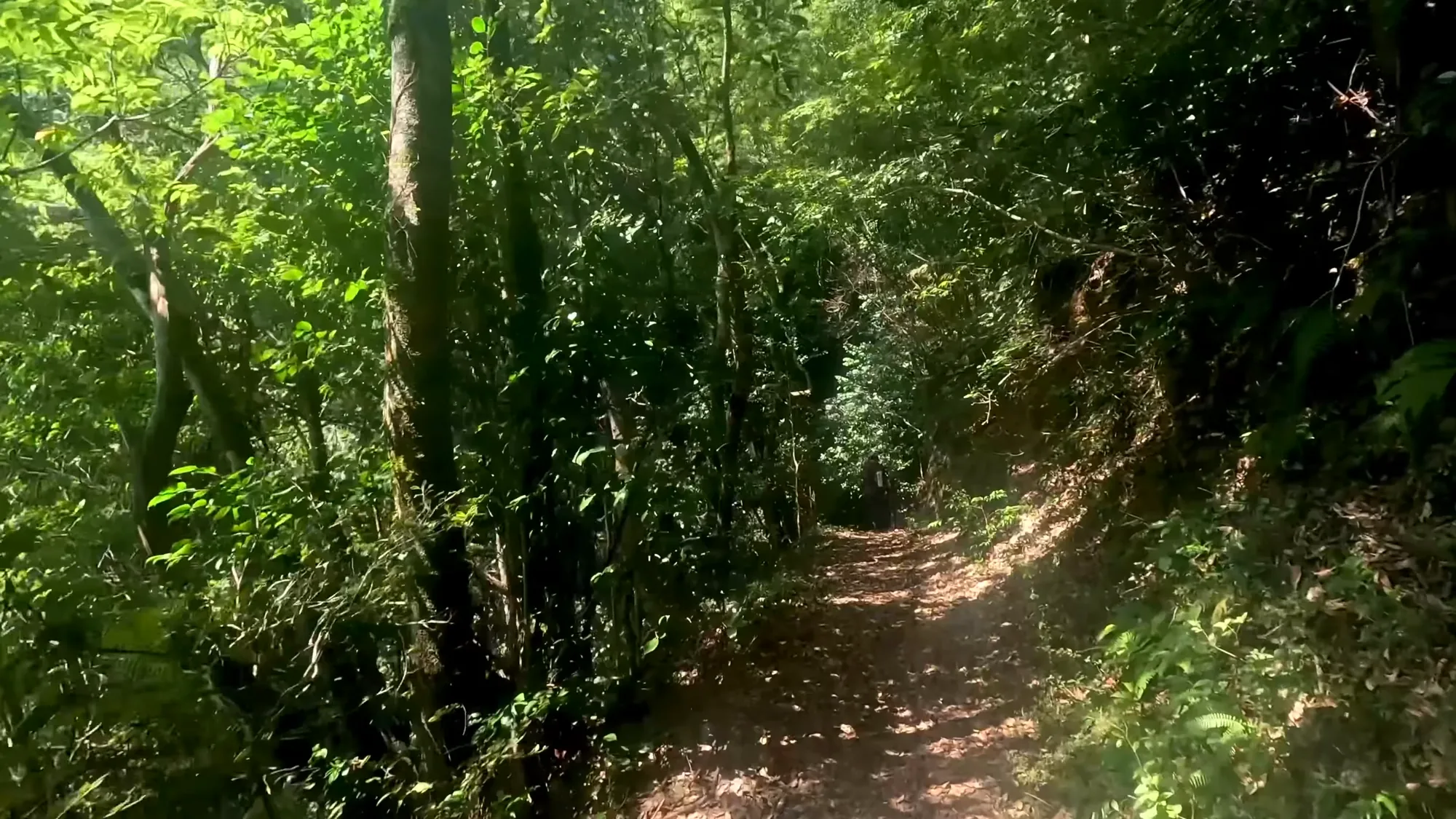
Early summer on the observation path, when the canopy closes over the track completely.
The domain’s reserve, and the protected forest
The Kinki-Chūgoku regional forest office publishes two protected forests on Mount Namera. One protects rare populations of red pine, fir, and hemlock, and runs to 25.16 hectares (62.2 acres).
It was first set aside in August 1916, and it is the oldest protected forest still existing in the office’s territory. Red pine grows on the ridges, urajirogashi (an evergreen oak) on the slopes, and hemlock on the steep lower slopes.
The second protects red pine, beech, and konara oak, over 51.19 hectares (126.5 acres): red pine, beech, konara, akashide (a hornbeam), and mizunara, with prized red pine over 200 years old. That forest was the Chōshū domain’s own reserve, held under strict limits on cutting. Both were designated in their present form in 1990.
Namera pine
The timber has its own history. Namera pine, the forest office says, is the name for the prized red pine growing in the Namera national forest.
In 1968, it says, more than 500 cubic meters (17,657 cubic feet) of logs were produced in a year, and the wood was used for the interior of the new palace at the Imperial Palace and for the piers of the Kintai bridge. A survey in 2013 found only 38 trees remaining, five of them dead.
The forest office designated the stand a forest genetic resource reserve of about 50 hectares (124 acres) in April 1990. The pine you see on the giant-tree road is what is left of a timber that was, within living memory, cut by the hundreds of cubic meters.
Six roads
The Society lists six roads. The bird-loving forest course (愛鳥林コース) is about 3.2 kilometers (2.0 miles). Its path splits into an upper and a lower way: the lower is a leaf-strewn path under dappled light, the upper looks out over the lake. The Society says more than thirty kinds of wild bird live there, and calls it a course for bird listening.
The Chōjagahara course (長者ヶ原コース) is about 1.5 to 5 kilometers (0.9 to 3.1 miles). The Society says it centers on a loop around the crater of an old volcano, with gentle paths of many sizes branching from it.
The Lake Ōhara course (大原湖畔コース) is about 3 to 11 kilometers (1.9 to 6.8 miles), along the lake’s left bank. The Society calls it a flat, fully paved barrier-free road.
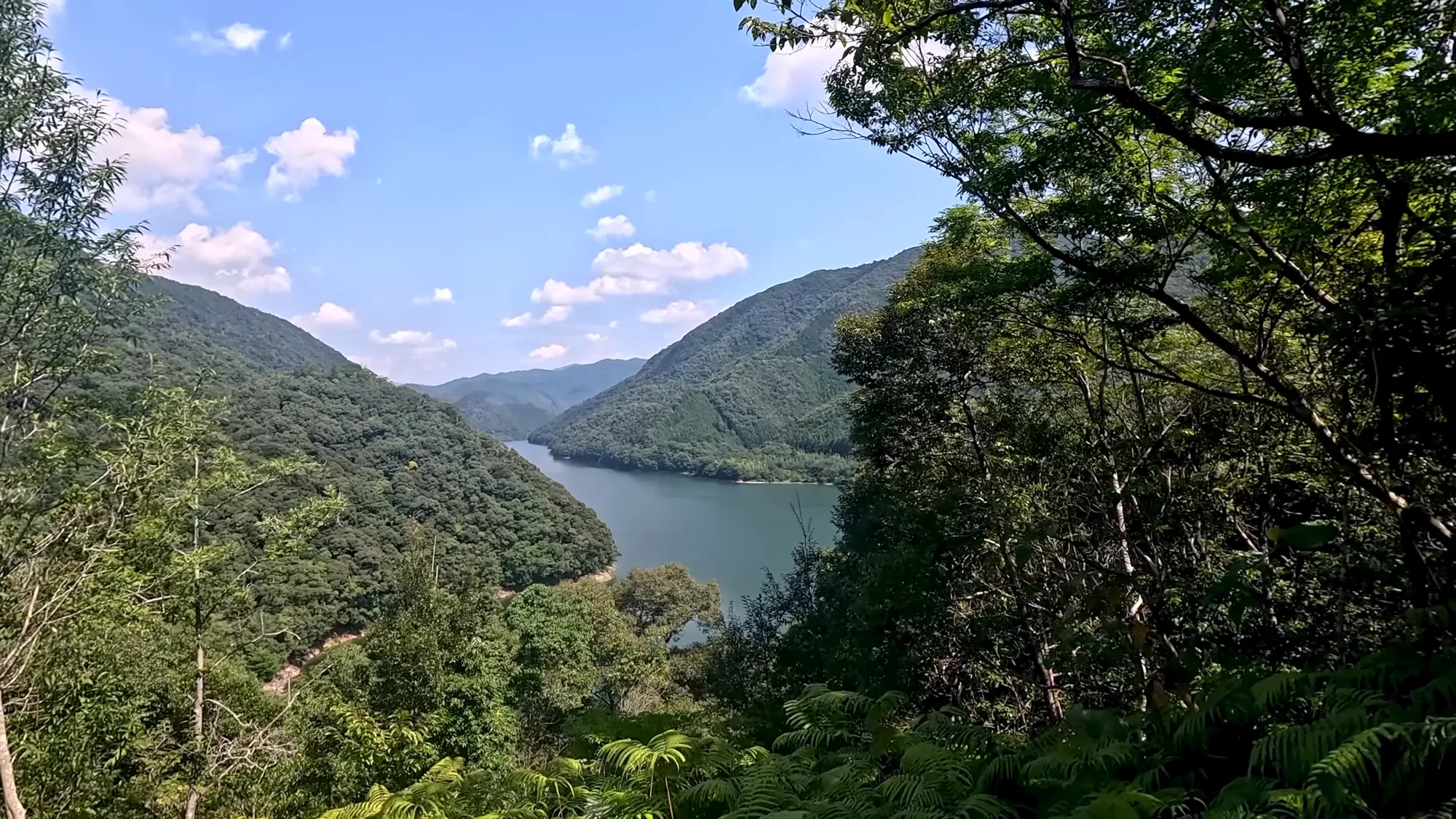
The water comes and goes between the trees for most of the walk.
The forest beauty course (森林の美コース) is about 3 kilometers (1.9 miles), to Kannon Falls (観音の滝), a waterfall in two drops. The Society says the path passes a fine stand of cedar and hinoki grown by multi-storied forestry by one of the prefecture’s leading foresters.
The Namera gorge course (滑峡コース) is about 3 to 5 kilometers (1.9 to 3.1 miles), in a part of the national forest where rare plants and ecosystems are kept, with a beautiful stream along a forest road.
The giant-tree forest course (巨樹の森コース) is about 3 to 6 kilometers (1.9 to 3.7 miles), at the deepest point of the base. The Society lists what is there: Namera pine, the fir forest of the Mōri domain, the three cedars (三本杉) among the hundred forest giants, a great katsura, and the Namera scenic forest.
Three cedars and three arrows
The forest office places the three cedars in the Namera national forest, in former Tokuji town. It gives the trees as 42 meters (138 feet) tall, 152 centimeters (60 inches) in diameter, and 200 to 299 years old.
Its account of why they survived is part history, part story. The trees grow close together, it says, and stood for 300 years in the Mōri domain’s forest on Mount Namera. Local people, it says, kept them uncut in the spirit of Mōri Motonari’s lesson of the three arrows.
The forest office lists them among its hundred forest giants, and tells the legend of the arrows as the reason they are still standing.
On wheels
The Society marks Tokuji barrier-free, and its description of the roads supports it. The Lake Ōhara course is flat, fully paved, and barrier-free.
That is consistent, not a contradiction. It is still not an answer.
Ask four things about the lakeside road. How wide is the paved surface, in centimeters? Is there a step or curb where it starts?
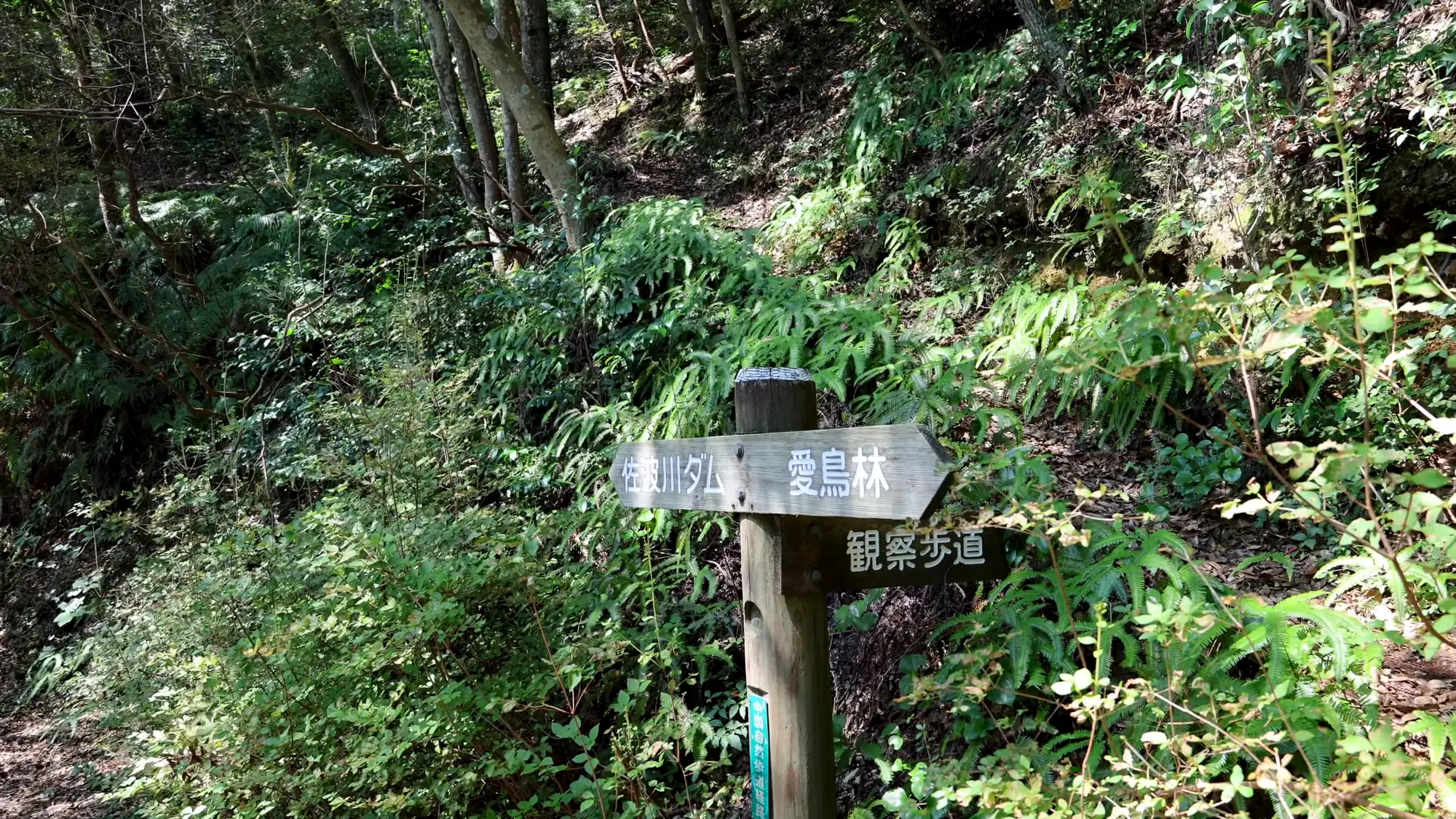
The post for the bird forest trail. Japan's first certified therapy base starts about here.
What is the surface between the parking area and the road? And is there an accessible toilet along it?
The other five roads are forest paths, a crater loop, and a forest road. None is described as passable on wheels.
The Society also says yes to corporate training groups, yes to visitors from abroad, and yes to children — and nothing in its description of the roads gives reason to doubt the answer that matters most here.
Saving the last pines
The forest office published an account in May 2014 of taking fifteen trainees from a forestry employment course, aged twenty to sixty, into the Namera national forest. It reads like a field guide to what is at stake.
It describes the Namera pine as more than 200 years old and threatened by pine beetles, and says successor trees are being raised by repeatedly cutting back the bamboo grass around them. It describes the three cedars as about 300 years old, the Mōri domain’s fir as about 200, and the beech as the westernmost on Honshu, the same claim the Society makes.
The forest office’s giant-tree entry gives the three cedars as 200 to 299 years old, and this account gives about 300. Three centuries, either way.
The lake and its cherries
Lake Ōhara is a dam lake. The prefecture’s tourism site, describing the lakeside campground, calls the dam a multipurpose gravity dam with a total storage of 24.6 million cubic meters (about 20,000 acre-feet). It says the water stays clear through the year, and that the lake is good for fishing for carp, crucian carp, and amago.
So the barrier-free road is a road along a reservoir, like the lakeside roads at other bases. It is another layer of older work under the certified forest.
The cherries are counted two ways: about 500 trees along the lake by the Society’s count, about 1,000 Yoshino cherries planted on the shore by the prefecture’s. Take whichever number you like. Both describe an avenue of cherry in April.
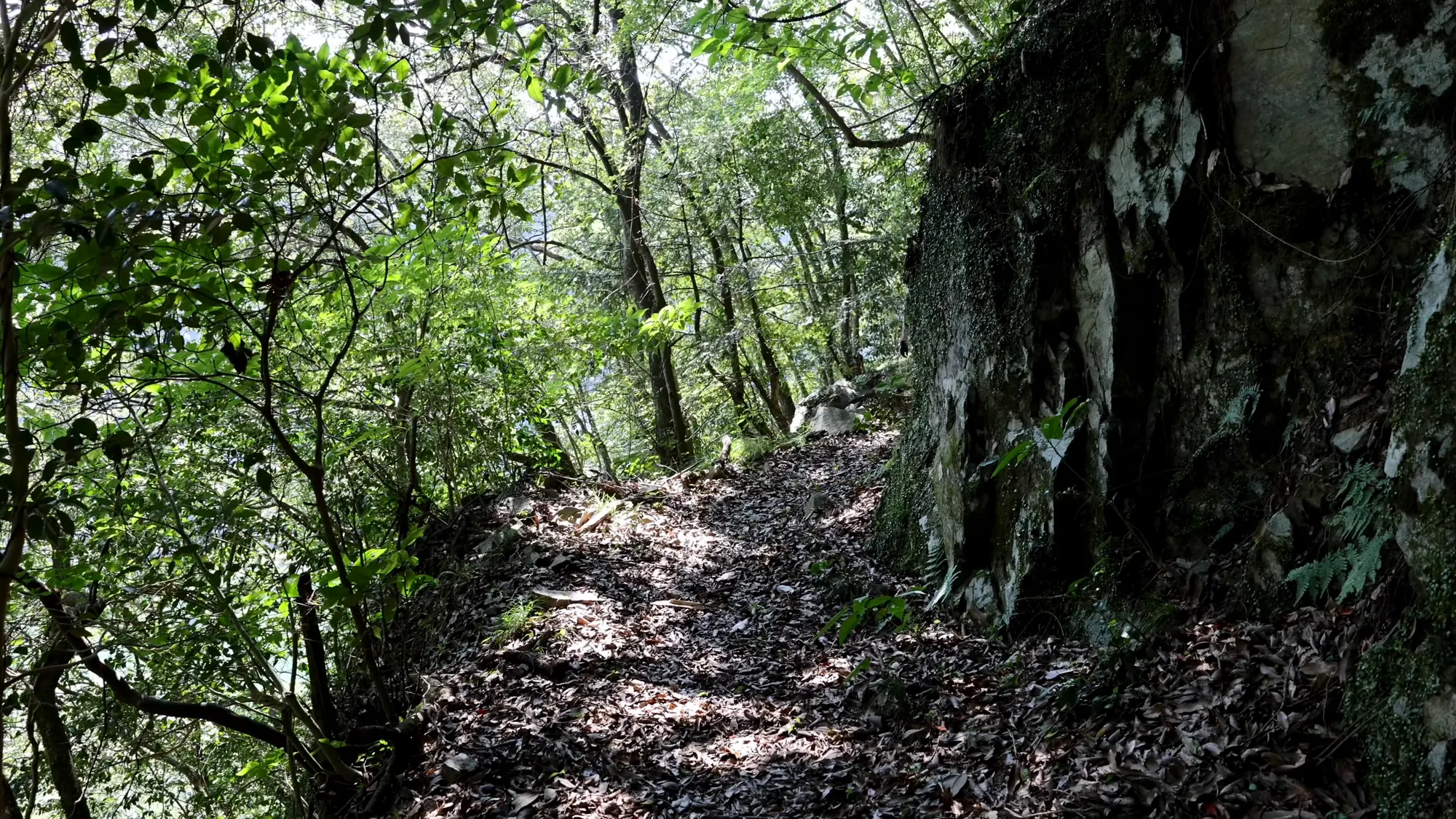
The path squeezes between the rock and the drop for twenty meters.
What lives here
The Society says more than thirty kinds of wild bird live in the bird-loving forest, without naming them. The prefecture’s tourism site describes the same course as a natural forest of wild red pine mixed with broadleaf trees, where you can enjoy birdsong.
The Society lists winter birds among the season’s sights. The tourism site names the fish in the lake, as above. Nobody names a mammal, an insect, or a single bird species on the roads.
That is a gap for a course named for birds, and the guides are the people to ask.
The Society’s seasons, and its trees
The Society sums up the seasons in lists.
Spring is the cherry avenue, a colony of the fern urajiro, and colorful budding. Summer is the national forest, clear streams, the multi-storied forest, the Kannon falls, and shade. Autumn is color, leaf-strewn paths, acorns, and mushrooms. Winter is silence, light through the branches, winter birds, snow scenes, and winter buds.
It gives hinoki, cedar, and red pine as the conifers, and sawtooth oak, maple, and mountain cherry as the broadleaves. It also names the cherries by the lake, a planted fir forest more than 200 years old, and what it calls the westernmost natural beech forest on Honshu. That last claim is the Society’s.
The Society gives the base area as about 3,700 hectares (9,143 acres), including the Namera national forest and a prefectural natural park.
The price
The Society publishes four plans. The forest therapy guided tour runs about two to five hours, with a guide fee of ¥6,000 (about $40) for up to ten people, or ¥3,000 (about $20) a person for groups over ten, plus insurance of ¥50 (about 35 cents) a person.
A forest therapy trekking tour runs four to six hours at ¥3,000 (about $20) a person plus insurance. A Nordic walking tour is priced like the guided tour. A Tree Climbing® experience runs two to two and a half hours, from ¥30,000 (about $200) plus ¥265 (about $1.75) insurance a person.

Everything damp here gets covered eventually.
The plans widen what a visit can be. Nordic walking and tree climbing sit beside the forest walks, and the guided tour is priced per guide for up to ten people, then per person above that.
For a party of ten on the guided tour, that is ¥6,500 (about $43) in all, or ¥650 (about $4) each.
The lunch
The Society says there is a healing-forest lunch (癒しの森弁当), made generously with seasonal food from the Tokuji area, at ¥1,000 (about $7) each.
Who runs it, and what that means
The operator is Forest Therapy Yamaguchi (森林セラピー山口).
Yamaguchi city’s April 2018 press material describes how the base is run. The forest guides’ association, the national youth nature center at Tokuji (山口徳地青少年自然の家), and the city work together, and the guides are certified by the city. A prefectural foundation ran a program at the youth nature center on 30 October 2022 called feel the forest with your heart and body, with those same city-certified guides as its instructors.
So the base is run by a guides’ organization working alongside the city and a national youth facility, and the city certifies the guides. The institutional backing is real; the day-to-day depends on the guides themselves.
The forest festival
The city’s 2018 material also describes how the base presents itself to its own region. Its guides, it says, have expanded their work through forest walks and therapy events, leading visitors safely into the forest, conveying its appeal, and aiming at the health of body and mind.
It announced the fourth forest festival (森フェス) for 4 May 2018, run by an executive committee of three: the guides’ association, the national youth nature center, and the city. The program listed forest walks and climbs, relaxation menus, outdoor play, crafts and workshops, displays, charity, forest music, and food.
That is a base with a public life beyond its guided walks. Whether the festival still runs is worth asking before you plan a trip around it.

The stream is small enough to step over and loud enough to hear from the ridge.
Two firsts
The Society gives the certification as April 2006. Yamaguchi city’s press material goes further: it says the area around Lake Ōhara was certified in 2006 as the first forest therapy base in the country, and opened as a base the following April.
The Forestry Agency’s 2006 announcement lists six bases in that first round, of which Tokuji is one. Both are on the record, and they are not the same claim: Tokuji was in the first group, not alone in it.
The base publishes neither the method nor the results of its certification. Methods are sometimes published; results never are.
Getting there
The prefecture’s tourism site gives the bird-loving forest road as about twenty minutes by car from the Tokuji exit of the Chūgoku Expressway, and about ninety minutes by bus from JR Hōfu station to the Aichōrin-iriguchi (愛鳥林入口) stop, one minute’s walk away. For the lake, it gives forty minutes from the Hōfu-higashi and Hōfu-nishi exits of the San’yō Expressway, and fifty minutes by car from JR Yamaguchi station.
The contact for the bird-loving forest road is the Tokuji agriculture and forestry office (徳地農林振興事務所), on 0835-52-1122. The lakeside campground is nearby, and so is a stone bath (野谷の石風呂).
The Society lists four places: the youth nature center, Fureai Park Ōhara-ko (ふれあいパーク大原湖), a hot spring (柚木慈生温泉), and a local produce shop (特産品販売所南大門).
The shape of a visit
Start on the lake road, the flat one, in early April if you can, under whichever count of cherries you believe. Then walk the upper way of the bird-loving forest and listen.
On another day, take a guide to the far end of the base, to the three cedars and the last of the Namera pine. Ask them about the temple.
Then stop at the produce shop on the way out. It is called Nandaimon (南大門), the Great South Gate.
Nearby and alike

Miyazaki · Certified 2006
Hinokage
One of Japan’s first six forest therapy bases, laid along an old railway, a logging trolley line and 1850s stone terraces.

Hiroshima · Certified 2012
Akiota
A gorge the prefecture protects for what may be its last preserved hinoki stand, a long-grazed grassy summit, Sandankyo by boat, and a lunch that always has beans.

Shimane · Certified 2007
Iinan (Furusato no Mori)
Four short courses in a working highland forest at about 450 meters, one of them through rows of shiitake logs, with a protected wetland nearby.

Origins
A forestry bureau named shinrin-yoku in 1982. The manners it asked for are older, and they are still kept.

Certification
Over sixty Japanese forests hold a therapy certificate. What the test involves, and what it does not promise.

Choosing a Base
Eight forests, from Kusatsu to Yakushima. Which fits your days, your season and the onsen waiting after.
Verified by The Japan Onsen Society
Sources
森林セラピーソサエティ「山口県 山口市徳地森林セラピー基地」— https://fo-society.jp/facility/yamaguchi/ (認定 2006年4月; all acceptance fields 可; 6 roads with lengths and texts incl. “全線舗装の平坦なバリアフリーロード”, 30+ bird species; tree fields; 特記 ~3,700 ha; seasons; four plans and prices; bentō ¥1,000; nearby; guide message; intro incl. “約840年前…東大寺を再建するために巨木を伐り出した『杣入りの地』”; contact)
林野庁「第1期(平成17年度)認定箇所一覧」平成18年4月18日 — https://www.rinya.maff.go.jp/puresu/h18-4gatu/0418b2.pdf (山口県山口市(徳地)among six; catchphrase; 大原湖周辺, 滑国有林)
近畿中国森林管理局 保護林 — 滑山アカマツ・モミ・ツガ等 · 滑山アカマツ・ブナ・コナラ等 (25.16 ha, 大正5年8月, oldest in jurisdiction; 51.19 ha, 長州藩の御立山; 200+ year pine; 平成2年)
近畿中国森林管理局 — 滑マツ · 三本杉 · 2014 training hike (昭和43年 500 m³+; 皇居新宮殿, 錦帯橋; 平成25年 38 trees, 5 dead; 平成2年4月 ~50 ha reserve; 三本杉 42 m, 152 cm, 200–299 years, Mōri, three arrows; 2014: pine beetle, bamboo-grass cutting, ~300-year cedars, ~200-year fir, westernmost beech)
山口市 平成30年4月 記者発表資料 — https://www.city.yamaguchi.lg.jp/uploaded/attachment/23812.pdf (“全国で初めて”, opened 翌年4月; city-certified 森の案内人; 森フェス committee of three, 4 May 2018)
山口県観光 — 愛鳥林 · 大原湖キャンプ場 (red pine and broadleaf, birdsong; Hōfu bus 90 min; Tokuji IC 20 min; contact 徳地農林振興事務所; multipurpose gravity dam 2,460万m³; ~1,000 Yoshino cherries; carp, crucian carp, amago; access times)
山口県ひとづくり財団 program (令和4年10月30日) — https://www.pref.yamaguchi.lg.jp/uploaded/attachment/128138.pdf (title; 森の案内人 as instructors)
Verified: 2026-10-05