Tottori · Certified 2010
Chizu: The Forest That Made the Tottori Sand Dunes
A town 93% forest, whose forestry is a protected national cultural landscape — with a welfare therapy road, a therapy lunch made under seven published vows, and a homestay where washing up is part of the experience.

Sun breaking through the tops of a dense stand of tall straight cedar at Chizu, Tottori
Step-free
Step-free
A welfare therapy road; wheelchair or stroller
The main road
Ashizu therapy road
芦津セラピーロード · three courses
Open
Year-round
Ashizu road under repair in 2026
The record
What you need to go
Open season
All four seasons carry their own event. Shower climbing in summer, color and trekking in autumn, a snow festival at the old post-town in winter
Getting there
No station or fare published. Programs assemble at the Chizu Town General Center at 9:00, with a published 30 minute transfer to the gorge
Fees
Not published. Two timetabled programs run, a half day of about three hours and a full day of about six with lunch, and neither carries a price
Onsen
not published
The walk
Main trail
The Ashizu therapy road (芦津セラピーロード), through natural cedar mixed with broadleaf beside the stream, holding three courses
All trails
4 trails, 3 of them described, none measured
The step-free road
The Yokose Gorge course is called a welfare forest therapy road and can be walked with a wheelchair or a stroller. No width or gradient is published
The forest
Forest type
A town 93 percent forest, its forestry landscape a national Important Cultural Landscape since 2018. Plantation of every age, plus natural cedar
What grows
Cedar · Hinoki cypress · Red pine · Beech · Mizunara oak · Horse chestnut, with planted forest 350 years old
What lives
not published
Certified since
2010
All figures updated 5 October 2026
The forest
This forest made a desert.
Over long ages, the headwater forest that nurtured those Tottori Sand Dunes spread out from here. The dunes are the largest in Japan and essentially the only thing most people can name about Tottori prefecture, and the sand arrived at the coast because rivers carried it there, and the rivers begin in these mountains.
Chizu is 93% forest. And it has spent some time thinking about what that means, because the town’s own catchphrase is one of the strangest and best in Japan: Chizu, the town of evacuation, where a green wind blows.
Sokai, evacuation, is the wartime word. It is what Japan did with its city children in 1944 and 1945: moved them out of the bombing, into the countryside, to be kept alive by strangers in villages. A town has taken that word, put it in quotation marks, and made it a tourism slogan.
Read it generously, and you are invited to, because the sentence that follows is about a place where you can take an unhurried deep breath and about nurturing the connections between people. It reads as come here to get out of there. Evacuate from the city. We did this before. We will do it again, and this time you can leave when you like.
And then Chizu does the thing almost no other base does. It states, as policy, that the forest is the town’s main theme: holding the forest to be the town’s important asset, attending to the healing effect the forest has, and taking up forest therapy as one of the main themes of its town-building.
Five reasons to come
A headwater forest that built the Tottori Sand Dunes, in a town that is 93% trees.
A designated national Important Cultural Landscape, for its forestry.
A welfare therapy road wheelchairs and strollers can use, along a clear stream.
A therapy lunch made under seven published vows, in wood and paper.

Straight enough that the sightline runs out before the trunk does.
Planted forest three hundred and fifty years old, begun in the Edo period.
A national Important Cultural Landscape, for forestry
The longest entry on Chizu’s official listing is not about trees. It is about why this forest is legally protected.
On 13 February 2018, “the forestry landscape of Chizu” was selected as a national Important Cultural Landscape.
Chizu’s forestry begins in the Edo period, symbolized by planted forest three hundred and fifty years old. Formed over that long history of forestry, three things are an important cultural landscape: the mountain village and its surrounding planted forest; the post-town that prospered on forestry and its surrounding woods; and the mid-mountain country where natural cedar and broadleaf forest spread.
Because a cultural landscape is a familiar landscape rooted in daily life, its value is hard to notice from day to day — but it is indispensable, formed by people’s living and their livelihoods and the character of the place, and we want to pass it on to the next generation as the pride of the region.
There is an argument running underneath all of this. Japan’s certified healing forests are not wilderness. They are worked ground: plantations at Nanasawa, coppice at Kitamoto, pilgrim roads at Kōyasan, a quarry track at Kanra, charcoal kilns at Saku, a logging railway at Akasawa, a salt road at Otari, silk country at Hinohara. Almost nowhere says so out loud.
Chizu states it. With a national designation behind it, and a date.
Important Cultural Landscape is a formal category under Japan’s cultural properties law, and it exists precisely for landscapes that are valuable because people have worked them — agricultural, forestry, fishing and settlement landscapes, protected as culture rather than as nature. Chizu’s forestry is a protected cultural property. The plantation is the heritage.
And the last sentence is the one worth carrying away, written by a small town in Tottori: a cultural landscape is hard to notice precisely because it is where you live.

Planted on a grid, which is still visible a century later.
Three hundred and fifty years is the other number to hold. Planted forest from the Edo period, still standing, still worked. Akasawa in the Kiso valley has four hundred years of protection behind it; Chizu is the same order of antiquity, except that here it is the plantation itself that is old rather than the policy.
By consultation: a third answer nobody else gives
Chizu’s service fields contain something no other base offers.
Barrier-free: 可. Children: 可. And then:
企業研修などへの対応: 要相談. インバウンド(訪日外国人)への対応: 要相談.
要相談 — by consultation; let us discuss it. Not 可. Not 否. A third option.
Chizu appears to be the only base that uses it, and it quietly solves a problem that runs right through the scheme. The Society’s form offers a town a choice between promising and refusing. A town that can probably manage something, depending on who is asking and when, has no honest box to tick — so it ticks no, and you learn nothing. At least six bases are marked no while their own prose describes the very thing they are declining.
By consultation is the answer those six should have given. It says: this is not a standing service, we will not guarantee it, and if you ring us we will probably sort something out. Which is the truth at most of the sixty-two.
So the useful part is not Chizu’s corporate program. It is that the form already permits a third answer, one town has used it, and the rest are choosing between a promise and a refusal when a conversation was available.
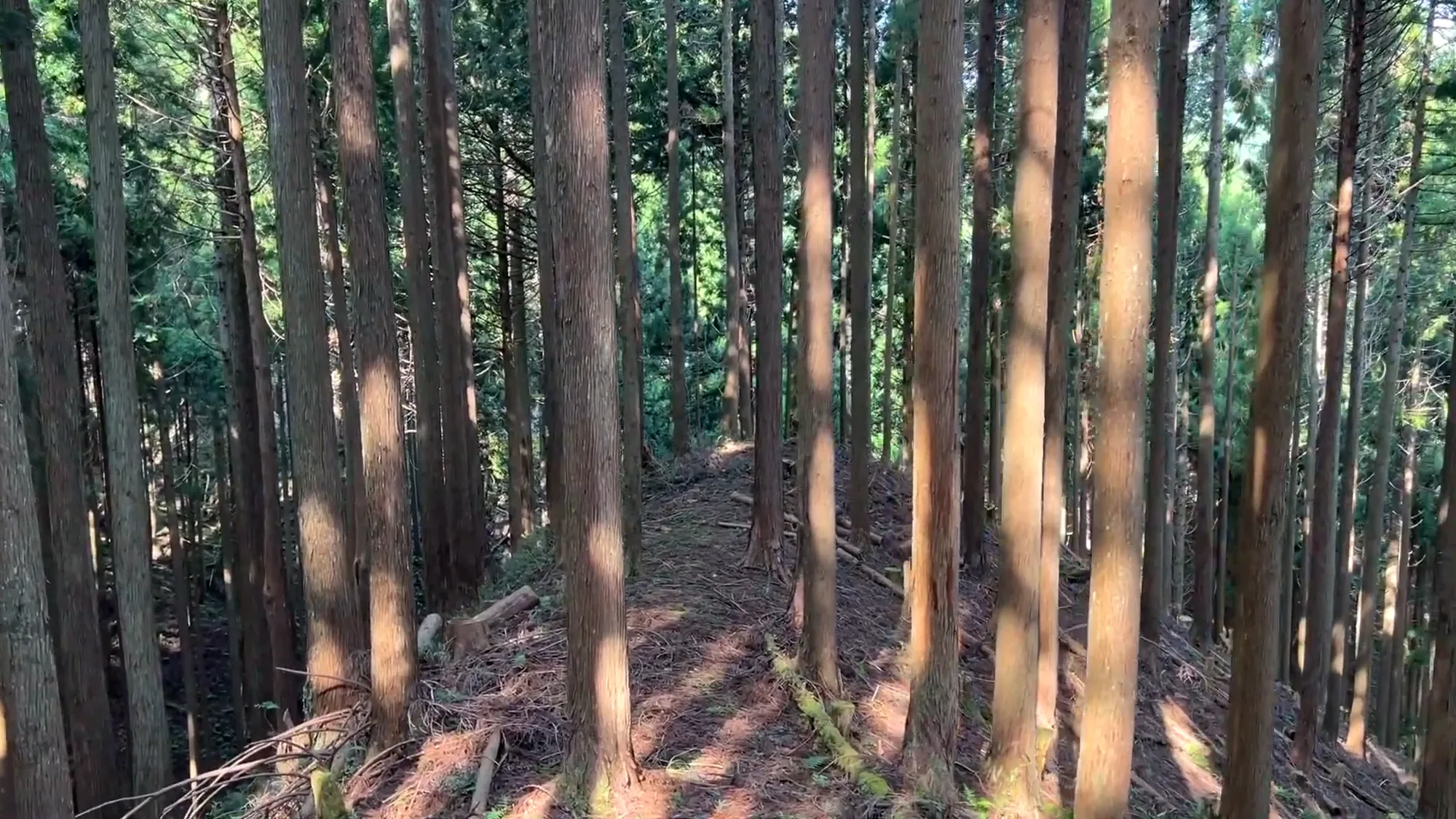
Nothing much grows under cedar, which is both the point and the problem.
And note which way round Chizu has used it. It says yes to wheelchairs and let-us-talk to companies — the opposite of nearly everywhere else, where accessibility is the first thing declined. Chizu will commit to a wheelchair and wants a conversation about a corporate booking.
It can commit, because it built a road for it.
福祉森林セラピーロード
Four roads, three described, and the third one has a name no other base uses.
The Ashizu therapy road (芦津セラピーロード) is Chizu’s flagship, and it runs inside the designated cultural landscape. The Ashizu gorge (芦津渓谷) holds what the town calls one of the foremost mountain streams in western Japan, and what grows beside it is natural cedar mixed with broadleaf — beautiful through all four seasons. The road runs from the Chūgoku Nature Trail (中国自然歩道) around the Mitaki dam (三滝ダム) and on into the headwater gorge itself, and three separate courses are set within it, each showing a different face.
Natural cedar is the thing to notice, self-sown rather than planted, in a town whose cultural designation is for its plantations. Chizu has both, and says which is which.
The Komorebi Forest (こもれびの森), also inside the cultural landscape, is wrapped in cedar and cypress a little over sixty years old, and full of komorebi — the light that falls through leaves. It sits close to the old post-town of Chizu-juku, with a view over the whole town, and they say the view and the wind do the healing.
Sixty years is the other end of the same story. Three-hundred-and-fifty-year plantation in the cultural landscape; sixty-year plantation on the therapy road. Chizu is a working forest at every age at once, which is what a forestry town looks like when nothing has interrupted it.
The Yokose Gorge course (横瀬渓谷コース) walks cedar forest beside a clear stream, with the water audible the whole way. And: it is a welfare forest therapy road, which can be done in a wheelchair or with a stroller.
A welfare forest therapy road. No other base uses that term, and it is the single most useful phrase in all the accessibility material these forests have produced, because it names the thing as a category rather than describing it as an exception.

The stream through Itaibara, with steps cut down to it.
A yes in a box is a claim. A road with the word welfare in its name is a road that was built for the purpose and is understood that way by the people who maintain it. It tells you that somebody made a decision, allocated a budget, and expects wheelchairs.
So a shape emerges. Akasawa paved an entire road and runs a wheelchair-boardable railway. Chizu named a road for welfare and said what it is for. Otari and Shiga Kōgen quantified. Hakone and BIOTOPIA wrote conditions into the answer. Minami-Minowa named its surfaces. Achi put a ropeway under the problem. Eight bases out of sixty-two have done something better than yes-or-no — and between them they have invented the standard the rest should adopt.
What Chizu does not publish is the measurement. No length, no time, no gradient, no surface width for the Yokose course or any of the others. So the four questions still go to 0858-76-1111 or therapy@chizukankou-kurashiya.jp — width, step, approach surface, toilet. But they go as a follow-up to a yes, rather than as a challenge to a no, and that is a different phone call.
The tree list is a clean inland set: conifers cedar, hinoki cypress and red pine; broadleaves beech, mizunara oak and horse chestnut. The two trees singled out are the Keichō cedar (named for the era around the turn of the seventeenth century, which fits the three-hundred-and-fifty-year plantation) and multi-storied cedar regeneration, which is a silvicultural technique rather than a tree: growing a new cohort beneath a standing one so the canopy is never cleared.
A base whose notable tree is a forestry method is a base that knows what it is.
And the third special-tree slot reads ⚪︎⚪︎⚪︎⚪︎. Four placeholder circles, left in the published page where a tree name should be. Somebody filled in two and never came back, and it was published that way. A small thing, and a useful reminder of what these pages are: a form, filled in once by a busy municipal officer, and never revisited.
Seven vows, and a lunchbox made of wood and paper
The bentō here is the only one with a constitution.
To raise the effect of forest therapy further, the town says, it is important to eat food that is gentle on the body. So Chizu makes and serves a forest therapy food found only in Chizu, built on a set of “seven vows”, with sincerity and by hand.

The lane to the old settlement, one car wide and rarely used.
Seven vows — glossed in the same breath as kodawari, the word for a particular insistence on doing a thing properly. A seven-point charter governing what may go in a lunchbox.
What the seven vows actually are is nowhere to be found, and it is the most tantalizing gap here. Every other base that offers a bentō describes the food; Hinohara in Tokyo lists six courses with a note each. Chizu describes the rules instead, and then withholds them.
And then the packaging, which no other base mentions at all: the lunchbox uses environmentally considerate, plastic-free containers made of wood and paper.
Designing the plastic out — in a lunchbox, at a certified forest, stated on the certifying body’s own page. It is the only environmental policy of any kind that any of these bases publishes, and it sits in the lunchbox field.
The Society’s certification requires a demonstrated physiological effect and says nothing at all about how a forest is cared for — no carrying capacity, no maintenance funding, no environmental standard. Chizu has written its own, for a lunchbox. It is a small jurisdiction to legislate, and it is more than the national standard manages.
Two programs, timed to the minute, and a homestay
The programs are published as timetables, which is usually a sign that somebody actually runs them.
The half-day Ashizu road, Chūgoku Nature Trail course runs about three hours. Morning: 9:00 assemble and register at the Chizu Town General Center → 9:10–9:40 move to the Ashizu gorge parking lot (about 30 minutes) → 9:40–12:30 forest therapy on the Chūgoku Nature Trail course → 12:30 finish. PM: 13:00 assemble → 13:40–15:30 therapy → 15:30 finish.
The full-day Ashizu headwater course, or the Mitaki dam course, runs about six hours. 9:00 assemble → 9:40–12:00 therapy → lunch → 13:00–15:30 therapy on the Ashizu headwater or Chūgoku Nature Trail course → 15:30 finish.

Itaibara, a mountain settlement that still has no road through it.
The thirty-minute drive is published, which matters more than it looks. It tells you the therapy road is not at the town center, that transport is arranged from a fixed assembly point, and that you can do this without a car — which almost nowhere else makes clear.
No price is given for either, which with two fully timetabled programs is the one serious omission here.
And the accommodation is the most distinctive of any base: Chizu’s healing lodgings are a homestay program. You stay in an ordinary family home, and preparing the meal and clearing up afterward are part of the experience. The page says the host families are easy-going and look forward to meeting travelers, that the conversations over those everyday tasks are one of the pleasures, and that it should feel like visiting the house of a distant relative or a friend.
Washing up as an advertised feature of a wellness stay is either absurd or exactly right, and in a town whose slogan is about evacuation and the connections between people, it is the second one. The other sixty-one bases offer you an inn. Chizu offers you somebody’s kitchen.
Every season here comes with an event rather than an adjective: spring 桜土手 and new green and the 智頭河畔桜cafeフェスティバル; summer シャワークライミング and the 来んさい!見んさい!踊りん祭!! festival; autumn color, trekking and the 智頭宿ハイカラ市; winter the 智頭宿雪まつり.
Shower climbing (going up a stream through the water itself) on a base whose roads follow a gorge that is among the best in western Japan, is the summer activity this terrain was made for.
What you will have to ask for
For a well-documented base, the gaps are specific.
Four roads, three described, none measured — no length, time, gradient or surface for any, including the welfare road, which is the one that most needs them. No elevation. No base area. No price for either program. No price for the bentō, and the seven vows are named but not listed. No fauna. The third special-tree slot is an unfilled placeholder. And no access information beyond the thirty-minute transfer — no station, no fare, in a town on a rail line through the mountains.
The operator is the town tourism association, on 0858-76-1111 or therapy@chizukankou-kurashiya.jp, with the official page on the town’s own site under sanson_saisei — mountain village regeneration.

The forest road was built to get the timber out and is now how you get in.
That URL path is worth one sentence. The town files its forest therapy program under mountain-village regeneration, not tourism. Saku filed its forest with the health department. Kusatsu filed it with health and welfare. Chizu filed it with depopulation policy. Three towns, three theories of what a forest is for, all visible in a web address.
Go in autumn, and stay in somebody’s house
The shape of a visit here is clearer than at most bases, because the town has thought about it.
Go in autumn. The gorge is among the best in western Japan, the mixed natural cedar and broadleaf turns, the 智頭宿ハイカラ市 is on in the old post-town, and the full-day program gives you six hours split across two courses with lunch between them.
Book the one-day Ashizu headwater course, which is the one that goes furthest up into the source forest — the ground that made the sand dunes. Order the therapy food, made to seven rules nobody will tell you, in a box of wood and paper. Walk the Chūgoku Nature Trail in the morning and the headwater in the afternoon, and ask the guide to show you where the three-hundred-and-fifty-year plantation is, because it is a cultural property and it is standing.
If you can only manage a flat walk, ask for Yokose, which is the welfare road, and which exists because somebody decided it should.
And stay in a house rather than an inn. You will help cook and you will help wash up, and that is advertised rather than apologized for. In a town that borrowed the word for wartime evacuation to describe what it offers city people, being handed a tea towel is the whole point.
Then stand somewhere in the Ashizu gorge and consider that the sand at Tottori, the one thing anybody outside Japan knows about this prefecture, came down from here, slowly, over a very long time, through a forest that people have been working since the Edo period and that the state now protects as culture.
Nobody notices the landscape they live in. The town says so itself, in writing, and then asks you to come and notice it.
Nearby and alike

Hyōgo · Certified 2015
Shisō
Three roads given to the percent, a six-hundred-year cedar in the Oirase of the West, Japan’s steepest monorail, and a guides’ association that tells you how many people it actually walked.

Nagano · Certified 2006
Akasawa
Four hundred years of protection, the cypress that rebuilds Ise Shrine, Japan’s first recreation forest, and the 1982 gathering that gave forest bathing its name.

Okayama · Certified 2008
Shinjo Village
Hammocks on a two-kilometer path at the foot of Mount Kenashi, a paved loop around a power company’s dam, and an old post town on the iron road.
Verified by The Japan Onsen Society
Sources
森林セラピー「鳥取県 智頭町」— https://fo-society.jp/facility/chizu/ (鳥取砂丘を育む源流の森; 智頭町; 認定 2010年4月; barrier-free 可 · corporate 要相談 · inbound 要相談 · children 可; 智頭町のキャッチフレーズは「みどりの風が吹く“疎開”のまち智頭」; ゆったり深呼吸できる豊かな自然空間と人々のつながりを育むまちづくり; 町の総面積の93%が山林で、長い年月をかけてあの鳥取砂丘を育んだ“源流の森”が広がります; “森林は町の大切な財産”としてとらえ、森の持つ癒し効果に着目し「森林セラピー」をまちづくりのメインテーマの一つとして取り組んでいます; ロード数 4, 3 described, none measured; 芦津セラピーロード — 西日本屈指の渓流, 天然杉と広葉樹の混交林, 中国自然歩道から三滝ダム周辺を巡り、さらに源流域の渓谷へ, それぞれ異なる表情を魅せる3つのコース; こもれびの森 — 樹齢60年余の杉や桧林に包まれ, 智頭宿に近く, 智頭のまちを一望できる景色と風; ⭐ 横瀬渓谷コース — 清流の音を聞きながら杉林を歩くコース。車椅子やベビーカーでも体験できる福祉森林セラピーロードです; ⭐⭐ セラピー弁当 有 — 「セラピー食」を“7つの誓い”(こだわり)の規定に基づいて…まごころと手をかけてお作りし、ご提供しております。弁当箱は環境に配慮した脱プラスチック容器(木と紙)を使用しております; conifers スギ・ヒノキ・アカマツ, broadleaves ブナ・ミズナラ・トチノキ, 特徴木: 慶長杉 · 杉の複状更新 · ⚪︎⚪︎⚪︎⚪︎ (an unfilled placeholder); ⭐⭐⭐ 樹木のその他特記事項 — 平成30年2月13日、「智頭の林業景観」が国の重要文化的景観に選定されました。智頭の林業は、樹齢350年の人工林に象徴される江戸時代に始まります。林業の長い歴史の中で形成された、「山村集落と周辺の人工林」「林業で栄えた宿場町と周辺の山林」さらに「天然スギと広葉樹林広がる中山間地」は、重要な文化的景観です。文化的景観は、日々の生活に根ざした身近な景観であるため、日頃、その価値に気がつきにくいものですが、人々の生活や生業、その地域の風土により形成された欠かせないものであり、地域の誇りとして次の世代へと継承していきたいと考えています。; all four seasonal fields filled with named events incl. シャワークライミング and 智頭宿雪まつり; 2 programmes with full timetables, including the 30-minute transfer from 智頭町総合センター; NO PRICES; guide message — 智頭町森のガイド; ⭐ 智頭の癒しの宿(民泊)— 一般家庭に宿泊し、受入れ家庭との交流と季節の田舎暮らしを体験, 食事の用意も、後片付けも体験のうち, まるで遠くの親戚や友人の家に遊びに行くような; contact 一般社団法人智頭町観光協会, therapy@chizukankou-kurashiya.jp, 0858-76-1111; official site https://www1.town.chizu.tottori.jp/chizu/sanson_saisei/therapy/)
森林セラピーソサエティ「森林セラピー基地 検索・一覧」— https://fo-society.jp/base-road_list/ (Chizu = No. 44, 鳥取県, 智頭町, all four columns ◯ — note the national table renders 要相談 as ◯, so it CANNOT be used to find other bases using the third answer)
森林セラピーソサエティ「基地認定 について」— https://fo-society.jp/authorization/ (the physiological-experiment requirement; and the absence of any environmental, carrying-capacity or maintenance standard)
Verified: 2026-10-05