Hyōgo · Certified 2015
Shisō: The Only Certified Forest That Publishes All Five Figures for Every Road
Three roads given to the percent, a six-hundred-year cedar in the Oirase of the West, Japan’s steepest monorail, and a guides’ association that tells you how many people it actually walked.

Tall slender waterfall falling into a gorge surrounded by red and gold autumn trees at Shiso, Hyogo
Step-free
Partly step-free
Monorail runs 1,100 m to the Kunimi road
The main road
Akasai Therapy Road
赤西セラピーロード · 1.6 km (1 mi) · 4% average
Open
Year-round
Snowshoe program in deep winter
The record
What you need to go
Open season
All four seasons carry events. A wisteria festival in spring, canoeing in summer, the maple festival in autumn, two ski areas in winter
Getting there
not published
Fees
Program prices are not published. The therapy bentō is ¥1,630 (about $11) with tea or ¥1,500 (about $10) without
Onsen
Mahoroba no Yu (まほろばの湯), an isotonic alkaline saline spring at pH 8.85, drawn from 1,300 m (4,265 ft) down through 250-million-year-old rock
The walk
Main trail
Akasai Therapy Road (赤西セラピーロード), 1.6 km (1 mi) at a 4 percent average over four hours, beside the clear Akasai river
All trails
3 trails, 1.5 to 2.3 km (0.93 to 1.4 mi), three to four hours each, at average gradients of 4 to 6 percent
The step-free road
Barrier-free is marked no, yet a universal-design monorail runs 1,100 m (3,610 ft) to the Kunimi road, a prepared promenade at 6 percent. Call before believing the no
The forest
Forest type
Deep interior Hyōgo. A valley the town calls the Oirase of the West, a thousand-year wisteria, and maples ranked first for their fallen carpet
What grows
Cedar · Cypress · Pine · Fir · Beech · Zelkova · Oak · Maple · Walnut · Hackberry · Horse chestnut, with a cedar 6 m (20 ft) around
What lives
Not published beyond deer, which the snowshoe program says you are lucky to meet with a fawn
Certified since
2015
All figures updated 5 October 2026
The forest, before the facts
Thirty meters (98 ft) of height difference. Average gradient four percent.
That is what the town publishes about its easiest road, and almost nobody else publishes anything like it.
Shisō gives a distance, an elevation, a height difference, an average gradient as a percentage, and a time, for every one of its three roads. A few other certified forests publish a gradient somewhere. None of them publish the whole set.
A gradient in percent is the language of a cycle route or a wheelchair standard, not a forest brochure. It is the single most useful number you can give somebody who does not know whether their body can do a path, and hardly anywhere in the scheme does anybody think to publish it.
And then the town tells you what it thinks its forest is: Shisō’s forest is like a doctor, gently watching over those who come looking for a healing while.
A town that calls its own forest a doctor, and then publishes gradients like a physiotherapist. The two belong together.
Five reasons to come
Three roads published with distance, elevation, height difference, gradient and time.
A six-hundred-year cedar with a six-meter (20 ft) girth, in a valley called the Oirase of the West.
What the park calls Japan’s steepest monorail, to a ridge with a view of three bridges and the Inland Sea.
Zazen in the valley in spring and autumn, snowshoes in deep winter.

The gorge floor stays dark enough that the moss never dries out.
A thousand-year wisteria, and maples ranked first in the country for their fallen carpet.
The numbers, road by road
Shisō (宍粟市) sits in the far interior of Hyōgo, in the country they call deep Harima, and it was certified in March 2015 as the first forest therapy base in the prefecture. The valley it leads with is the Akasai gorge (赤西渓谷), which the town calls the Oirase of the West, after the famous gorge up in Aomori.
Three roads, and here is all of it.
Akasai Therapy Road (赤西セラピーロード). Along the clear water of the Akasai river, through mixed forest on a walkable forest road: cedar and fir above, horse chestnut, zelkova and walnut below. The town gives you the four seasons in one line: new green in spring, clear water in summer, yellow leaf in autumn, snow mountain in winter. 1.6 km (1 mi) · elevation 635 m (2,083 ft) · 30 m (98 ft) of height difference · 4% average gradient · 4 hours.
Kunimi Forest Therapy Road (国見の森セラピーロード). You ride what the park calls Japan’s steepest monorail up through the prefectural Kunimi-no-mori park, then walk a prepared promenade from the summit station. On a clear day the view takes in the Akashi Kaikyō Bridge (明石海峡大橋), Awaji island (淡路島), as far as the Naruto Bridge (鳴門大橋), and Mount Hyōnosen (氷ノ山). 2.3 km (1.4 mi) · elevation 425 m (1,394 ft) · 42 m (138 ft) of height difference · 6% average gradient · 4 hours.
Tōyama Therapy Road (東山セラピーロード). A bowl-circuit along the ridge around Forest Station Haga, at 740 m (2,428 ft), with a cool breeze even in summer and the settlements far below laid out like a bird’s-eye map. Afterwards there is hot spring, restaurant, hotel and auto-camping on site. NHK’s morning show came and filmed the forest therapy here. 1.5 km (0.93 mi) · elevation 740 m (2,428 ft) · 70 m (230 ft) of height difference · 4% average gradient · 3 hours.
Three things to notice in that set.
The times are generous and they are the point. 1.6 kilometers (1 mi) in four hours is four hundred meters (1,310 ft) an hour. That is not walking; it is stopping. The road data describes a therapy session, not a hike, and the only way to tell is that the numbers say so.

Late in the turn, when half the color is on the ground.
The gradients are gentle and now you can prove it. Four percent, six percent, four percent. Four percent is a slope most people would not notice they were climbing. For comparison, Tsu’s lakeside road over in Mie runs 10.7 kilometers (6.6 mi) with 20 meters (66 ft) of height difference, which works out under 0.2 percent. Shisō’s roads are steeper than that and still shallow by any ordinary standard.
And the shortest road has the most climb. Tōyama is 1.5 kilometers (0.93 mi) with 70 meters (230 ft) of height difference, against Akasai’s 1.6 kilometers (1 mi) with 30 (98 ft) — so the ridge circuit does more than twice the vertical work in a slightly shorter distance, while reporting the same average gradient. Averages hide things, which is why the height difference is published beside them. Both numbers together tell you what one cannot.
Marked no for wheelchairs, against its own evidence
Shisō is marked no for barrier-free, and it may be the most thoroughly self-defeating no in the whole scheme.
Yes for corporate training, yes for overseas visitors, yes for children. No for wheelchairs and strollers.
Now read what the town says about the Kunimi road. It is reached by a monorail, and the town describes that monorail in full: 1,100 meters (3,610 ft) of mini-monorail linking the mountain foot to the summit, and it is a universal-design facility by which anybody can easily reach the top and come into contact with nature.
Universal design. Anybody, easily. And from the summit station, a prepared promenade at an average gradient of six percent.
A universal-design lift to a prepared path at six percent, in a town marked no for wheelchairs.
And then the smallest, most telling detail of all. The photograph illustrating that road is filed under the name Kunimi road, barrier-free path. Somebody at Shisō walked that road, photographed it, called the file barrier-free path, uploaded it — and the same submission marked the town a no.

Maple in the second week of November, which is the week everyone comes.
That no is not a measurement of a path. It is a town declining to promise. Kanra answered no while describing its own course as barrier-free. Saku answered no on a wood-chip path beside an expressway. Kijimadaira answered no with a barrier-free visitor center. Shisō answered no with a universal-design monorail and a photograph called barrier-free path.
So four questions are worth the phone call, and they go to 0790-64-0923 or info@shiso.or.jp: whether a wheelchair can board the monorail, the surfaced width of the Kunimi promenade, whether that six percent is continuous or hides steeper pitches, and where the accessible toilet is at the summit station.
On the published evidence, the honest answer at Kunimi may be yes.
Three special trees, all measured
Most certified forests name no notable trees at all. Shisō names three, and puts a number on every one.
The first is the Akasai Valley Thousand-Year Cedar (赤西渓谷千年杉): estimated age six hundred years, girth six meters (20 ft).
Note what the town has done there. The tree is called the thousand-year cedar, and the town published the estimate anyway — six hundred, not a thousand. It printed the local name and the real number side by side and left the gap visible. That is a small act of honesty, and almost nothing else in the scheme does it.
The second is the Thousand-Year Wisteria at Ōtoshi Shrine (大歳神社千年藤), over a thousand years old, and that one is not hedged. A wisteria of that age is a serious thing: the vine becomes a trunk and the trunk becomes a structure. There is a wisteria festival for it in spring.
The third is Saijōsan Park (最上山公園), whose maples are ranked first in the country in Jalan’s carpet category.

The hillside turns from the top down and takes about ten days to finish.
That last one needs a note. Jalan is a travel booking site that runs reader rankings, and it has a carpet category for autumn-leaf destinations. Not for the color on the tree. For the fallen leaves on the ground.
Somebody in Japan ranks maple sites by how good the leaf litter looks, and Shisō is first in the country. Autumn here also brings the maple festival, the Hara-Fudō falls (原不動滝) and the color in the Fukuchi gorge (福知渓谷).
The ordinary tree list is unusually full too: cedar, cypress, pine and fir among the conifers; beech, zelkova, oak, maple, walnut, hackberry, horse chestnut and magnolia among the broadleaves — eight broadleaf species where most certified forests manage three or none.
And every season comes with an event rather than an adjective: spring, the wisteria festival, rhododendron at Forest Station Haga, and Shisō’s fifty famous mountains; summer, auto-camping, canoeing on Lake Onzui (音水湖) and the Yamasaki fireworks; autumn, the maple festival and two gorges; winter, two ski areas, Chikusa Kōgen (ちくさ高原) and Banshū Tokura (ばんしゅう戸倉).
Shisō’s fifty famous mountains is a municipal list of fifty peaks inside one city, which tells you what kind of place this is more efficiently than any description could.
Five programs, and one of them is zazen
Shisō runs five programs, and they are worth going through one by one, because together they make an argument about what a forest is for.
Forest therapy and an e-bike. An electrically assisted bicycle in the Akasai valley, for healing plus exertion plus exhilaration. The route comes with numbers, as everything here does: elevation 686 m (2,251 ft), 8.8 km (5.5 mi) one way, 350 m (1,150 ft) of climb, one way, under power assist.

Close to, the red has about four shades in it.
Forest therapy and zazen. Seated meditation in the great nature of the Akasai valley, in the good seasons, spring and autumn. The town sets out what zazen is said to do, and hedges it carefully as something said rather than proven: the mind settles, calm comes, concentration sharpens, stress lifts, the balance of the autonomic nervous system is adjusted, and you come away exhilarated. Those are the town’s claims about the practice, not medical advice, and nobody here is making you a promise about your health.
The autonomic nervous system is the phrase that matters, because it is exactly what the Forest Therapy Society’s certification experiments measure — the shift toward parasympathetic activity that defines the forest therapy effect. Shisō has put a seated meditation practice next to a certified forest and described both in the same physiological vocabulary, and then said it is said. That is the right amount of confidence.
Aroma craft and aroma relaxation, in the valley.
The summer-holiday family event, held in support of Mountain Day, and the most practically thoughtful program in the whole scheme. In the Akasai valley, the adults get a while away from child-rearing and relax in forest therapy. Meanwhile the children, with an instructor, make an oniyanma-kun. Then a handmade lunchbox, and then a clear stream running at 18 °C (64 °F) even in summer, for water play and fishing, or whatever toys you brought.
Read that again. A certified forest therapy town has written, in public, that the point of its family event is to give parents an hour off from their children, and has arranged supervised craft so they can have it. Nowhere else in the scheme has anybody acknowledged that the person who most needs a forest may be holding a toddler.
An oniyanma-kun is a dragonfly-shaped charm worn to keep biting insects away, on the folk principle that dragonflies eat mosquitoes. Children make one, wear it, and go into a river. It is a perfect summer craft and it costs nothing.
Snowshoe hiking. The Akasai valley in deep winter, with the line every guide eventually writes: lucky if you meet a doe and her fawn.
And the lunchbox is priced to the yen, with a distinction nobody else makes: ¥1,630 (about $11) with tea, ¥1,500 (about $10) without. Shisō is the only certified forest that prices the tea separately. The bentō is built around ingredients from inside the city, and made with health in mind.

Looking up from the riverbank, with the valley running out underneath.
The guides publish their own figures
The guides’ own message ends with a line nobody else in the scheme comes close to, and it is the reason to trust everything above it.
The Shisō City Healing Forest Guides’ Association was founded on 22 May 2016. And then, in brackets:
Results for fiscal 2023: 600 people guided, over 45 days, 31 members, 105 guide turnouts.
It is the only operating statistic published anywhere in the scheme by a guides’ association about its own guiding. Kusatsu publishes a visitor figure, but that is the count for a hot spring town of three million. Kanegawa in Yamanashi publishes park usage against a target. Shisō counts the work of thirty-one people: how many walkers, on how many days, with how many members turning out.
Do the arithmetic it invites. Six hundred people over forty-five days is about thirteen a day. One hundred and five deployments across forty-five days is between two and three guides per session. Thirty-one members sharing 105 turnouts is roughly three and a half days each per year.
That is what a working forest therapy base looks like from the inside, and it is a small, modest, entirely sustainable operation — nothing like the scale you might imagine from a national certification. Thirteen people a day, three guides, a few days a year each.
And the honesty of publishing it is the strongest credential they have. A town that tells you it guided six hundred people is a town that counted.
Water from two hundred and fifty million years ago
The hot spring deserves its own paragraph, because the town describes it with a precision almost no other onsen gets.
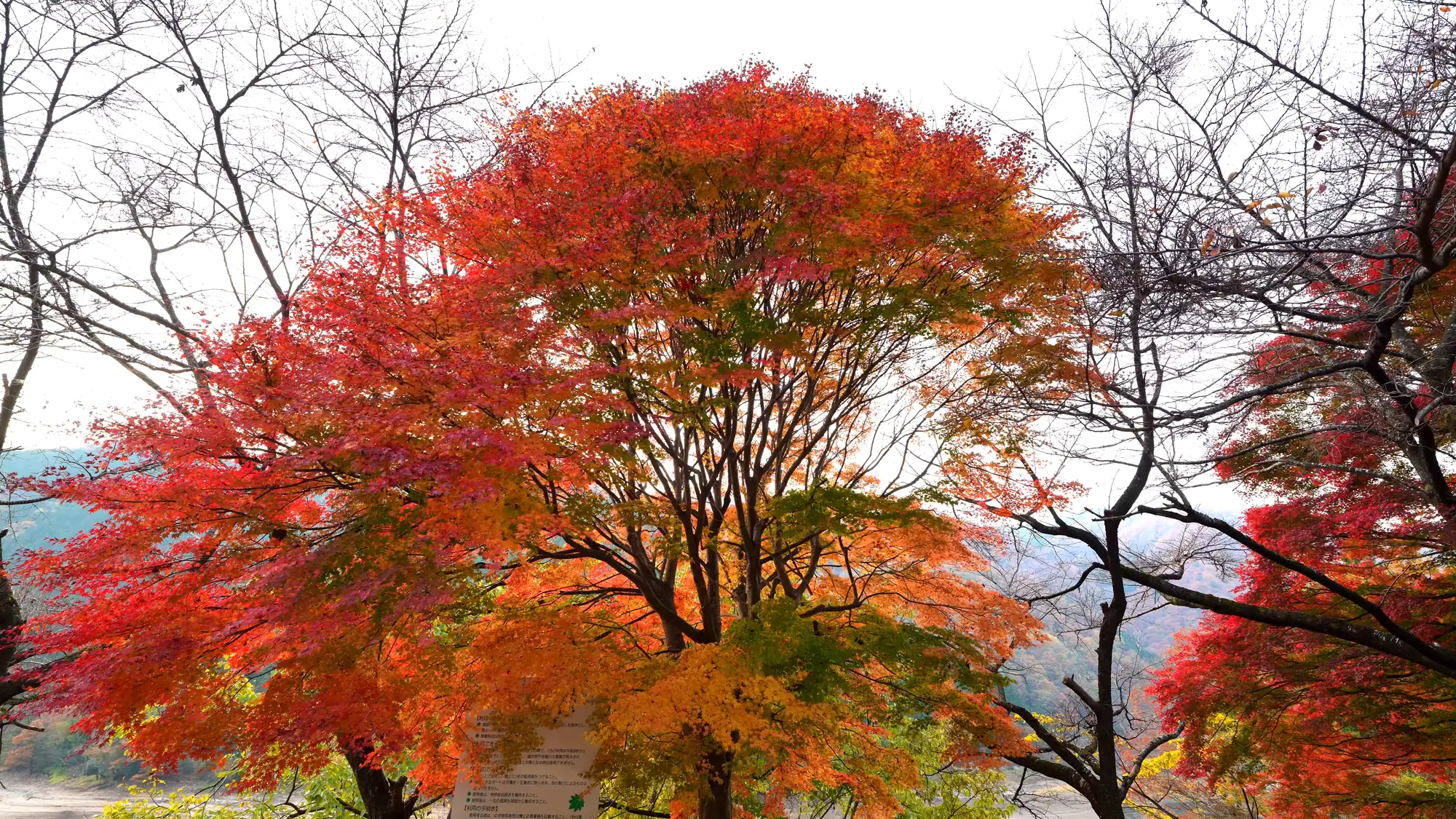
One tree a fortnight behind everything around it.
Mahoroba no Yu (まほろばの湯) is isotonic, which the town explains means you do not tire easily even after a long soak.
And the geology: a therapeutic hot spring welling up from a stratum 1,300 meters (4,265 ft) down, in the upper Maizuru group — sedimentary rock laid down about 250 million years ago.
An alkaline saline spring, salt and a long list of mineral components, pH 8.85, described as mild, and held good for recovery after illness, chronic rheumatism, cold hands and feet, sprains and bruises. Those indications are the bathhouse’s own, not a doctor’s.
Therapeutic hot spring is the same register Kusatsu chose when it named its council a forest medicine council rather than a forest therapy one: the vocabulary of treatment rather than leisure. A pH to two decimal places, a depth in meters, a rock age in hundreds of millions of years, and a list of indications. It reads like a label, and that is the compliment.
The other facilities are substantial. Forest Station Haga (フォレストステーション波賀) is a forest resort of about a million tsubo, roughly 3.3 km² (1.3 sq mi), with a hotel, the Tōyama hot spring, cottages, auto-camping and barbecue sites, and the Tōyama therapy road runs from it, with Akasai nearby. Kunimi-no-mori Park (兵庫県立国見の森公園) holds the monorail and the Kunimi road, and exists for environmental learning, forest conservation work, and exchange with the cities. Chikusa Kōgen ski area (ちくさ高原スキー場) sits at 900–1,125 m (2,950–3,690 ft) on the Okayama and Tottori border, with snowmaking, drawing fifty thousand visitors from Himeji, the Kansai cities, Chūgoku and Shikoku, and running a campsite in summer.
The operator is the Shisō Forest Kingdom Tourism Association, working out of the prefectural Kunimi-no-mori park, on 0790-64-0923 or info@shiso.or.jp, with the site at shiso.or.jp/therapy.
Forest Kingdom is what the town calls itself.
What you will have to phone for
For a town this well documented, the list is short.

Above the gorge it is all planted cedar, and has been for generations.
No surface is given for any of the three roads — gradients and height differences, yes; what is underfoot, no. No wildlife named, beyond the deer in the snowshoe program. No price for any of the five programs except the lunchbox, which is the gap that matters: five programs, five phone calls. And no access information: no station, no journey time, no fare, in a city in the deep interior of Hyōgo that you will almost certainly reach by car.
And the no for barrier-free, which the town’s own monorail description, its own six-percent gradient and its own photo caption all argue against.
Go in November, and ask about the monorail
The timing is published for once, so take it.
Go in autumn. The maples at Saijōsan Park are ranked first in the country for their fallen carpet. The Akasai valley turns yellow rather than red, which in a forest of beech, zelkova, walnut and horse chestnut is the right word. And there are two more gorges on the list.
Walk Akasai: 1.6 kilometers (1 mi), four percent, four hours. Take the four hours seriously. Four hundred meters (1,310 ft) an hour means the road is not the point and the stopping is. Stand under the six-hundred-year cedar with the six-meter (20 ft) girth, which the town calls a thousand years old and then tells you is six hundred. Order the lunchbox with the tea; it is a hundred and thirty yen, about ninety cents.
If you are coming in spring, come for the wisteria, over a thousand years old, with a festival, and book the zazen, which runs in spring and autumn and is rare enough that you will not easily find it at another certified forest.
If you have small children, book the August family event, because it is the only program in the system designed around the parent rather than the child.
And if you use a wheelchair, phone before you believe that no. There is a universal-design monorail up the mountain, a prepared promenade at six percent at the top, and a photograph on the Society’s own page filed under the name barrier-free path. Somebody at Shisō already knows the answer. It just is not in the box.
Nearby and alike

Niigata · Certified 2008
Taruda-no-mori
A beech forest in Japan’s deepest snow country, with three measured roads and a locked gate from December. Open May to November, and the town barely knew it was there.

Tottori · Certified 2010
Chizu
A town 93% forest, whose forestry is a protected national cultural landscape — with a welfare therapy road, a therapy lunch made under seven published vows, and a homestay where washing up is part of the experience.

Wakayama · Certified 2007
Kōyasan
A monastery has managed this mountain’s trees since the ninth century. One certified road is the ridge women walked when they were forbidden the summit.
Verified by The Japan Onsen Society
Sources
森林セラピー「兵庫県 しそう森林セラピー基地」— https://fo-society.jp/facility/shiso/ (兵庫の奥播磨宍粟市 西の奥入瀬 赤西渓谷; 宍粟市; 認定 2015年; barrier-free 否 · corporate 可 · inbound 可 · children 可; 宍粟の森は、癒しのひと時を求めて訪れる方を優しく見守ってくれるドクターのようです; 宍粟市は2015年3月、兵庫県下初の森林セラピー基地に認定されました; ⭐⭐ 3 roads each with FIVE figures — 赤西セラピーロード: 全行程約1.6km / 標高635m / 高低差30m(平均斜度4%)/ 所要4時間, 赤西川の清流, スギやモミの針葉樹や広葉樹のトチ、ケヤキ、クルミなどの混交林, 春の新緑・夏の清流・秋の黄葉・冬の雪山; 国見の森セラピーロード: 全行程約2.3km / 標高425m / 高低差42m(平均斜度6%)/ 所要4時間, 兵庫県立国見の森公園の日本一の急こう配のモノレールに乗り山上駅から整備された遊歩道, 明石海峡大橋や淡路島から鳴門大橋、さらには兵庫の高峰氷ノ山; 東山セラピーロード: 全行程約1.5Km / 標高740m / 高低差70m(平均斜度4%)/ 所要3時間, フォレストステーション波賀周辺の稜線を歩く『お鉢巡り』, 夏でも涼風, まるで鳥瞰図のよう, NHK番組「あさイチ」で森林セラピーの取材を受けました; ⭐ セラピー弁当 有 — 宍粟市内の食材を中心に取り入れ、健康に配慮したお弁当。お茶有り:1個 1,630円 / お茶無し:1個 1,500円; conifers 杉・桧・松、樅, broadleaves ブナ・ケヤキ・ナラ、モミジ、クルミ、エノキ、トチ、ホウ; ⭐⭐ 特徴木: 赤西渓谷千年杉(推定樹齢600年、幹回り6メートル)・大歳神社千年藤(樹齢1000年以上)・最上山公園もみじ(じゃらんカーペット部門一位); all four seasonal fields filled with named events; ⭐⭐ 5 programmes — 森林セラピー&E-BIKEレンタル【標高686m 走行距離片道8.8Km 標高差350m】; 森林セラピー&座禅(心が落ち着く、安らぎが得られる、集中力が増す、ストレスが解消できる、自律神経のバランスを整える、爽快感が得られるなどさまざまな効能があるといわれています); 森林セラピー&アロマクラフト・アロマリラックス; 夏休み、山の日協賛森林セラピーファミリーイベント(おとなは子育てからひと時離れ森林セラピーでくつろぎます、その間子どもは講師指導で『おにやんま君』を作ります、夏でも水温18℃の清流); 森林セラピー&スノーシューハイク(鹿の親子に会えたらラッキー); ⭐⭐ guides’ message — 私たち宍粟市癒しの森ガイドの会は2016年(平成28年)5月22日に発足いたしました…(令和5年度実績:600名案内・45日、会員31名・延出役105名); ⭐ まほろばの湯 — 体にやさしい等張性の温泉, 長く入浴しても疲れにくい, 舞鶴上層群上部(約2億5000万年前の堆積岩)、地下1,300mの地層から湧き出ている療養温泉, アルカリ性の食塩泉, pH8.85の緩和性, 病後の回復・慢性リウマチ・手足の冷え・捻挫・打ち身; フォレストステーション波賀 — 約1,000,000坪, ホテル東山温泉メイプルプラザ・東山温泉・コテージ村・オートキャンプ場・バーベキューサイト, 東山セラピーロードはここにあり、赤西セラピーロードも近く; ⭐ 兵庫県立国見の森公園 — 自然環境学習、森林保全活動、都市との交流拠点, 山麓と山上を結ぶ延長1,100mのミニモノレールがあり、誰もが簡単に山上へアクセスでき自然とふれあえるユニバーサルデザインの施設, 国見の森セラピーロードはここにあります; ちくさ高原スキー場 — 標高900~1,125m, 岡山県と鳥取県境, 降雪設備, 来客5万人; 🔴 the image illustrating the 国見の森 road is filed as 「3-2-2つ目のおすすめロード国見ロードバリアフリー道DSC08334」; contact 公益財団法人しそう森林王国観光協会 / 兵庫県立国見の森公園, info@shiso.or.jp, 0790-64-0923; official site https://shiso.or.jp/therapy)
森林セラピーソサエティ「森林セラピー基地 検索・一覧」— https://fo-society.jp/base-road_list/ (Shisō = No. 43, 兵庫県, しそう森林セラピー基地; barrier-free BLANK, corporate ◯, inbound ◯, children ◯ — confirms the 否 on barrier-free against the national table)
森林セラピーソサエティ「基地認定 について」— https://fo-society.jp/authorization/ (the physiological-experiment requirement, for the 自律神経 comparison)
森林セラピー「三重県 津市森林セラピー基地」— https://fo-society.jp/facility/tsu/ (for the gradient comparison: 10.7 km with 20 m of height difference)
Verified: 2026-10-05