Toyama · Certified 2012
Kamiichi Forest Therapy Base: A Temple’s 400-Year-Old Fir Avenue, Walkable by Wheelchair Despite the Field
Three areas below Mount Tsurugi: a fir avenue planted for Ryūsenji in the 1600s, a rock-carved Fudō at Nissekiji, and thousand-year Tateyama cedars at the climbers’ base.

White summit post reading Nakayama beside a weathered stump with mountains beyond at Kamiichi, Toyama
Step-free
Partly step-free
Barrier-free to the main hall
The main road
Fir avenue course
トガ並木コース · 1.1 km (0.7 mi) · about 90 min
Nearest station
Kamiichi
Toyama Chihō Railway, then 10 min by taxi
The record
What you need to go
Open season
Not published. Wildflowers at Banbajima in spring and color in autumn, and a forest restaurant tour runs there from May to November
Getting there
Kamiichi (上市駅) on the Toyama Chihō Railway, then about 10 minutes by taxi to Ryūsenji. Free parking for fifty cars
Fees
Not published. The therapy bentō, Shun no Ka, is booked seven days ahead and carries no published price
Onsen
Alps no Yu (アルプスの湯), with an artificial carbonated bath, and day bathing at Banbajima Lodge below Mount Tsurugi
The walk
Main trail
The fir avenue course (トガ並木コース), 1.1 km (0.7 mi) in about 90 minutes, under firs 400 years old and 20 m (66 ft) tall
All trails
6 trails across three areas, 0.8 to 5.2 km (0.5 to 3.2 mi), 1.5 to 5.5 hours, climbing 10 to 545 m (33 to 1,788 ft)
The step-free road
The access field says no, yet the base’s own text says the fir avenue is barrier-free as far as the main hall entrance and can be walked in a wheelchair
The forest
Forest type
Three areas at the foot of Mount Tsurugi, two of them starting at temples and the third at a mountaineers’ lodge
What grows
Fir · Tateyama cedar · Hiba arborvitae · Kuromoji spicebush · Shirodamo · Bigleaf magnolia, with Tateyama cedars over 10 m (33 ft) around
What lives
Japanese serow on the fir avenue course. Birds are mentioned on the Ōiwa road without a single species named
Certified since
2012
All figures updated 5 October 2026
The forest, before the facts
The avenue of firs at Ryūsenji was planted for a temple. In the Kan’ei era, between 1624 and 1645, when the temple was being rebuilt, seedlings were brought from the Noto peninsula and planted along the approach for four kilometers (2.5 mi), as far as what is now the center of Kamiichi town. The trees that survive are about 400 years old, and Toyama Prefecture has made the avenue a natural monument.
The description of the walk under them is short: firs more than 400 years old and about 20 meters (66 ft) tall, called toga locally, and a path that is barrier-free as far as the entrance to the temple’s main hall, so that you can walk it in a wheelchair. The town tourism association says the same thing in nearly the same words.
And yet the Society’s own access answer for this base is no, not barrier-free. Its own road description, and the operator’s, both say a wheelchair can go up the avenue to the temple door. Both halves of that contradiction are below, because you will need both.
Five reasons to come
An avenue of 400-year-old firs, planted for a temple, walkable by wheelchair.
A rock-carved Fudō more than three meters (9.8 ft) tall at a temple of 1,300 years.
Tateyama cedars said to be more than a thousand years old, below Mount Tsurugi.
A walk past stone Kannon images on a low hill above the town.
The farmhouse that served as a model for an animated film.
The contradiction, first
The Society’s barrier-free answer for the Tsurugi Kirameki forest (剱・きらめきの森) is no. Its own description of the first road, the fir avenue course, says this: the fir avenue is barrier-free to the entrance of the main hall of Ryūsenji, and a wheelchair walk is possible.
The town tourism association repeats it: from the fir avenue approach to the main hall entrance is barrier-free, and you can walk it in a wheelchair.

A planted avenue, dead straight, with the trunks doing all the work.
That is two statements of wheelchair access against one negative answer. The answer under-reports at several forests in the scheme, and this is another. Treat it as a defect in the form, not in the path.
The fir avenue course runs 1.1 kilometers (0.7 mi), an hour and a half, with 30 meters (98 ft) of height difference, between 90 and 120 meters (295 and 394 ft) above sea level.
On wheels
Ask the tourism association four things about the fir avenue. How wide is the barrier-free section, in centimeters? Is there a step at the start, or at the temple gate?
What is the surface between the parking lot and the avenue? And is there an accessible toilet at the temple or the parking lot?
The 30 meters (98 ft) of height difference on the course is worth asking about too. Barrier-free to the main hall may describe only part of the 1.1 kilometers (0.7 mi).
A temple’s avenue
The temple’s history takes a few lines. Ganmokuzan Ryūsenji (眼目山立山寺) was founded in 1370 by Gasan Jōseki, the second patriarch of Sōjiji, the head temple of the Sōtō Zen school. It was once a temple with a full complement of halls, but in the Warring States period it was burned in the fighting when Uesugi Kenshin invaded the region, and only the founder’s hall survived.
The fir avenue belongs to its rebuilding. In the Kan’ei era, seedlings were brought from Noto and planted along four kilometers (2.5 mi) of approach. The trees are firs; toga is simply what they are called here.
That puts Kamiichi among the certified forests laid over somebody else’s older work, and the work here is religious: an approach avenue planted for a temple almost 400 years ago.

Hollow for most of its height and still putting out new growth at the top.
Three areas, six roads
The base is three areas at the foot of Mount Tsurugi (剱岳), a peak of the Tateyama range you can see from anywhere in Kamiichi: Sakka (眼目), Ōiwa (大岩) and Banbajima (馬場島). Six roads, each with a distance, a time and a height difference.
In the Sakka area are the fir avenue course and the Kushigata hill walk (櫛形山ウォーキングコース), 1.8 km (1.1 mi), two hours, 120 meters (394 ft) of height difference, between 90 and 210 meters (295 and 689 ft). It starts from Ryūsenji and passes stone Kannon images you can stop and pay your respects to along the way.
In the Ōiwa area are the Ōiwa forest course (大岩の森コース), 3.8 km (2.4 mi), four hours, 296 meters (971 ft) of height difference, between 150 and 446 meters (492 and 1,463 ft), on the Jōgadairayama trail, listening to birds in dappled light; and the flower house course (花の家コース), 5.2 km (3.2 mi), four and a half hours, 290 meters (951 ft), from 130 to 420 meters (427 to 1,378 ft).
In the Banbajima area are the easy family forest course (ゆったり家族の森コース), 0.8 km (0.5 mi), an hour and a half, 10 meters (33 ft) of climb, between 720 and 730 meters (2,362 and 2,395 ft); and the Banbajima trekking course (馬場島トレッキングコース), 5.0 km (3.1 mi), five and a half hours, 545 meters (1,788 ft), between 710 and 1,255 meters (2,329 and 4,117 ft).
The temple of the rock-carved Fudō
The flower house course starts at a second temple. Ōiwasan Nissekiji (大岩山日石寺) is a head temple of the Shingon esoteric school with a history of about 1,300 years. Its figure of Fudō Myōō, carved directly into the rock face, is a national Important Cultural Property and reckoned among the finest rock-carved Buddhas in Japan.
The carving stands more than three meters (9.8 ft) tall, and the course runs past the Sengankei stream (千巌渓), with views of Mount Tsurugi.
So the Ōiwa area too has a road that begins at a religious work. Roads in two of the base’s three areas start at temples, and the third area centers on a mountaineers’ lodge.
The flower house
The flower house course ends at a farmhouse. It starts at Nissekiji and aims for the old house called the flower house (花の家), which was the model for a house in the animated film Wolf Children.

The avenue runs further than it looks. The trunks make it hard to judge.
There is a tour built around it, the flower house plan, and a second Ōiwa plan that pairs the forest with shabutsu, the copying of Buddhist images by hand. Neither price is published, so you will have to ask.
The cedars at Banbajima
The Banbajima area is the climbers’ base for Mount Tsurugi, and the trekking course on the Nakayama trail is one for strong walkers. At Gohonsugi no Taira (五本杉の平), the five-cedars flat, giant Tateyama cedars stand in a row, the largest more than 10 meters (33 ft) around the trunk.
The cedars are said locally to be more than a thousand years old — a local claim rather than a measured age. The course crosses streams three times, with wildflowers in spring and color in autumn.
The easy family course is the other Banbajima road: the forest around Banbajima Lodge (馬場島荘), a base for climbing Tsurugi, in natural forest of beech and Tateyama cedar. The slope is gentle, and it is recommended for families and for older walkers. There is the clear water of the Tateyama river (立山川), and a building called Peter House.
What lives here
One animal is named: the Japanese serow (カモシカ), on the fir avenue course. And two plants: the silver fragrant olive at Ryūsenji, and kuromoji, a spicebush, on the Kushigata walk.
The Ōiwa forest course invites you to listen for birds without naming a single one. The conifers listed are fir, Tateyama cedar and hiba arborvitae; the broadleaves are spicebush, shirodamo bay laurel and the Japanese bigleaf magnolia. The notable trees are the fir avenue and the giant Tateyama cedars.
Nothing is published about the seasons. Spring wildflowers and autumn color at Banbajima is as close as anyone comes to telling you when to go.
The lunch, and the eye-tree tea
The therapy bentō is made, they say, so that the person eating it becomes healthy: in the image of forest bathing, lightly seasoned, low in calories, packed in a bamboo-sheath box with the local flavors of the season. Book it seven days ahead.

Thinned enough that grass has come back underneath, which is unusual here.
It is called Shun no Ka (旬の香), the scent of the season, made by a local kitchen. There are other therapy foods: a cake named for the fir approach, made with a local taro bean paste and yuzu jam in a matcha-almond sponge; a tea brewed from the eye-medicine tree (メグスリノキ); and an ice cream made from the same tree at Ōiwa.
No prices are published.
A season at Banbajima
A Ministry of the Environment document lists a Kamiichi program called listening to scent in the forest of an old temple — a forest restaurant tour. It runs in the Banbajima area at about 750 meters (2,461 ft), from May to November, with forest walking, an outdoor restaurant, and a night in a tent under the stars, weather permitting.
The Banbajima roads run between 710 and 1,255 meters (2,329 and 4,117 ft), so 750 puts you at the low end of the area.
What is claimed
The nearby hot spring, Alps no Yu (アルプスの湯), has an artificial carbonated bath, made by dissolving a high concentration of carbon dioxide into the natural spring water. It is said to improve blood flow and to be good for the skin. That is the bathhouse’s claim, with no study behind it, and nobody here is making you a promise about your health.
Neither the method nor the results of the certification experiment are published anywhere. Methods sometimes are. Results never are.
Who runs it, and what that means
The operator is the Kamiichi town tourism association (上市町観光協会), whose site carries a forest therapy section: the roads, the tours, the food, an introduction to the guides, and a page for registering as a forest therapist or guide.
That is a tourism association that recruits its own guides, sells tours built around temples, an anime location, and a mountain lodge, and lists local food makers by name. The implication is a base that lives on visitors and on the town’s support for its association, and that has tied itself closely to the town’s shops and temples.

First snow on the Tsurugi ridge while the valley is still turning.
The Society’s answer for visitors from abroad is no. The association’s site offers English, Korean and Chinese pages, but nothing anywhere says whether the walks themselves are offered in those languages. Ask.
Ten guides, registered with the town
Ten people are introduced: three forest therapists and seven forest therapy guides, the two grades of the Society’s qualification.
The registration page explains how they are counted. A therapist or guide who has passed the Society’s examination, is a registered member, and works from this base can register with the town. The application goes not to the association but to the commerce and tourism team of the town hall’s industry section, on the third floor, by hand or by post.
So the operator picture has two layers. The tourism association sells the tours and answers the phone; the town hall keeps the register of who may guide. Nothing says anything about fees or pay.
What a walk can hold
The programs may include zakan, sitting and looking; zazen, seated meditation; forest yoga; and aroma crafts. The association also attributes a soothing effect to phytoncides, the volatile compounds trees give off. That is the association’s claim, not a settled finding, and it is theirs to make rather than ours to repeat.
Zazen fits the place. Ryūsenji, where the fir avenue ends, is a Sōtō Zen temple, and the Kushigata walk begins there.
The advice for first-timers is practical: for walking or light climbing, wear long sleeves, long pants, a hat, and shoes you are used to, because the programs take place in the forest and being prepared is part of being safe.
The certificate
The certification is dated March 2012. Nothing anywhere describes the experiment behind it.
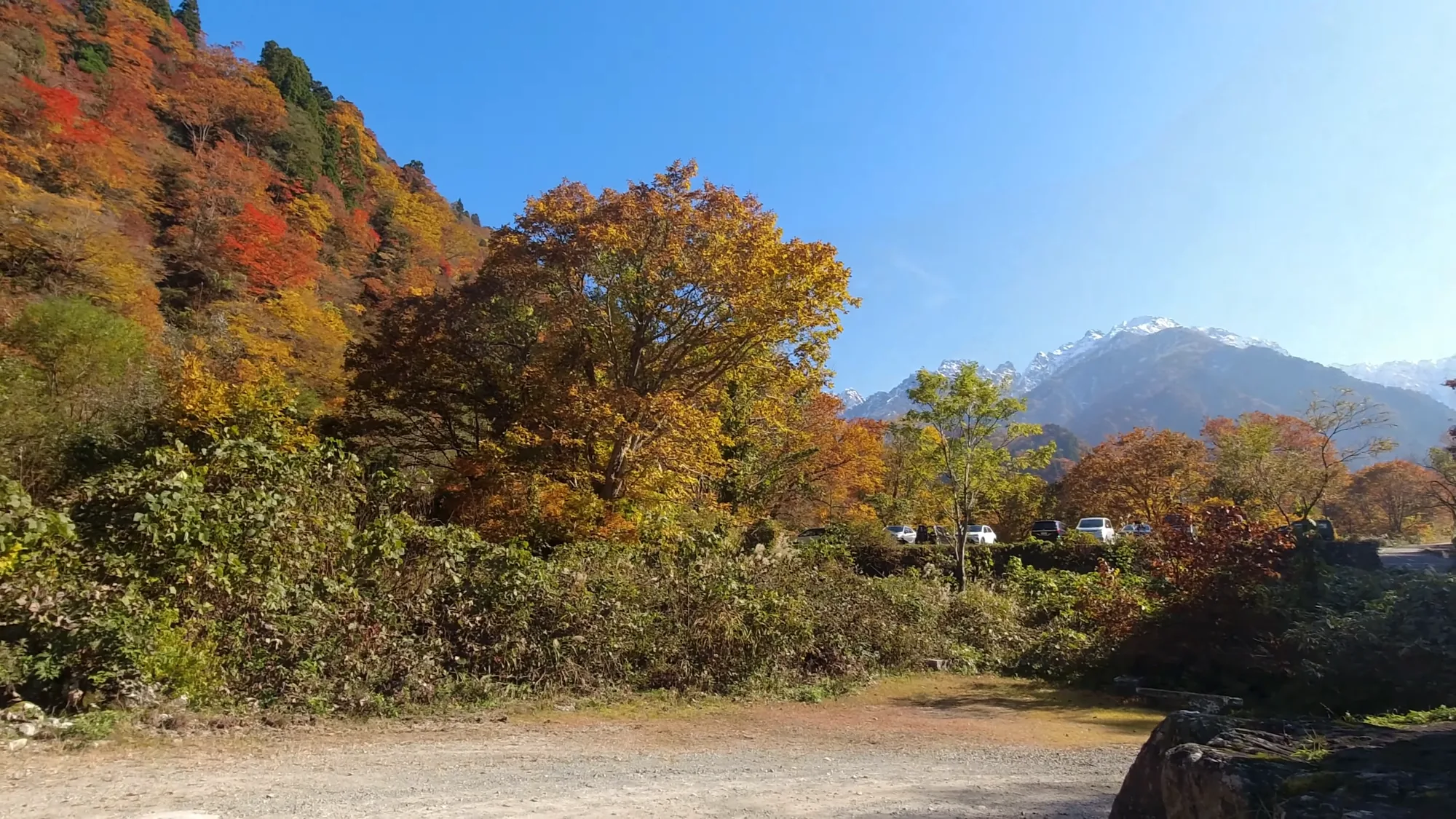
The clearing at the road head, where the walking starts.
The notices page dates the opening. The base had its grand opening on 8 September 2015, at the Banbajima family forest, and about eighty people walked the family forest course with guides that day. It had been certified three and a half years before it opened.
The same page records a two-day training course for guides in the autumn of 2015, and two study trips to the Shinano base in Nagano, in November 2015 and March 2016, with nine guides each time. The most recent notice on the page is dated 1 March 2016. That does not mean the base stopped; it means the notices page did. Ask the association for the current schedule.
Getting there
Ryūsenji is about ten minutes by taxi from Kamiichi station on the Toyama Chihō Railway, about 6.5 kilometers (4 mi) from the Namerikawa exit of the Hokuriku Expressway, and about 8 kilometers (5 mi) from the Tateyama exit. Parking for fifty cars, free.
Banbajima Lodge (馬場島荘) serves Tsurugi climbers and the Banbajima area, with a restaurant, rooms and day bathing, and a souvenir shop selling local products.
The guide’s message
The guides’ own message is modest. Their first aim, they say, is that you go home well and saying it was fun, and they try to let you feel a forest that changes with the season, listening to what each guest wants.
The shape of a visit
Start at Ryūsenji in the morning and walk up the fir avenue to the main hall, on wheels if you need to, having asked the four questions first. Look for the serow, and ask whether the session can include zazen, which the association lists among its activities.
In the afternoon, go to Nissekiji and stand in front of the Fudō carved into the rock. Then walk toward the flower house, if your legs allow.
Come back in summer for Banbajima, the thousand-year cedars, and a night under the stars below Tsurugi.
Nearby and alike

Toyama · Certified 2009
Tateyama-sanroku (Toyama City)
A ski company’s summer: six forest roads over the Gokurakuzaka and Raichō Valley slopes, a level birch kilometer, cuckoos on the plateau, and a 200-meter water slide over rock.

Ishikawa · Certified 2013
Tsubata (Ishikawa Prefectural Forest Park)
Five therapy roads, one barrier-free, in Ishikawa’s prefectural forest park above Kanazawa, with a vermilion bridge, a new protection zone for migrating birds, and the Kurikara pass nearby.

Hiroshima · Certified 2013
Jinsekikōgen
A 2.2-kilometer lakeside path in the Taishaku gorge that the Society says a wheelchair can use, despite its own negative field, plus therapy dogs when the mountain area reopens.

Certification
Over sixty Japanese forests hold a therapy certificate. What the test involves, and what it does not promise.

Choosing a Base
Eight forests, from Kusatsu to Yakushima. Which fits your days, your season and the onsen waiting after.

Origins
A forestry bureau named shinrin-yoku in 1982. The manners it asked for are older, and they are still kept.
Verified by The Japan Onsen Society
Sources
森林セラピーソサエティ「富山県 剱・きらめきの森」— https://fo-society.jp/facility/toyama-kamiichi/ (認定 2012年3月; barrier-free 否, inbound 否; 6 roads with distance, time, height and range; トガ並木 “本堂入口までバリアフリー。車イスでの散策も可能”; tree fields; seasons blank; bentō; nearby 馬場島荘, アルプスの湯, つるぎの味蔵, 日石寺 (~1,300 years, 磨崖仏 重要文化財); guide message; intro; contact)
上市町観光協会「森林セラピー」— top · roads · tours · food · about · starter · guides · registration · notices (barrier-free repeated; カモシカ, ギンモクセイ, クロモジ; 磨崖仏 >3 m; 千巌渓; cedars “樹齢千年を超えるといわれています”; 3 stream crossings; ピーターハウス; plans; 旬の香 by 四季料理 華生, other foods; activities incl. 坐禅; 3 therapists + 7 guides; registration via town hall; grand opening 2015-09-08; last notice 2016-03-01)
たびんぐ「眼目山立山寺」— https://tabi-mag.jp/ty0144/ [CITABLE, secondary] (建徳元年 1370, 峨山韶碩; burned in 上杉謙信’s campaign; 栂 avenue planted 寛永年間 from Noto seedlings, 4 km, ~400 years, prefectural natural monument; forest certified; access; 50 spaces)
環境省 regional activity document — https://www.env.go.jp/content/000062728.pdf (forest restaurant tour at Banbajima, 750 m, May–November)
Verified: 2026-10-05