
Black timber post reading Yamanaka Gorge entrance in front of autumn trees at Yame, Fukuoka
Step-free
Partly step-free
Lake road near flat; acorn road unpaved
The main road
Zenzō Pond loop
熊笹と湖の小道 · 2.26 km (1.40 mi) loop
Open
Year-round
Camellia and sasanqua in winter
Nearest station
Chikugo-Funagoya
Kyushu Shinkansen, then about 50 min by taxi
The record
What you need to go
Open season
Open year round. Rhododendron, azalea and mountain wisteria in spring, maple in autumn, camellia and sasanqua in winter
Getting there
Chikugo-Funagoya (筑後船小屋) on the Kyushu Shinkansen, then about 50 minutes by taxi. By car, about 40 minutes from the Yame interchange
Fees
No price published for walks, guides or workshops. A day bath is ¥510 (about $3) for adults and ¥260 (about $2) for children, 10:00 to 22:00. A night with two meals from ¥10,980 (about $73)
Onsen
The Greenpia Yame onsen hall, an alkaline simple spring from 1,600 m (5,249 ft) down, with an open-air bath, a sauna and family baths
The walk
Main trail
The path of dwarf bamboo and the lake (熊笹と湖の小道), a 2.26 km (1.40 mi) loop around Zenzō Pond, rising only about 8 m (26 ft)
All trails
3 trails, 1.77 to 2.26 km (1.10 to 1.40 mi), combinable into 8 km (5.0 mi). One is closed for reservoir works
The step-free road
No published answer is usable. The lake road is close to flat, the acorn road is asphalt at the start and unpaved after, and parking holds 500 cars
The forest
Forest type
About 300 ha (741 acres) at roughly 400 m (1,312 ft), holding nine lakes. Conifer over most of the land, broadleaf along the paths
What grows
Cedar · Hinoki cypress · Sawtooth oak · Maple · Camellia · Evergreen oak · Konara oak, plus the boroboronoki
What lives
Wild birds around Yamanaka Pond, with no species named
Certified since
2008
All figures updated 5 October 2026
The forest, before the facts
There are nine lakes on a hilltop in the tea country of southern Fukuoka, some large and some barely more than ponds, and the forest has grown down to the edge of every one of them. On a still morning in autumn the water holds the whole slope upside down: cedar, then cypress, then a band of maple going red, then the sky. The surfaces melt into the forest around them. From the right spot you cannot quite tell where one stops.
The walk here is not a climb. The three roads stay between about 417 and 481 meters (1,368 and 1,578 feet) above sea level, and the gentlest of them barely changes height at all. They go around water, past a big konara oak, over a bridge to a small island, through a carpet of dwarf bamboo under the cedar.
And at the end of the morning there is a bath of water that rises from 1,600 meters (5,249 feet) underground. This is the forest therapy base for people who want to stay for a few days, walk slowly, and not have to drive anywhere afterward.
Five reasons to come
Nine lakes inside one forest, each mirroring a different slope of cedar and maple.
Three short, gentle roads that can be joined into an 8-kilometer (5-mile) walk.
A hot spring rising from 1,600 meters (5,249 feet) down, where the roads begin.
A wisteria trellis of about 3,000 square meters (32,300 square feet), flowering mid-April.
Hinoki and camellia shavings you turn into your own scented sachet.
A hilltop resort that became a forest
The forest therapy base at Yame is built around a single property, the Greenpia Yame Forest of Rest (くつろぎの森グリーンピア八女). It is about 300 hectares (741 acres) of land at about 400 meters (1,312 feet), holding nine lakes large and small: a resort for rest among forest and lakes, with a hotel at the center and the three therapy roads running east and west from it.
That arrangement matters for how the place feels. Here the trailheads are at the hotel door. On the same grounds there are cottages, an onsen hall, a campsite, a barbecue area, a soccer field, tennis courts, a leisure pool, a gymnasium, and a kyūdō range, and three of the cottages take pets.
So this is a different kind of base from a sacred mountain or a shrine approach. It is a place built for families and company outings that was then certified, in April 2008, as a forest worth walking in slowly. The setting is a resort; the forest is the same forest it always was.

Ginkgo drops all at once, usually overnight, usually in the third week of November.
Twenty-fifth, and first together
A small piece of history is worth keeping. The town of Kurogi, now part of Yame city, was certified in April 2008, in the third round of certifications, which made it the twenty-fifth forest therapy base in the country.
It was also one of the first two in Fukuoka Prefecture, certified alongside Ukiha, which was itself the first in northern Kyushu.
Kurogi has since been merged into Yame, which is why the contact is the Kurogi branch office of Yame city rather than a town hall.
The bamboo road around the lake
The longest single road is the path of dwarf bamboo and the lake (熊笹と湖の小道). It circles Zenzō Pond (善蔵池), runs 2.26 kilometers (1.40 miles), and stays between about 433 and 441 meters (1,421 and 1,447 feet). That is a rise of about eight meters (26 feet) over the whole loop, which is as near to flat as a forest path gets.
The ground under the cypress and cedar along the shore is covered in kumazasa, a dwarf bamboo, spread like a carpet. Around the pond, conifer plantation and mixed broadleaf woods alternate, so that in autumn the shoreline becomes a gradient from green to red. The path follows the lake’s contours, and the view turns from side to side as you go.
There is one place to stop and look out. From an embankment partway around you can see across the whole pond to the mountains beyond, including Shaka-dake (釈迦岳), the highest peak in Fukuoka Prefecture.
The island, and the birds
The second road is the walk to the spring and the small island (泉と小島への散歩道). It runs 1.83 kilometers (1.14 miles), between about 420 and 464 meters (1,378 and 1,522 feet), starting at the hotel and passing the cottages on the way to the water.
Take it if you want deciduous trees and wild birds. The route passes a large konara oak, then reaches Yamanaka Pond (山中池), surrounded by relatively old broadleaf trees. They shelter the water from wind, so the surface stays still, and new leaves in spring and color in autumn make it especially beautiful.
One detail gives the road its name. A footpath along the pond leads to a small island joined by a bridge, and from there the contrast between trees and water through the seasons resembles a stroll garden, the kind of landscape garden designed to be walked around.
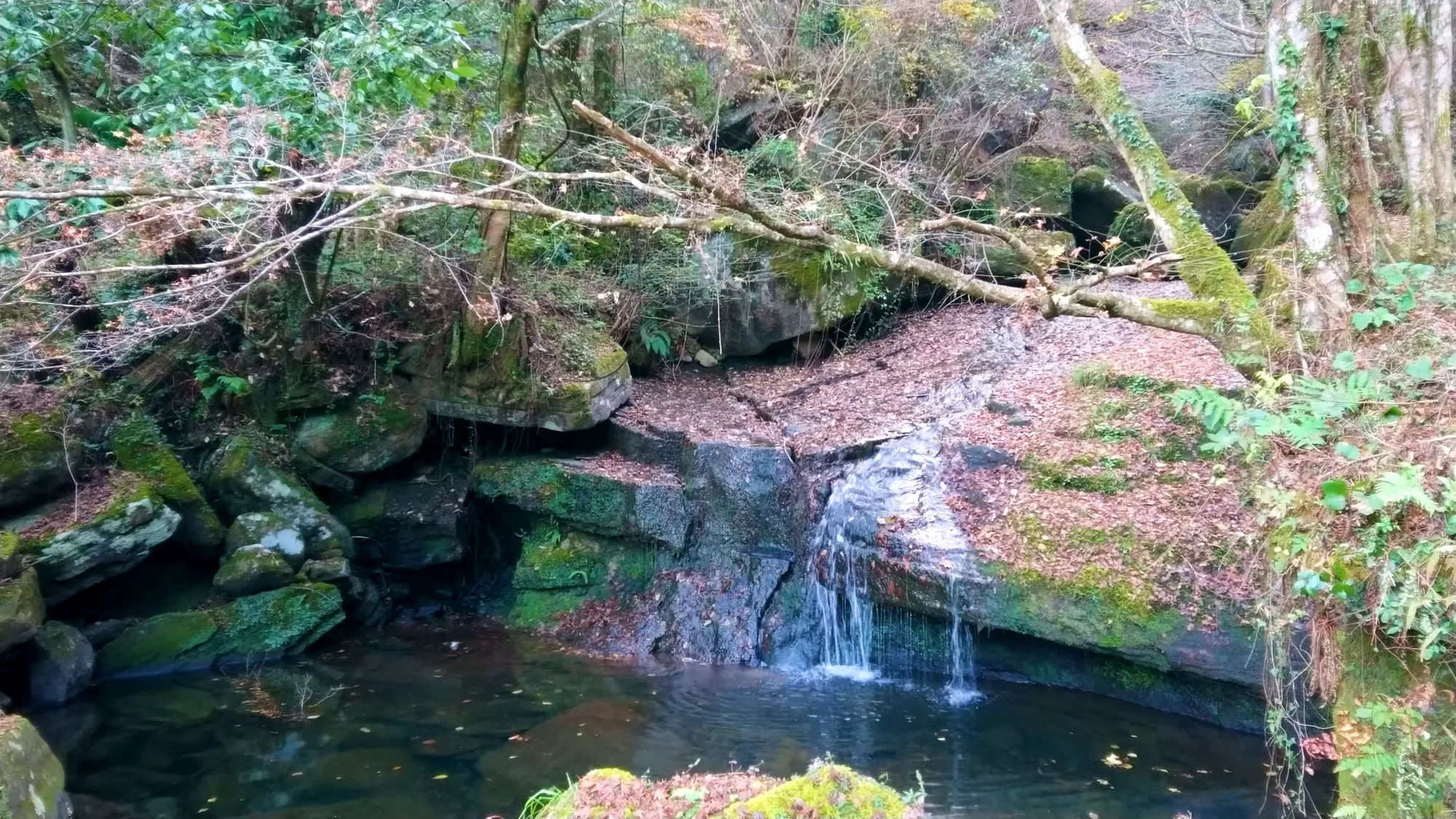
The Yamanaka gorge, which is small, cold and almost always empty.
What birds, nobody says. No species is named anywhere. Bring binoculars and find out.
The road that is closed
The third road is the acorn-gathering path (どんぐり拾いの小道). It is relatively gentle and easy, with a lookout and a green tunnel of leaves in early summer, cherry trees and hydrangeas, sawtooth oak woods full of acorns, and sasanqua camellias in winter.
It is also closed, because of construction work on a nearby reservoir. That closure has been posted since June 2024. Either the work is long and still underway, or the road has reopened and nobody has said so. Ask before you count on it.
The details are worth knowing if it is open. It runs 1.77 kilometers (1.10 miles) from the hotel and back, between about 417 and 481 meters (1,368 and 1,578 feet), so it is the hilliest of the three. It is paved with asphalt only at the start and unpaved after that, and from a lookout partway along you can see the “male” and “female” peaks (雄岳・雌岳), well known for easy hiking.
Eight kilometers, if you want them
The three roads are short, but what they add up to is the point. Because they all leave from the hotel and run east and west, they can be combined into a single route of up to 8 kilometers (5.0 miles) for strong walkers.
That is worth knowing because it changes the base from a morning to a day.
With the acorn road closed, the full combination may not currently be possible. The other two together come to just over four kilometers (2.5 miles).
Which forest is it?
Most of the forest here is cedar and hinoki cypress. Most of the roads run through broadleaf woods of the warm temperate zone: camellia, evergreen oak, sawtooth oak, konara oak, and maple.
Both are true at once: conifer across most of the land, and the paths drawn through the broadleaf woods.

Maple planted at the gorge mouth, in its one good fortnight.
The conifers are cedar and hinoki, the broadleaves sawtooth oak and maple, and there is one “special tree”: the boroboronoki (ボロボロノキ), whose name means something like “the crumbling tree.” Ask a guide to show you one.
What blooms, and when
The seasons here are short and specific.
In spring, you walk among rhododendrons, azaleas, mountain wisteria, and wild cherry. In early summer, the new green and the light through the leaves are the point. In autumn, the color of the Japanese maple, and the sound of leaves underfoot. In winter, the clear air, followed by a long soak.
Around the grounds through the year: cherry, azalea, and rhododendron in spring, hydrangea in summer, autumn leaves, and in winter nandina, camellia, and sasanqua. Cherry and hydrangea grow near the parking area.
No animal is named here beyond “wild birds.” For a forest of 300 hectares (741 acres) with nine lakes, that is a real gap.
What the guides do, and what you make
The base’s guides, the forest guides (森の案内人), walk with every visitor. Their job is to show you how to use all five senses in the forest, to choose the right road and the right pace for you, and to help you feel the forest’s effects as fully as possible. Their own message is warm and brief, and it ends with an invitation to come and stay.
There are three listed activities. The first is a scented sachet: you shave hinoki and camellia wood from inside the base, stamp or write on the bag, add an essential oil of your choice, and take home something nobody else has. It needs a reservation.
The second is Nordic walking on the therapy roads with poles, run as an event about once a year. The third is hammocks strung in the forest, where you lie and listen to birds and wind, also listed as an event.

The rail is older than the path surface and greener than either.
No price is published for any of these, or for a guided walk. The phone number to ask is the Kurogi branch office, 0943-42-1112.
The base’s motto is a small piece of wordplay that does not survive translation intact. Roughly: with freshly made air, take a deep breath, a body breath, a heart breath. The three words for breath share a sound, shin, written three different ways. The idea of air made fresh, as if just out of the oven, is the kind of thing a resort says, and here the resort is a forest.
The guides call this the forest therapy base of the forest’s lakes, and the lodging and the hot spring are their points of pride.
The lunch, and the bath
The therapy bentō here is the forest healing lunch (森の癒し弁当). It uses plenty of local ingredients, the container was chosen with care, and the color and scent when you lift the lid are meant to move you. No price is published.
The bath is the other half of the day.
The large bath at the onsen hall is natural hot spring water rising from 1,600 meters (5,249 feet) underground, an alkaline simple spring. There is also an open-air bath, a sauna, and private family baths, and day visitors are welcome from 10 a.m. to 10 p.m., last entry at 9 p.m. The price is ¥510 (about $3) for junior-high age and up and ¥260 (about $2) for children from four through elementary school.
The onsen hall opened in 1999. If you stay, a night with two meals starts at ¥10,980 (about $73), and from ¥13,180 (about $88) in the cottages that allow pets.
The wisteria and the gorge
Two places nearby are worth the detour, and the first is reason enough to time a visit. At Susanoo Shrine (素盞嗚神社) is the great wisteria of Kurogi (黒木の大藤). The trellis covers about 3,000 square meters (32,300 square feet) and flowers around mid-April each year, with purple clusters and a sweet scent.
The second is the Yamanaka gorge (山中渓谷), a streambed polished by running water, with several small waterfalls along it. It is pretty in new leaf and in autumn color.

The pool below the falls collects everything the gorge drops.
Yame city is in the south of Fukuoka, a tea-growing district known across Japan, with tea fields almost everywhere in the city.
On wheels
No published answer on barrier-free access is enough to plan with. What is known is that one road is nearly flat, and that the acorn road is paved at its start and unpaved after.
What you need to ask the Kurogi branch office are four things.
How wide is the surfaced part of each road, in centimeters? Is there a step where the road leaves the hotel or the therapy plaza? What is the surface between the parking lot and the start of the lake road? And is there an accessible toilet at the onsen hall or the hotel?
There is parking for 500 cars. Whether any of it is close to a trailhead is a question for the resort.
Getting there, and the shape of a stay
The address is Kurogi-machi Kiya 10905, Yame. There are two ways in: about 50 minutes by taxi from Chikugo-Funagoya (筑後船小屋) station on the Kyushu Shinkansen, or about 40 minutes by car from the Yame exit of the Kyushu Expressway.
By road it is about 22 kilometers (14 miles), with the last 6 kilometers (3.7 miles) on a mountain road. Two phone numbers are in circulation for the resort, 0943-42-2400 and 0943-22-8813. Call the city’s branch office if neither answers.
The shape of a good stay assembles itself. Arrive in mid-April for the wisteria if you can, or in autumn for the maples. Walk the bamboo road around Zenzō Pond in the morning with a guide, slowly, and stop on the embankment to look for the highest mountain in the prefecture. Take the island road in the afternoon, and stand on the bridge until the water stops moving.
Then go up to the onsen hall, get into water that came up from 1,600 meters (about a mile) underground, and look out at the forest you just walked through. Stay the night. Tomorrow, the lakes will be still again.
Nearby and alike

Fukuoka · Certified 2008
Ukiha
Three hundred rice terraces walled by hand four centuries ago, a cedar forest that supplies a town’s taps, and two short roads between them.

Fukuoka · Certified 2009
Sasaguri
Half an hour from Fukuoka, six certified roads thread an eighty-eight-temple pilgrimage, a giant cedar found in 2000, and a university forest.

Fukuoka · Certified 2013
Buzen
Six roads under Kubote, a mountain of ascetics’ ruins and 850 stone steps, with buckwheat lunch and a soft hot spring after.

Forest and Onsen
Two old Japanese ways of resting the body meet in the Kiso valley. Cypress air, hot water, and what is known.

Choosing a Base
Eight forests, from Kusatsu to Yakushima. Which fits your days, your season and the onsen waiting after.

The Walk
A measured forest walk is about thirty minutes and no destination. Here it is, sense by sense, step by step.
Verified by The Japan Onsen Society
Sources
森林セラピーソサエティ「福岡県 くつろぎの森グリーンピア八女」— https://fo-society.jp/facility/fukuoka-yame/ (認定 2008年4月; third round, 25th nationally, first in Fukuoka with Ukiha; ~400 m, ~300 ha, 9 lakes; cedar/hinoki vs broadleaf roads; 1,600 m alkaline simple spring; 3 roads and descriptions; acorn road closed for reservoir works, undated; bentō; tree fields incl. ボロボロノキ; four seasons; sachet, Nordic walking, hammock; guide message; motto; 黒木の大藤 ~3,000 m² mid-April at 素盞嗚神社; 山中渓谷; contact)
クロスロードふくおか(福岡県観光連盟)road pages — https://www.crossroadfukuoka.jp/spot/15542 · https://www.crossroadfukuoka.jp/spot/15543 · https://www.crossroadfukuoka.jp/spot/15544 (lengths and elevation ranges for all three; acorn road closed as of June 2024; asphalt start; 雄岳・雌岳 view; kumazasa carpet; island and bridge; stroll-garden comparison)
クロスロードふくおか「森林セラピー基地 八女」— https://www.crossroadfukuoka.jp/feature/trail/therapy2 · https://www.crossroadfukuoka.jp/spot/11438 (8 km combined; tea-growing district; resort phone 0943-42-2400)
クロスロードふくおか「くつろぎの森 グリーンピア八女」— https://www.crossroadfukuoka.jp/spot/12842 (facilities; seasonal flowers; day-bath hours and prices; lodging from ¥10,980 / ¥13,180; 500 parking; Chikugo-Funagoya 50 min taxi; Yame IC 40 min; phone 0943-22-8813)
クロスロードふくおか(繁體中文)「森林浴基地(黑木町)」— https://www.crossroadfukuoka.jp/tw/spot/11438 [CITABLE, older listing] (onsen hall opened 1999; IC distances 22 km; 6 km mountain road)
Verified: 2026-10-05