
Worn stone steps climbing between old cedar and a moss-covered retaining wall at Kubotesan, Buzen, Fukuoka
Step-free
Not step-free
The signature road is a stone staircase
The main road
Kubote circuit
求菩提山 · 3.4 km (2.1 mi) · 250 m climb
Open
Apr – Jun, autumn
About eight event walks a year
Nearest station
Buzen-Matsue
JR Nippō Line, about 50 min from Kitakyushu
The record
What you need to go
Open season
Walks run as events, about eight a year in spring and autumn. Cherry in April, new green in May, hydrangeas in June, ginkgo in November
Getting there
Buzen-Matsue or Ujima on the JR Nippō Line, about 50 minutes from Kitakyushu. No leg from the station to a trailhead is published
Fees
Not published. It varies by program, and each walk includes a therapy bentō or a buckwheat noodle set
Onsen
Kubote Onsen Bokusen-no-sato (求菩提温泉 卜仙の郷), an alkaline simple spring, soft on the skin, with the season in view
The walk
Main trail
The Kubote circuit (求菩提山周回コース), about 3.4 km (2.1 mi) and five hours, climbing 250 m (820 ft) past ascetics’ ruins and five caves
All trails
6 trails, about 3 to 4 km (1.9 to 2.5 mi), one and a half to five hours, climbing 130 to 250 m (427 to 820 ft)
The step-free road
Barrier-free gets a one-word answer, and the signature road is a stone staircase. The Jirōbō Tengu bridge course is laid with cedar and hinoki chips, soft underfoot
The forest
Forest type
Roads under Mount Kubote, 782 m (2,566 ft), a national historic site of mountain ascetics, above stone-walled terraces named an Important Cultural Landscape
What grows
Cedar · Hinoki cypress · Japanese fir · Zelkova · Urihada maple · Edo higan cherry, plus kagonoki
What lives
Birdsong along the streamside road, and no species named anywhere
Certified since
2013
All figures updated 5 October 2026
The forest
There is a stone staircase on a mountain in eastern Fukuoka with 850 steps, and the town at its foot says demons built it. They were supposed to finish in a single night. The legend, as the town tells it, is that dawn came before they were done and they ran — which is why it is called the demons’ steps (鬼の石段), and why it is still there for you to climb.
The mountain is Kubote (求菩提山), 782 meters (2,566 ft) high, and it was a great center of the mountain asceticism of the Buzen region. There is a four-character phrase for it: one mountain, five hundred lodgings. The ruins of that world are scattered through the trees: lodging sites, halls, graves, and a shrine at the top.
At the bottom, on the farmland under the mountain, there are stone-walled rice terraces, a single cherry tree on a hill that people walk to see in spring, and a valley where somebody has been planting hydrangeas for more than twenty years. The forest therapy base here is all of that, stitched together into six roads, and lunch is buckwheat noodles.
Five reasons to come
Eight hundred and fifty stone steps that legend says demons left unfinished at dawn.
A mountain of mountain ascetics, with lodging ruins, caves and a summit shrine.
About sixteen thousand hydrangeas, planted over twenty years in one valley.
The only streamside road here, through moss, birdsong and clear water.
A single cherry tree on a ridge, walked to only during spring events.
Six roads
There are six roads, and three of them are measured. The Kubote circuit (求菩提山周回コース) is about 3.4 kilometers (2.1 mi), takes five hours on foot, and climbs 250 meters (820 ft). The Inugatake streamside forest course (犬ヶ岳せせらぎの森コース) is about 4 kilometers (2.5 mi), three hours, and 165 meters (541 ft). The Edagawachi hydrangea course (枝川内あじさいコース) is about 4 kilometers (2.5 mi), three hours, and 130 meters (427 ft).
The other three are the Jirōbō Tengu bridge course (次郎坊天狗橋コース); a village walk at Toriihata (鳥井畑里山おさんぽコース); and the lookout hill of the single cherry at Saio (才尾の一本桜見晴らしの丘コース). No distances exist for any of them. Across all the activities, reckon on anything from an hour and a half to five hours.

The approach is paved in stone the whole way, which is why it has lasted.
Five hours for a 3.4-kilometer (2.1 mi) circuit is the number to notice. That is a slow pace for the distance, and the circuit is a mountain of ruins and steps: there is a great deal to stop for.
The demons’ stairs
The Kubote circuit is the heart of the base. It crosses a mountain designated a national historic site in 2001, past the remains of the ascetics’ world, the stone stairs, the shrines.
The stairs are the part people remember. The 850 steps run between the middle shrine and the upper shrine, Kunitama (国玉神社上宮), at the summit. They are where the demons were set to work, and from which they fled when dawn came.
There are also the five caves (五窟) on the circuit, and one of the guided programs is built around them: the sacred ground of the ascetics, and a round of the five caves. Nobody has written down what is inside them.
What all this means on the ground is that the forest here is not a backdrop to the history. When you walk the circuit, the trees and the ruins are the same place.
The farmland under the mountain
There is a second designation, from 2012, and it is the one that tells you how people lived here. The farm landscape at the foot of the mountain was named an Important Cultural Landscape that year.
The Toriihata village walk is about exactly that landscape: stone-walled terraced paddies inside the designated area, with mitsumata and cherry blossom in spring. One of the guided programs is a walk through the rural scenery and the terraces.
So the roads here fall roughly into two kinds. Some go up into the ascetics’ mountain. Some stay down among the fields below it.

The old cedar beside the path, left standing because of what the mountain is.
The streamside road
The Inugatake course is the one for water: the only road here that runs alongside a stream, with clear water and the sound of it moving, moss-covered ground, birdsong, and leaves that change with the season.
Inugatake itself is the higher mountain, 1,131 meters (3,711 ft). It sits with Kubote inside the Yaba-Hita-Hikosan Quasi-National Park (耶馬日田英彦山国定公園), designated on 29 July 1950 and covering 8,269 hectares (20,433 acres).
The park’s designated plants include genkai-tsutsuji azalea and shikoku-mamakona, alongside beech, mizunara oak and akebonosō, and its beech forests are described as precious. None of those is pinned to a particular therapy road, so take them as what grows in the wider park.
Sixteen thousand hydrangeas
The hydrangea course is the one with the longest care behind it. About sixteen thousand hydrangea plants line the valley at Edagawachi, tended for more than twenty years. In early autumn the buckwheat flowers come out.
The program is hydrangea viewing with a forest therapy walk, and lunch is a buckwheat noodle set made locally. In 2026 the hydrangea walk ran on 10 June, at about 4 kilometers (2.5 mi).
Twenty years is a long time to keep planting one valley, and the walk is timed for when it is at its best.
The single cherry
One course you cannot simply walk whenever you like. The lookout hill of the single cherry at Saio is a spring route: a lone cherry tree, a ridge path, and wide views over Buzen city and the Suō Sea. It is open only during events.
The program is exactly that and nothing more — a spring-only walk, aimed at one tree. Spring here is mountain cherry and mitsumata, new green and a mossy world.
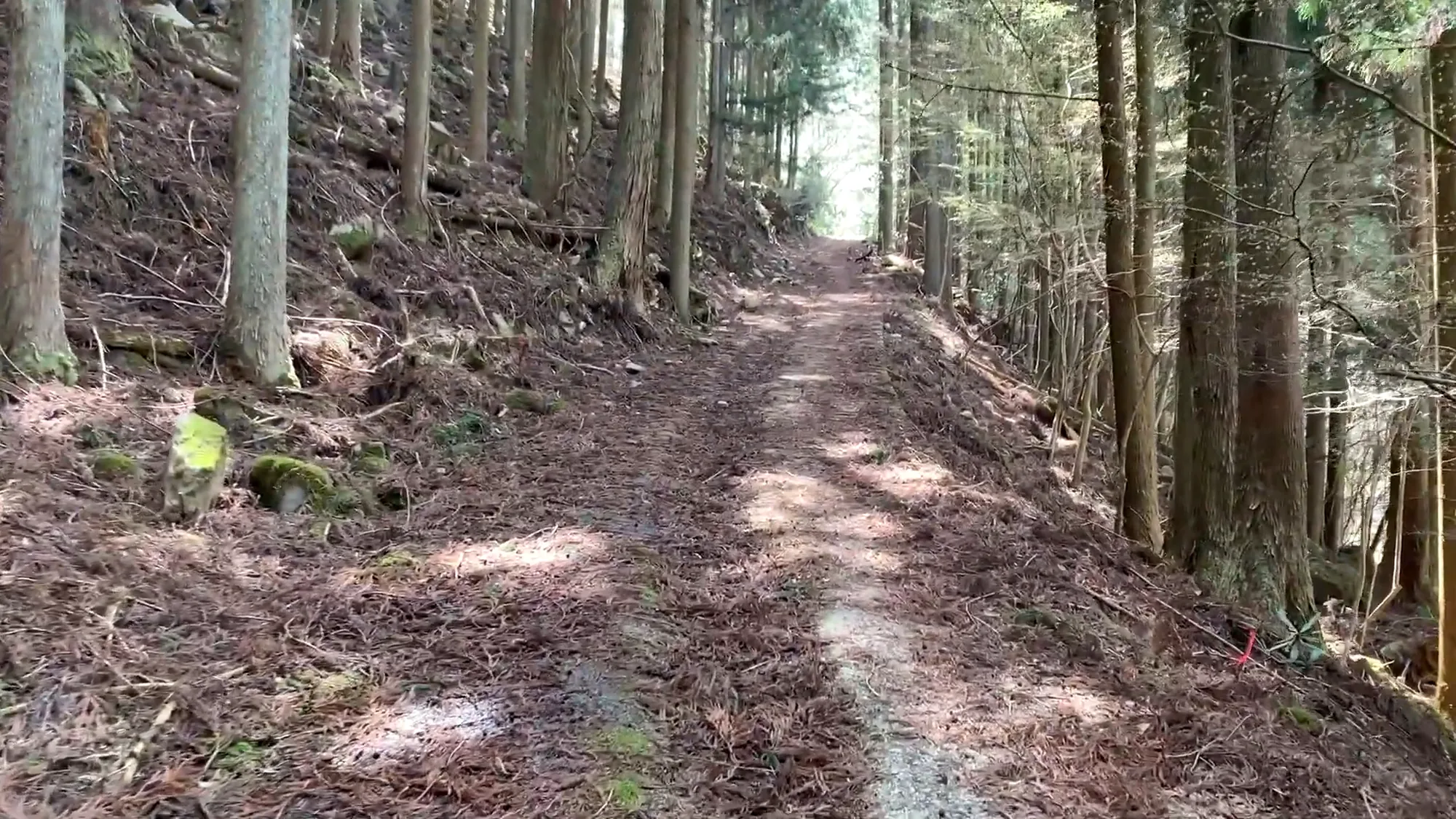
The forestry track, which is newer than the stone steps by about eight centuries.
Nobody explains why the hill is open only on event days. It is enough to know that if you want the tree, you come when the guides do.
What the guides run, and when
The base runs its walks as events rather than on demand: about eight a year, in spring and autumn, open to individuals, couples, friends and groups. Among the activities it lists are forest yoga, aroma crafts, enzyme juice making, and herbal blending.
The 2026 spring calendar, run by the Buzen guides’ association, gives the shape of a season. It ran from 12 April to 21 June across eight dates: the Toriihata walk on 12 April, the streamside forest on 26 April and 31 May, the lookout hill on 10 May and 7 June, the Jirōbō Tengu bridge on 17 May, the hydrangeas on 10 June, and the Kubote circuit on 21 June. Each includes a therapy bentō or a buckwheat noodle set.
Other activities run through the year: wreath making, bonfires, sutra copying, hot spring bathing. Autumn brings a session making animal figures from fallen leaves and nuts, and an early-winter mountain walk with a bonfire.
No price is published for any of it — it varies by program, and you will have to ask. Bring trekking shoes, warm clothing, long sleeves and pants, a hat, gloves, a backpack, a water bottle and a rain jacket.
What the trees are
The conifers are cedar, hinoki and the Japanese fir. The broadleaves are zelkova, a maple, and the Edo higan cherry.
The trees singled out as special are the kagonoki — and then the fir and the higan cherry again, both already in the ordinary list. Nobody explains why.
The clearest picture of what these woods smell like comes from the Jirōbō Tengu bridge course. Its path is laid with chips of local cedar and hinoki, soft underfoot, with the scent of the wood coming up at you, views, and more of the ascetics’ ruins along the way.
Through the year
The four seasons here are short. Spring is new green, a mossy world, mountain cherry and mitsumata. Summer is the river, the clear stream, and the moss again. Autumn is color.

Planted over a boulder field, which is why the rows wander.
Winter is snow scenes and the clear air that comes with them.
Month by month: April for cherry blossom, May for new green, June for hydrangeas, November for ginkgo and autumn leaves. The town keeps a longer flower calendar than that, taking in wisteria, azaleas, iris, magnolia, lotus and buckwheat.
And the next season is already published. The program for autumn 2026 through summer 2027 is built around the town’s culture, nature, food and people.
In the guides’ own words
Buzen is plain about what it thinks it is offering: a forest therapy base where a great deal of history remains, with menus that either combine forest and history or simply let you become one with the forest. Five senses, in a mountain village.
There are five named programs: the ascetics’ holy mountain with its five caves; a five-senses walk in the Inugatake streamside forest; a walk through the rural scenery and the terraces; hydrangea viewing with a forest walk and buckwheat lunch; and the spring-only walk to the single cherry of Saio.
The guides’ own message is shorter and more personal. They call it a place like no other, a place you will want to come back to, and a place where you can feel at ease. Those are three different promises, and the third is the one that matters most if you are arriving alone.
The lunch, three ways
The therapy bentō is made by three local vendors, from local ingredients, and it changes with the season. On the hydrangea walk it is a buckwheat noodle set instead.
Lunch, in other words, comes from three kitchens in a small town rather than one. The base’s own tagline is a village of play, food and nature, and it puts food in the middle.

The stream the pilgrims washed in before the climb.
The tea house and the bath
Two places sit at the center of a visit. The first is the Iwaya revitalization center (岩屋活性化センター), the information hub and the meeting point for events.
The second is the Kubote tea house (求菩提茶屋), which opened in April 2024 as KUBOTE SATOYAMA BASE, with guides who know the area on hand. Drinks only from Tuesday to Thursday; meals on Fridays, weekends and holidays.
For the bath, there is Kubote Onsen Bokusen-no-sato (求菩提温泉 卜仙の郷) — an alkaline simple spring, soft on the skin, with the seasonal landscape in view. A walk down from a mountain of 850 steps into soft water is not a bad shape for a day.
What you will have to ask for
Buzen is thin on measurement and almost silent on animals. There is birdsong, and there are songbirds, and that is the whole of it. No species of bird, mammal or insect is named for any of the six roads, anywhere.
Road elevations do not exist either. The mountains are 782 and 1,131 meters (2,566 and 3,711 ft), and three roads have a height difference attached, but nobody says where any road starts or finishes in altitude.
And there is one disagreement about length. The streamside forest course is given as about 4 kilometers (2.5 mi) in one place and about 3 kilometers (1.9 mi) in another, on both the dates it actually ran.
On wheels
The barrier-free question gets a one-word answer here, and on a mountain of stone stairs that is not surprising. The other roads are the ones to ask about, particularly the village walk and the hydrangea valley.
Ask the tourism association four things.

A flat spot halfway up, which is where everyone stops.
How wide is the surfaced part of the path, in centimeters? Is there a step at the start? What is the surface between the parking area and the trailhead? And is there an accessible toilet at the Iwaya center or the tea house?
The Jirōbō Tengu bridge course is a woodchip path of local cedar and hinoki. Soft underfoot is not the same as passable on wheels, but it is the right thing to ask about first.
Getting there
The tourism association is at Hachiya 2025-2, Buzen, open nine to five, on 0979-53-6660. By car it is about 90 minutes from Fukuoka, about 80 from Kitakyushu, about 90 from Ōita.
By train, the nearest stations are JR Buzen-Matsue and Ujima on the Nippō Line: about an hour and a half from Fukuoka, about 50 minutes from Kitakyushu, about an hour and a half from Ōita. Highway buses take an hour and a half to two and a half.
The town sits in the Keichiku region of eastern Fukuoka, facing the Suō Sea to the north, where the fishing is still active, with the forest therapy courses in the mountains to the south.
The shape of a day
Come in spring, on one of the event dates, and choose by what you want to stand inside.
The single cherry in April. The streamside moss in May. The hydrangeas in June. The demons’ stairs whenever the Kubote circuit runs, if you have five hours and good knees.
Eat buckwheat noodles from a local kitchen. Go down to the soft water at Bokusen-no-sato. And on the way out, look back at the cone of Kubote and think of the staircase on it, built by somebody, finished by somebody, and still credited by the town to demons who ran from the light.
Nearby and alike

Fukuoka · Certified 2008
Ukiha
Three hundred rice terraces walled by hand four centuries ago, a cedar forest that supplies a town’s taps, and two short roads between them.

Fukuoka · Certified 2009
Sasaguri
Half an hour from Fukuoka, six certified roads thread an eighty-eight-temple pilgrimage, a giant cedar found in 2000, and a university forest.

Ōita · Certified 2012
Ōita
Ten certified roads within an hour of Ōita, from a flat museum loop to a five-star ridge, with guides at ¥3,000 a group.

Origins
A forestry bureau named shinrin-yoku in 1982. The manners it asked for are older, and they are still kept.

Choosing a Base
Eight forests, from Kusatsu to Yakushima. Which fits your days, your season and the onsen waiting after.

Forest and Onsen
Two old Japanese ways of resting the body meet in the Kiso valley. Cypress air, hot water, and what is known.
Verified by The Japan Onsen Society
Sources
森林セラピーソサエティ「福岡県 森林セラピー基地 豊前」— https://fo-society.jp/facility/fukuoka-buzen/ (認定 2013年; 6 roads, 3 described with distance/time/height difference; ~16,000 hydrangeas, 20+ years; buckwheat; bentō from three vendors; tree fields; four seasons; five named programs; guide message; intro; tagline)
豊前観光まちづくり協会 — http://www.buzen-kk.jp/osusume_therapy.html · 「求菩提山」spot page · 「森林セラピー基地豊前」spot page (782 m; 一山五百坊; 豊前修験道; 2001 national historic site; 2012 Important Cultural Landscape; 850 steps and legend; ~8 events/yr; activities; access times; address and hours; ぶぜん“み”たいけん)
クロスロードふくおか(福岡県観光連盟)「森林セラピー基地 豊前」— https://www.crossroadfukuoka.jp/feature/trail/therapy4 (all six course names; 国玉神社上宮; 五窟; woodchip course; terraces; Saio cherry event-only; streamside the only stream course; activity range 1.5–5 h; monthly pointers; 岩屋活性化センター; 卜仙の郷; 求菩提茶屋 opened April 2024 and hours; Keichiku region, Suō Sea, fishing)
クロスロードふくおか「森林セラピー体験2026春 豊前」— https://www.crossroadfukuoka.jp/event/16121 (eight 2026 spring dates and course lengths; 犬ヶ岳 about 3 km; bentō or soba included; kit list; price varies) · autumn events 16559, 16561 (titles only)
福岡県「耶馬日田英彦山国定公園」— https://www.pref.fukuoka.lg.jp/contents/yabahita.html (designated 29 July 1950; 8,269 ha; 犬ヶ岳 1,131 m; 求菩提山 782 m; ゲンカイツツジ, シコクママコナ, ブナ, ミズナラ, アケボノソウ; precious beech forests)
Verified: 2026-10-05