Yamanashi · Certified 2022
Kanegawa Forest Therapy Base: A Flood-Defense Forest From 1907, and a Barrier-Free Road With Its Width Published
A lowland forest planted after the great flood of 1907, now a 36-hectare prefectural park with a paved, step-free road 2.5 meters wide, three minutes from the expressway.

Large timber sign reading Kanegawa no Mori Forest Park among golden autumn trees, Yamanashi
Step-free
Step-free
Asphalt, about 250 cm (98 in) wide, no steps
The main road
Barrier-free course
Asphalt end to end · about 2.5 m (8.2 ft) wide
Open
Year-round
Closed Mondays Nov–Mar and New Year
Nearest station
Isawa-onsen
JR Chūō Line, then 10 min by taxi
The record
What you need to go
Open season
Open all year, 9:00 to 18:00 April to October and 9:00 to 17:00 November to March, closed Mondays in those months and on 31 December and 1 January
Getting there
JR Isawa-onsen, about 10 minutes by taxi. Highway buses from Shinjuku stop at Ichinomiya (一宮), a 25 minute walk, and the expressway exit is 3 minutes away
Fees
Session prices are not published, and a forest therapy lunch of Fuefuki vegetables and fruit comes with one. A separate exercise program sells an activity tracker for ¥4,500 (about $30) including tax
Onsen
Isawa Onsen (石和温泉), a town of inns that take day bathers, lit with cherry blossom in spring and lights in winter. Kasugai Onsen is also close
The walk
Main trail
The barrier-free course, paved in asphalt for its whole length with no steps, about 2.5 m (8.2 ft) wide
All trails
2 roads. The acorn forest course is 1.0 to 1.2 m (3.3 to 3.9 ft) wide, the barrier-free course about 2.5 m (8.2 ft). Neither has a published length
The step-free road
Marked yes and specified: about 250 cm (98 in) wide, asphalt throughout, no steps. Multipurpose toilets are listed without a location, and the approach surface is not given
The forest
Forest type
36.2 ha (89.5 acres) of flat lowland forest, rare in a mountain prefecture, three minutes from an expressway exit and busy with about 300,000 visitors a year
What grows
Sawtooth oak · Konara oak · Katsura · Kobushi magnolia · Red pine · Needle juniper, with a katsura avenue and a walk planted for its scent
What lives
More than 300 kinds of plant and nearly 70 kinds of bird by the park’s count, none of them named. The birds are easier to see and hear once the leaves fall
Certified since
2022
All figures updated 5 October 2026
The forest, before the facts
In 1907 the Kane river (金川) flooded, and afterward people planted a forest along its banks to hold the water back. The park says it in a sentence: the great flood of that year led to the planting of a forest to guard against flood damage. The prefecture calls the result a valuable lowland forest with a history of flood defense along the river.
That forest became a prefectural park in 1996. It covers 36.2 hectares (89.5 acres) of flat ground in a mountain prefecture, which the park itself calls unusual for Yamanashi, and it is three minutes from an expressway exit. About 300,000 people a year visit it, the Society says.
What makes it worth the trip is one road. The Society gives its barrier-free course as about 2.5 meters (8.2 feet) wide, paved in asphalt for its whole length, with no steps. Very few barrier-free roads come with a published width, and the width is the first thing a wheelchair user asks.
Five reasons to come
A lowland forest planted after the great flood of 1907, as flood defense.
A barrier-free road 2.5 meters wide, paved throughout, with no steps.
Three minutes from an expressway exit, by the park’s own directions.
More than 300 kinds of plants and nearly 70 kinds of birds, by the park’s count.
An archaeological-site museum, wineries, and the Isawa hot springs nearby.
A forest planted against the river
The park gives the history plainly. The great flood of 1907, it says, led to the forest being planted as a flood-defense forest. A prefectural document on the park describes it as a valuable lowland forest with a history of flood defense along the Kane river.
That makes Kanegawa a certified forest laid over somebody else’s older work, and of an unusual kind. Not a railway or a mine or a temple’s timber, but a protective planting: a forest put there to stand between a river and the fields.
The park’s page adds that it is a forest park in a lowland forest, rare in mountainous Yamanashi, made up of six forests over about 36 hectares (89 acres).

The path is still there under all of it, and you find it by feel.
A protection forest
The forest’s legal status still carries its history. Yamanashi Prefecture’s 2018 call for a designated manager describes the park as a facility set up to strengthen the forest’s functions as a protection forest, while using it as a place of rest for the people of the prefecture.
So the park is a protection forest first and a park second, at least in the prefecture’s own wording. The walks and the barbecues sit inside a forest the prefecture still describes as a protection forest.
Six forests, two roads
A prefectural document names the six forests: the acorn forest, the sports forest, the cherry forest, the rhinoceros beetle forest, the meeting forest, and the dappled-light forest.
The Society lists two roads. The acorn forest course is mostly an unpaved walking path 1.0 to 1.2 meters (3.3 to 3.9 feet) wide, with ups and downs, a course for getting closer to nature.
The second is called simply the barrier-free course. The Society says it is about 2.5 meters wide, paved with asphalt over its whole length, with no steps, and suited to wheelchairs.
Neither road has a published length or walking time.
On wheels
This is the most complete barrier-free description of any base here. The Society says yes, and its description of the road gives a width of about 250 centimeters (98 in), an asphalt surface throughout, and no steps.
That answers two of the four questions outright. The width is about 250 centimeters (98 in), and there are no steps on the course itself.
Two remain. What is the surface between the parking area and the start of the barrier-free course? And is there an accessible toilet near it? The park’s website lists multipurpose toilets among its facilities, without saying where.
The acorn forest course is not for wheels. The Society gives it as 1.0 to 1.2 meters (3.3 to 3.9 ft) wide, unpaved, with ups and downs.

A deck built around a tree rather than instead of one.
Wheels of another kind
The prefecture’s evaluation of the park for fiscal 2023 lists six programs the manager runs on its own initiative. One of them is bicycles for welfare use, which the evaluation names alongside forest therapy and an exercise program.
The evaluation does not describe the bicycles further. Their presence on the list, beside a paved 2.5-meter (8.2 ft) road, is a reason to ask what the park can offer a visitor who cannot walk far.
A session in the morning
The park’s forest therapy page gives a model plan. It begins at 9:30 with a health check and an icebreaker, then warm-up exercises, and the forest therapy walk from 10:00. At 12:00 there is another health check, and the group disperses at 12:30.
Participants get a forest therapy lunch, which the Society describes as colorful and made mainly with vegetables and fruit from Fuefuki city. The park’s page lists nine sessions in its 2026 schedule.
No price is published for the sessions. The park points to its monthly program sheets for details.
What is checked, and what is claimed
The model plan has a health check before and after the walk. The park does not say what the check measures.
The same page lists the effects it attributes to forest therapy: lower stress hormones, steadier blood pressure and pulse, and a balancing of the autonomic nervous system toward parasympathetic dominance. Those are the park’s claims, and it cites no study or result of its own behind them.
So Kanegawa checks something before and after, and publishes the general claims but not its own numbers. Methods are sometimes published; results never are.
Who runs it, and what that means
The contact is the park’s service center. A prefectural evaluation names who runs it: a designated-manager group, the cowshi Kanegawa forest partners.

Zelkova leaves with the sun behind them, which is the whole reason to come in November.
The group is made up of the Yamanashi timber association and three private companies. Its term runs from 1 April 2023 to 31 March 2027.
That is an unusual arrangement: a consortium of a timber trade body and private firms, managing a prefectural park on a fixed-term contract. What it means is plain enough. The operator is chosen for a term and could change at the next selection, while the park and its roads stay with the prefecture.
A park, not a wilderness
The park lists what else goes on under the trees: play equipment and rides, barbecue sites, a cycle station, a dog run, and target bird golf, which it explains as a sport of hitting a plastic ball with feathers into a goal shaped like an upturned umbrella.
That is the setting for a therapy walk here. The roads run through a public park that families use for the day, and a therapy walk shares it with them.
A park that counts its visitors
The same evaluation gives the park’s annual visitors for five fiscal years: 249,762 in 2020, 286,143 in 2021, 297,750 in 2022, 295,100 in 2023, and 311,200 in 2024.
It gives the opening date as 30 May 1996 and the area as 36.2 hectares (89.5 acres). For fiscal 2024, it reports a user satisfaction rate of 99.1 percent, and calls the operation one run from the user’s point of view, which it rates highly.
It does not give a count of forest therapy participants. A park with 300,000 visitors a year and nine therapy sessions in a year’s schedule is a busy public park with a therapy program, not a therapy forest with a park attached.
Walking for points
The park runs a second health program, separate from forest therapy. The park describes an exercise program in which participants buy an activity tracker for ¥4,500 (about $30) including tax, and their activity in the park is measured, with monthly rankings and prizes.
The page gives the park’s paths an average gradient of 2 degrees, suitable for walking and jogging. It says the program’s hours are 4:30 to 19:00 from April to September and 5:30 to 18:00 from October to March, well outside the park’s general opening hours.
The park also claims that the exercise builds muscle quickly, and that forest bathing is expected to balance the autonomic nerves and relieve stress. Those are the park’s claims, offered without a study behind them.

Early April, and for about ten days the whole park is this color.
Two dates for one certificate
The Society gives the certification as April 2022. The park says it was certified as a forest therapy base in April 2022.
An earlier prefectural document says the certification came in fiscal 2021. Japan’s fiscal year runs from April, so April 2022 belongs to fiscal 2022. Both dates are on the record, and neither source explains the difference.
What lives here
The park’s website says it has more than 300 kinds of plants and nearly 70 kinds of wild birds, along with small animals. It does not name them.
The Society says that when the leaves fall, you can see the birds and hear their calls more clearly, and enjoy the winter buds. In summer a stream runs through the road, so you can stay cool listening to water and trees.
The rhinoceros beetle forest is named for an insect, and the acorn forest for a seed. Neither name is a survey.
The Society describes all six forests as made up mainly of deciduous broadleaf trees, sawtooth oak and konara above all, with walking paths, including the two therapy roads, a service center, toilets, and parking: the basic facilities, it says, of a therapy base.
The trees the Society chose
The Society’s tree list holds a surprise. The conifers are red pine, loblolly pine, and needle juniper.
The broadleaves are sawtooth oak, katsura, and kobushi magnolia. It also names an avenue of katsura, a scented walk in the cherry forest, and the cherry forest itself.
Trees chosen for their scent, dankōbai and yabunikkei among them, have been planted. This is a forest designed to be smelled as well as seen.
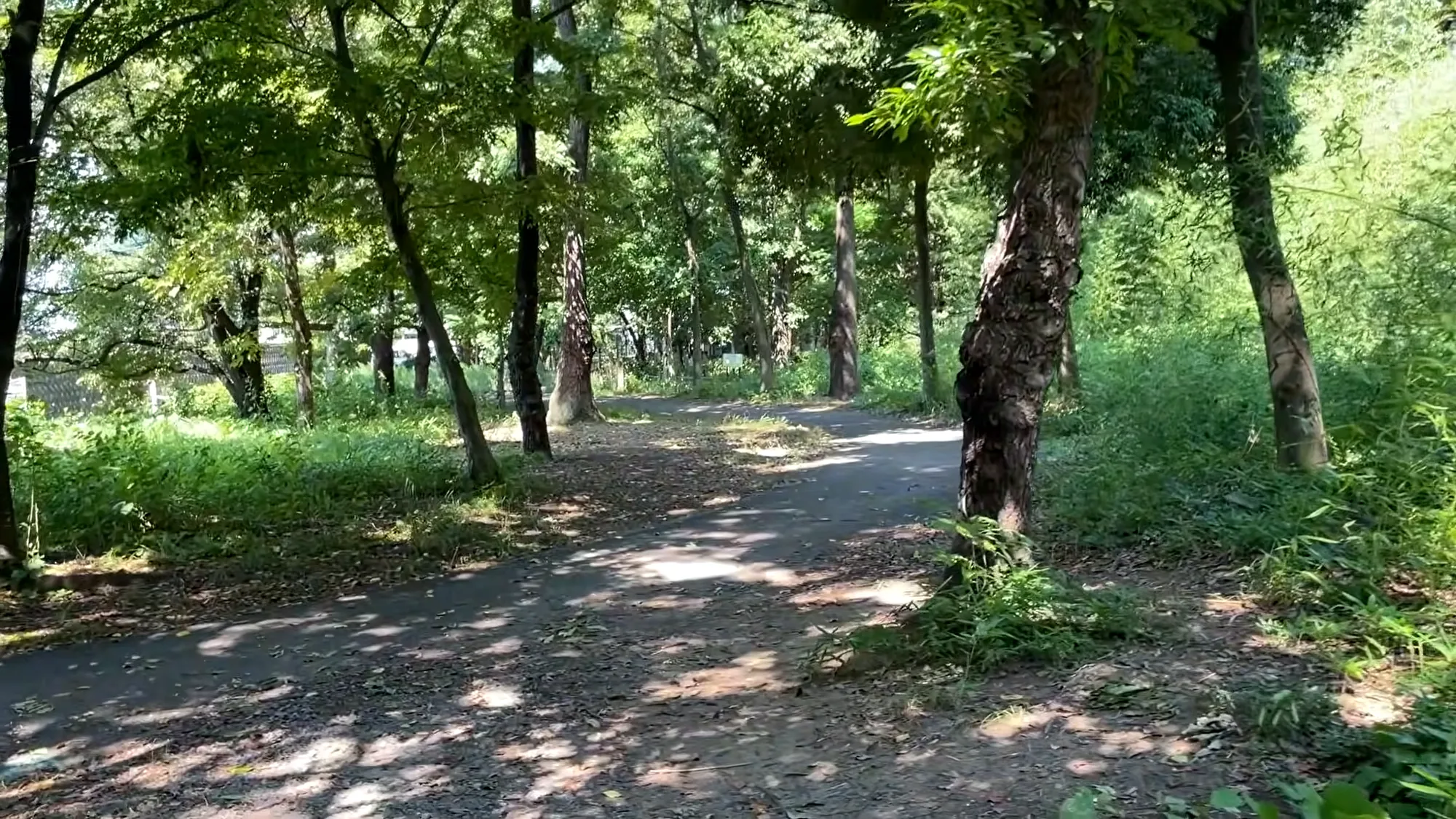
The same avenue in July, when none of the ground gets any light at all.
The seasons
The Society’s seasons are written for the senses. Spring is kobushi, cherry, and peach blossom. Summer is the stream and the sound of water and trees.
Autumn is the scent of katsura spreading through the forest as you enter, with autumn color, so that smell and sight are both stirred. Winter is birds seen and heard more clearly through the bare branches, and winter buds.
How the manager is graded
The prefecture’s monitoring sheet for fiscal 2023 sets out the manager’s results against its targets. Visitors came to 295,100 against a target of 300,000, or 98.4 percent. Satisfaction with the facility overall was 99.4 percent, counting those satisfied or fairly satisfied.
Paid facilities, among them bicycles and target bird golf, were used 47,448 times, 88.6 percent of the target. The prefecture asked the manager to look into why rental bicycle use had fallen, and to improve its events and their promotion to raise visitor numbers.
The sheet lists the manager’s own programs, among them one called Kanegawa Foresta Felice, the exercise program, the welfare bicycles, and forest therapy. It does not give a separate figure for forest therapy.
Hours and access
The park’s website gives its hours as 9:00 to 18:00 from April to October, every day, and 9:00 to 17:00 from November to March, closed on Mondays and on 31 December and 1 January. Several of its numbered parking lots keep shorter hours.
The park gives three minutes by car from the Ichinomiya-Misaka (一宮御坂) exit of the Chūō Expressway, and ten minutes by taxi or rental car from JR Isawa-onsen station. Highway buses from Shinjuku stop at Ichinomiya (一宮) and Kai-Ichinomiya (甲斐一宮), 25 and 22 minutes’ walk away.
The address is 1162-1 Kokubu, Ichinomiya-chō, Fuefuki, Yamanashi (山梨県笛吹市一宮町国分1162-1).
Nearby
The Society’s descriptions of the nearby places are fuller than most. The Shakadō Site Museum (釈迦堂遺跡博物館) shows many of the clay figurines and pottery found at the Shakadō site, it says, and nearby is the prefectural museum, with exhibitions on Yamanashi’s history.
On wine, the Society says that grape growing for wine thrives in the Kyōtō area that includes Fuefuki, and that wine is made at every scale, from small family wineries to large ones. On the hot springs, it names two towns in Fuefuki, Isawa and Kasugai, with many inns that take day bathers; Isawa is lit with cherries in spring and illuminations in winter, and Kasugai has guesthouses, inns, and large resort hotels.

Hollow most of the way up and still leafing out at the top.
The park names Isawa Onsen (石和温泉), the hot-spring town, and says it was ranked third in the Mainichi newspaper’s selection of a hundred new Japanese tourist sites. It also points to Katsunuma Budō-no-Oka (勝沼ぶどうの丘), the grape hill, among other places.
The prefecture’s tourism site describes the Shakadō museum as holding more than 5,000 important cultural properties from the Jōmon period, from about 5,500 to 4,500 years ago.
The Society lists four kinds of place nearby: the Shakadō site museum; the Isawa and Kasugai hot springs; wineries; and farm stands.
The Society says visitors from abroad are welcome, with one condition attached: if there is an interpreter.
The guide’s message
The Society’s guide message begins with the park’s best argument. Kanegawa, it says, is easy to reach from the city, and a place of rest for many people from inside and outside the prefecture.
By experiencing forest therapy here, it goes on, you may notice a new value in a park you thought you knew. In spring you can view the cherries from a viewing platform in the cherry forest; in autumn you can enjoy the peaches and grapes Kōshū is known for, at the fruit farms and farm stands around the park.
And it adds a line that changes the picture: there are many archaeological sites in the park, it says, and you can come into contact with Jōmon culture. That is a third layer under the flood forest, older than either, and the guide’s message is the only place it is mentioned.
The shape of a visit
Book one of the nine scheduled sessions, and arrive by 9:30 for the first health check. If anyone in your party uses a wheelchair, take the barrier-free course; the Society has already told you it is 2.5 meters (8.2 ft) wide and has no steps.
In autumn, walk into the katsura and smell them. Then go down to Isawa for the hot spring, and stop at a winery on the way.
Nearby and alike

Yamanashi · Certified 2013
Takeda no Mori (Kōfu)
A prefectural forest above Kōfu, replanted from the 1950 national festival on, with a barrier-free road under 5 percent and a set day that measures blood pressure before and after.

Yamanashi · Certified 2007
Nishizawa Gorge (Yamanashi City)
A national-park gorge whose return path is the bed of a 1933–1968 forest railway, plus a lake road at 1,464 meters, a Fuji-view hillside and a Man’yō plant park by the station.

Hiroshima · Certified 2013
Jinsekikōgen
A 2.2-kilometer lakeside path in the Taishaku gorge that the Society says a wheelchair can use, despite its own negative field, plus therapy dogs when the mountain area reopens.

Choosing a Base
Eight forests, from Kusatsu to Yakushima. Which fits your days, your season and the onsen waiting after.

Certification
Over sixty Japanese forests hold a therapy certificate. What the test involves, and what it does not promise.

Forest and Onsen
Two old Japanese ways of resting the body meet in the Kiso valley. Cypress air, hot water, and what is known.
Verified by The Japan Onsen Society
Sources
森林セラピーソサエティ「山梨県 山梨県森林公園金川の森」— https://fo-society.jp/facility/yamanashi-kanegawa/ (認定 2022年4月; acceptance incl. inbound “通訳がいれば可”; 2 roads with widths and surfaces; tree fields and scent trees; seasons; bentō; nearby descriptions; guide message incl. “公園には遺跡も多くあり、縄文文化に触れる”; intro 36.2 ha, ~30万人/年, six forests)
金川の森 (park site) — top · about · forest therapy · health · enjoy · access · sightseeing (明治40年 大水害 → 水害防備林; 平地林; 300+ plants, ~70 birds; hours; model session with health checks; effect claims; 9 sessions 2026; 令和4年4月; exercise program ¥4,500, 2° gradient, hours; facilities; access; Isawa 3rd in Mainichi’s list)
山梨県 指定管理者関係 — R6 evaluation · R5 monitoring · earlier overview · H30 call (manager consortium and term; visitors R2–R6; 開園 平成8年5月30日; 36.2 ha; satisfaction 99.1% / 99.4%; paid use 47,448; issues; self-run programs incl. 福祉用自転車, 森林セラピー; six forests named; 令和3年度 certification; “保安林として機能の増進を図る”)
山梨県観光「釈迦堂遺跡博物館」— https://www.yamanashi-kankou.jp/y-tabi/learn/syuryou/shakado.html (5,000+ important cultural properties; Jōmon 5,500–4,500 years ago)
Verified: 2026-10-05