Miyagi · Certified 2008
Tome Forest Therapy Base: Eight Loops, a Charcoal Kiln, and Three Hundred and Fifty-Nine Species
A forest counted to the species and cut into eight connecting circuits, run by the cooperative that works it, below a Meiji town that stopped growing when the prefectural office moved away.

Aerial view of a long lake with cherry blossom, a red bridge and wooded hills beyond at Tome, Miyagi
Step-free
Unverified
Answered yes, no length or surface published
The record
What you need to go
Open season
not published
Getting there
not published
Fees
Program prices are not published. A cottage at the forest park is ¥1,600 (about $11) a person with five sharing, admission included. A day bath at Oiwake Onsen is ¥300 (about $2)
Onsen
Oiwake Onsen (追分温泉), a single inn alone in the mountains about 14 km (8.7 mi) southeast, once lit by lamps, with a bath built of nutmeg wood
The walk
Main trail
Not published. The eight are short circuits that touch, so you assemble the walk as you go
All trails
8 trails, all of them loops and designed to be combined. None of them is measured
The step-free road
All four service questions are answered yes, but no length, gradient or surface is published for any of the eight loops
The forest
Forest type
Worked woodland run by the forestry cooperative that cuts it, with an old-style charcoal kiln still firing inside the forest
What grows
Cedar · Pine · Chestnut · Konara oak · Japanese snowbell, with weigela, spindle, winged spindle and azalea along the margins
What lives
Not published for the forest. Izunuma and Uchinuma nearby are Japan’s largest wintering ground for migratory birds, with swans
Certified since
2008
All figures updated 5 October 2026
The forest, before the facts
Somebody has counted the plants here. Not estimated, not sampled for a brochure — counted, to the species. The number is published plainly: 77 families, 359 species of vascular plants confirmed in this forest.
That is the kind of figure that only exists because a botanist walked the ground repeatedly over several seasons with a notebook, and it is the only number of its kind at any certified forest in Japan. Most of them offer three conifers, three broadleaves and a word for each season. Tome offers a census.
What that census sits in is eight short walking courses on a hillside east of a town that calls itself Miyagi’s Meiji Village — a former castle town of a Date branch domain, briefly the seat of a prefectural government, which still has its nineteenth-century streets and its pseudo-Western public buildings standing. The courses are all loops, all short, and all connected, which is the design decision that makes this base what it is: you do not choose a route here, you assemble one.
And the forest is run by the people who cut it. The number you call is not a tourism department or a village office but the Tome forestry cooperative (登米町森林組合), which also makes charcoal in a kiln in these woods and sells shiitake noodles.
Come in October, walk three or four loops in whatever order the day suggests, shower at the park, and drive fourteen kilometers (8.7 mi) southeast to a single inn in the mountains where the bath is made of nutmeg wood and costs three hundred yen, about two dollars.
Five reasons to come
A plant census: 77 families and 359 species, counted and published.
Eight short loops you can combine into any walk you want.
Charcoal art made from a kiln inside the forest, decorated with what you picked up.
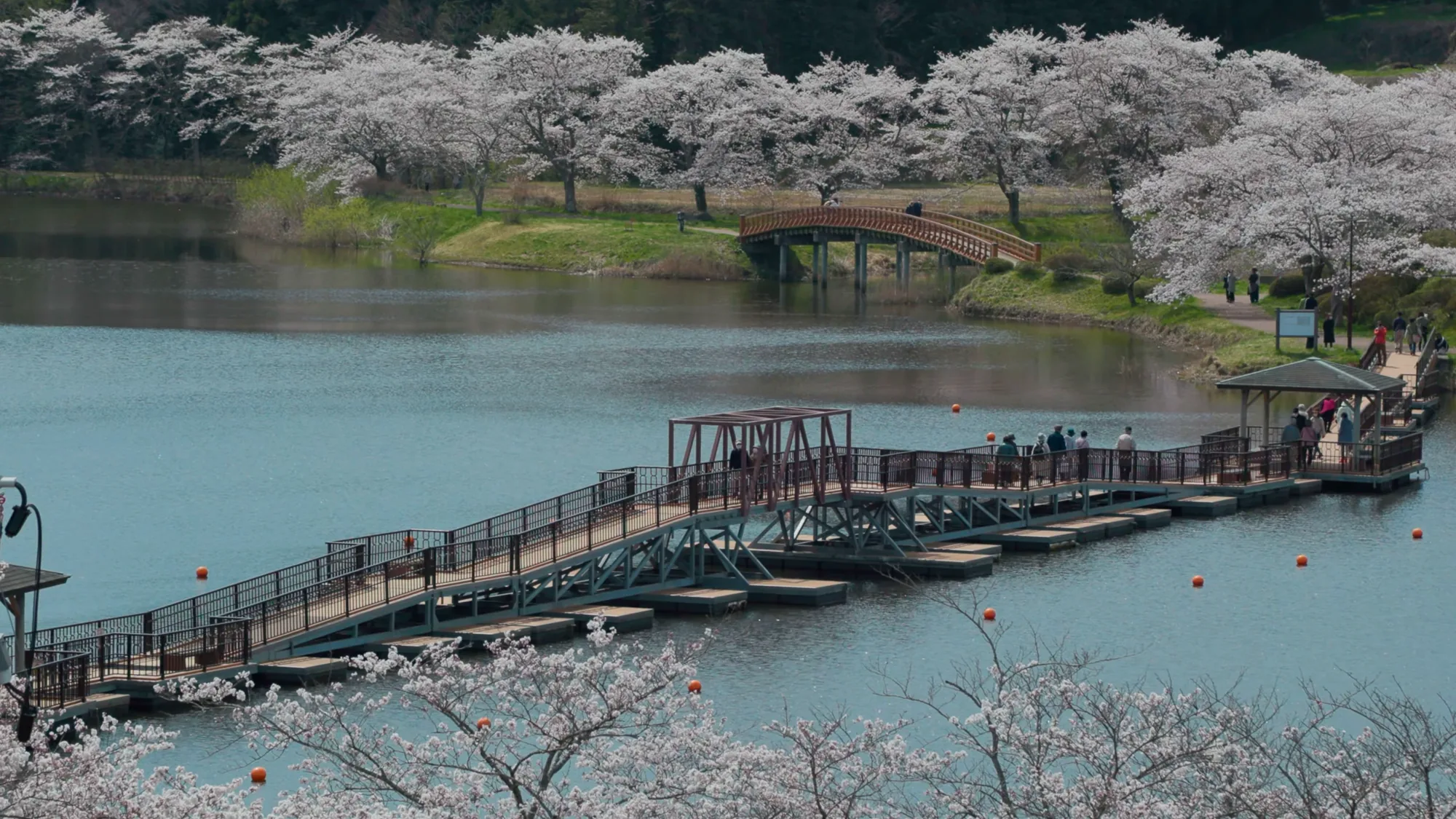
Byodonuma in the second week of April, when the whole rim of the lake goes pale at once.
A former lamp inn with a nutmeg-wood bath, two hundred yen under a bus fare.
Japan’s largest wintering ground for migratory birds, half an hour away.
Eight loops and no itinerary
Tome Fureai no Mori (登米ふれあいの森) lies in the hills east of the city center, and you go in through Tome Forest Park (登米森林公園), which has five cottages and a free campsite. The certified roads, eight of them, are laid out across the park’s eastern side.
How they work is one sentence, and it is the key to the place: each course on its own is short, but because they are loops you can combine several and walk them as one.
That is a genuinely different proposition. At Mizukami you choose the short course or the long one. At Uenomura there is a single twelve-kilometer (7.5 mi) path. At Okukuji there is one road and a published pace. Here there are eight circuits that touch, and the walk you do is a decision you make while walking, extended or cut short according to how the morning is going. For a practice whose entire instruction is go slowly and stop when something stops you, a network of short loops is arguably the correct architecture, and Tome is the only place that has built one.
No length, time, gradient or surface is published for any of the eight. That is the gap, and at a base built on combination it matters more than usual, because you cannot plan a two-hour outing without knowing whether a loop is four hundred meters (1,310 ft) or two kilometers (1.2 mi). It is the first question to ask the cooperative.
The base was certified in April 2008, and it answers yes to all four of the Society’s service questions — wheelchairs and strollers, corporate training, overseas visitors, children. Very few forests in the scheme say yes four times.

The walkway goes right across the water, which is the only way over it.
Three hundred and fifty-nine species
The census is the thing to come back to, because of what it implies.
A handful of what is in it gets named: cedar, konara oak, Japanese snowbell, weigela, spindle, a woodland sedge and azalea, and in the tree fields pine, chestnut and winged spindle, the one that turns scarlet. The general composition is given as conifer and broadleaf evergreen.
Taken together that is not a plantation list. Snowbell, weigela, spindle, sedge and azalea are understory and edge species; chestnut and konara are the signature of a worked secondary woodland; winged spindle and weigela are the plants of a sunny margin. 359 species in 77 families is the signature of a forest with many different kinds of edge: tracks, clearings, slopes facing different ways, wet hollows. That is exactly what eight interlocking loops on a varied hillside produce.
So the census and the loop network are the same fact seen from two directions. A forest cut into circuits has a great deal of margin, and margin is where diversity lives.
And not a word is published about the seasons, which, given that census, is the most frustrating omission here. A forest with 359 confirmed species and no seasonal calendar is a reference book with the index torn out. Whatever survey produced that number almost certainly carries flowering periods with it.
Charcoal, qigong, and walking with poles
The activities at Tome are unusually specific, and one of them you will not find anywhere else.

Two planks wide, and it moves under you the whole way.
The forest holds an old-style charcoal kiln, still producing charcoal — and the most popular program here is charcoal art, in which you use that charcoal together with nuts, seed cases and leaves gathered on the walk to make something and take it home. The note that comes with it is a good piece of writing: the forest is full of materials that provoke the urge to make something.
That is worth more than its charm. Every other base hands you an experience. This one hands you a bag and expects you to come back with the raw material. The walk stops being consumption and becomes gathering, which is a far older relationship to a wood and the one a forestry cooperative would naturally reach for.
The other two named programs are Nordic walking and forest qigong. Nordic walking means walking with poles, a genuinely good idea on loop paths with mixed gradient, and almost nobody else offers it. The qigong is described as receiving the forest’s power, with an exclamation mark, which is less clinical than the measurement language elsewhere in the system and probably more honest about what people are actually after.
The cooperative also makes and sells, beyond charcoal: shiitake noodles from the local crop, bamboo charcoal, and wood vinegar and bamboo vinegar — the condensate drawn off during a charcoal burn, used in Japan as a soil treatment and a bath additive. A place that sells you the by-product of its own kiln is operating on a different model from one that sells you a guided session.
Where to wash, where to sleep, and a bath made of a tree
The park is the practical base: five cottages plus a free-pitch campsite, with bedding hire and showers, and the price is published and startling: ¥1,600 (about $11) per person including admission when five share a cottage. There is wooden play equipment, which makes it popular with families. The management building has coin showers, and the park makes the obvious suggestion out loud: if you have worked up a sweat walking, rinse off here before you drive home. Open 9:00 to 17:00, closed Tuesdays, on 0220-52-3482.
And then, fourteen kilometers (8.7 mi) southeast of the Tome great bridge, toward Ishinomaki, there is Oiwake Onsen (追分温泉) — and it is the best small find on this whole hillside.
It is a single inn standing alone in the mountains. It was, they say, a lamp inn — lit by oil lamps, which in Japan means genuinely remote until relatively recently. The building is modeled on an old schoolhouse, and the atmosphere it reaches for is that of a tōji inn, a place for taking the cure over days rather than an evening. The bath is built of kaya, the Japanese nutmeg tree, with two tubs indoors, one hot and one lukewarm, which is the classic configuration for a long soak. The interior woodwork and furniture are praised. And because the mountains here run almost to the Sanriku coast, the kitchen gets both: the harvest of mountain and sea, on the same table.

Ten days, and then the lake is green for the rest of the year.
Day use is ¥300 (about $2). That is the cheapest bath anywhere in the scheme, by a factor of two, in a nutmeg-wood tub, at a former lamp inn, forty minutes from a forest with 359 species in it.
The swans
The wildlife at Tome is not in the forest. It is twenty-odd kilometers (about 13 mi) northwest, and it is one of the largest wildlife spectacles in Japan.
Izunuma and Uchinuma (伊豆沼・内沼) are shallow lakes on the Tome–Kurihara boundary, and they were the second site in Japan designated under the Ramsar Convention, after Kushiro. In the hierarchy of Japanese wetland conservation that is close to the top, and it puts the recognition in the early 1980s.
In late July to late August the surface disappears under lotus, thickly enough that pleasure boats are run through channels cut in it. And in winter the lakes become Japan’s largest wintering ground for migratory birds, with swans in great numbers.
If you want the wildlife half of a Tome visit, plan around January rather than October, and treat the forest and the lakes as one trip. Nothing in the official material connects them. They are twenty-five minutes apart.
What the certificate measures, and what a forestry cooperative knows instead
No result from Tome’s April 2008 certification experiment is published. Not the institution, not the sample size, not the measure. No certified forest in the country publishes one.

The same crossing in summer, with the blossom long gone.
What Tome has instead of research data is a different kind of knowledge, and it is worth naming. The body running this base is a forestry cooperative. So is the body running Kōyasan’s. These are organizations whose core business is knowing a forest well enough to cut it correctly over a hundred-year horizon, and who have been asked, relatively recently, to also walk people through it slowly.
That shows in what they publish. Not a stress-check protocol — a species count, a charcoal kiln, wood vinegar, and a coin shower for afterward. It is the forest-as-workplace offering hospitality, rather than a wellness product that happens to be outdoors, and the difference is legible on the page.
What a forestry cooperative is, and why it changes the offer
It is worth being precise about who runs this base, because forestry cooperative does not quite translate, and the difference matters.
A Japanese forestry cooperative is a member organization of forest owners, often hundreds of small holdings, some of them a hectare or two, pooled so that thinning, felling, replanting, road maintenance and timber sales can be done at a scale that works. It is closer to an agricultural co-op than to a logging company. Its members are the people who own the hillside, its staff are the people who go up it with saws, and its horizon is the rotation length of the trees, which for cedar is somewhere between fifty and a hundred years.
So when the Tome forestry cooperative is listed as the contact for a certified forest therapy base, three things follow.
The forest is not set aside. It is working ground that also has walking loops in it, which is why there is a charcoal kiln in production and why the by-products, bamboo charcoal, wood vinegar and shiitake noodles, are on sale beside the therapy programs. Nothing here is pretending the wood is untouched.
The knowledge on offer is silvicultural rather than clinical. Nobody at Tome is going to explain phytoncide concentration curves to you. Somebody can explain why that stand was thinned and this one was not, what the charcoal kiln needs, and which of the 359 species turn up after a felling.

Over the inlet and straight into the trees on the far side.
And the economics are different. A tourism department needs visitor numbers. A cooperative needs its members’ timber to be worth cutting, and forest therapy is one of several ways to make a hillside pay — alongside the kiln, the mushrooms and the vinegar. That is a sturdier footing than a grant-funded wellness initiative, and it is probably why a base certified in 2008 is still publishing a program list in 2026 when Yoshino’s, certified four years later, has gone quiet.
Getting there, and the town that stopped
No station, journey time, bus route or fare is published anywhere. Tome city is in northern Miyagi, inland from the Sanriku coast, and the cooperative is on 0220-52-2075.
Leave time for the town, because Miyagi’s Meiji Village is not a theme park — it is the actual surviving fabric of a place that was important and then was not. Tome prospered as the castle town of a Date branch domain and briefly held the prefectural office in the early Meiji period, and when the administration moved away the money stopped and so did the rebuilding. What is left is a run of pseudo-Western architecture, Japanese carpenters interpreting Western buildings from drawings: the Education Museum (教育資料館), the former Tome higher elementary school with its white balcony; the Police Museum (警察資料館), the former police station, with its cells still in place; and the Mizusawa Prefectural Office Memorial Hall (水沢県庁記念館), on the site of the prefectural office.
The style is worth unpacking, because the buildings are stranger and better than Western architecture would be. Japanese carpenters in the 1870s and 1880s were being asked to produce Western public buildings having mostly never seen one, working from drawings, prints and description. What they built uses Japanese joinery and Japanese proportion to produce something that reads as Western from forty paces and as entirely itself up close — balconies that are really verandas, sash windows framed like shoji, a symmetry that is slightly too careful. The former elementary school at Tome is one of the better survivals of it in the country, and it is standing in a town of this size precisely because nobody had the money to replace it.
Eat abura-fu don while you are there. Abura-fu is wheat gluten, fried, which sounds like nothing and behaves in a donburi broth like the most absorbent thing in the world — it drinks the stock and goes silky, and Tome is where it comes from. The other local item is roof-tile crackers, shaped exactly like what they are named for.
So: a town that stopped, a forest that was counted, eight loops you put together yourself, a kiln, and a three-hundred-yen bath, about two dollars, in a nutmeg tub at an inn that used to run on lamps. Nobody is going to measure your blood pressure. They will sell you some wood vinegar.
Nearby and alike

Yamagata · Certified 2006
Nukumidaira
Five and a half kilometers of flat road through two-hundred-year-old beech, in a town that is 95 percent forest — guided, if you ask, by working matagi.

Ibaraki · Certified 2016
Okukuji
Forty-nine hectares planted in a single ceremony in 1976, listed among Japan’s hundred best forest-bathing forests a decade later. The guides stake it all on what grows on the floor.

Akita · Certified 2008
Kazuno
Three hot spring districts under one certified forest on Hachimantai, one of them a tōji cure-place for centuries. Beech above, Akita cedar below, and a public bath inside the therapy station.

Forest Bathing in Japan
Japan named forest bathing in 1982, then measured it. The practice, the places, and what the studies show.

The Walk
A measured forest walk is about thirty minutes and no destination. Here it is, sense by sense, step by step.

Choosing a Base
Eight forests, from Kusatsu to Yakushima. Which fits your days, your season and the onsen waiting after.